Cash cow ETFs up 7% over past 6 months
High free cash flow firms draw attention as AI investment weighs on markets

ETFs targeting companies with strong cash generation are drawing investor attention as global equity markets struggle amid concerns over deteriorating free cash flow and uncertain returns on AI investment.
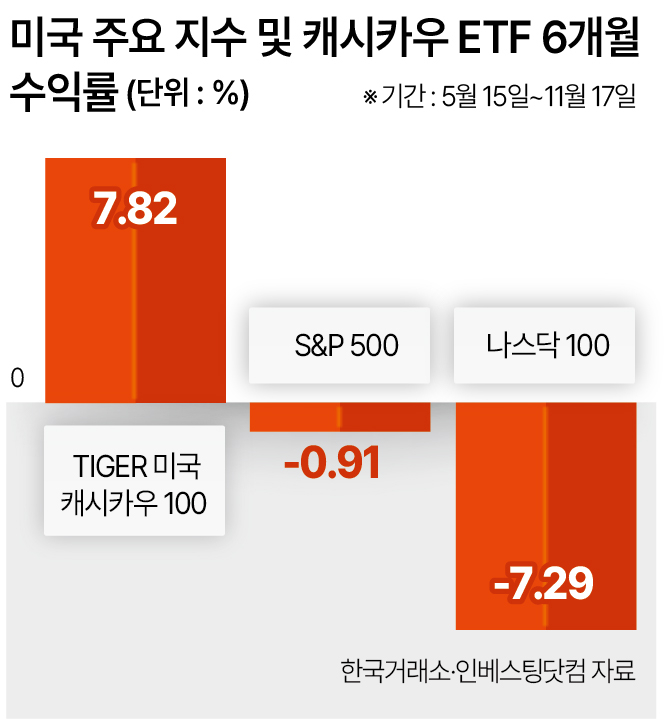
According to Korea Exchange on Wednesday, the TIGER US Cash Cow 100 ETF rose 7.82% over the past six months — a stark contrast to the Nasdaq 100 index and the S&P 500, which fell 7.29% and 0.91%, respectively, over the same period. The fund demonstrated its defensive credentials by posting gains even as broader markets declined.
"Amid growing attention on the massive capital expenditure driven by AI investment expansion, companies that generate high cash flow without excessive debt are outperforming a market heavily weighted toward AI," said Kang Song-cheol, a researcher at Eugene Investment & Securities.
The surge of interest in high-cash-flow companies stems from the enormous AI spending burden weighing on big tech. As US tech giants pour cash into AI infrastructure, doubts are growing about when — and whether — that investment will translate into profits. Rising interest rates have added to financing pressures, and free cash flow forecasts for US hyperscaler companies have been revised down repeatedly.
According to Goldman Sachs, the 12-month forward FCF yield for the S&P 500 stands at just 3.8 percent, below the 5.6 percent recorded by the STOXX Europe 600, an index of 600 major European companies.
"The US is deploying capital to secure future market dominance at the expense of current cash flow," Goldman Sachs said, adding that investors now face new risks including declining return on invested capital and deteriorating capital efficiency.
FCF is calculated by subtracting capital expenditures — such as facility investment — from cash generated through operating activities. Because it accounts for the gap between book profits, such as accounts receivable, and actual cash inflows, it is a useful measure of a company's true cash-generating ability. The FCF yield is an indicator of cash generation relative to enterprise value.
Rising interest rates are also enhancing the appeal of high-cash-flow companies. Firms that invest using borrowed money face growing interest burdens, while those that fund investment from their own cash reserves face less exposure to external financing pressures.
Against this backdrop, ETFs that screen for companies with strong cash generation are gaining traction as an investment alternative.
The TIGER US Cash Cow 100 ETF tracks the Global X US Cash Flow Kings 100 Index, selecting 100 stocks with the highest FCF yields from among the top 1,000 US companies by market capitalization. Its major holdings include Accenture, Cardinal Health, Altria Group, Intuit and Comcast.
Compared with the S&P 500, ETFs focused on strong cash flow companies carry lower weightings in IT and financial stocks and higher weightings in energy and healthcare — one reason they have relatively limited exposure to the AI investment cycle.
COWZ, FLOW and VFLO, all listed on US exchanges, are also ETFs that invest in US companies with strong free cash flow. Over the past six months, COWZ and VFLO rose 8.98 percent and 20.66 percent, respectively.
"Concerns persist in the current market about the sustainability of capital flows toward AI capital expenditure-related companies, including semiconductors," said Kim Seong-geun, a researcher at Mirae Asset Securities. "Until FCF recovery can be confirmed around the first quarter of next year, investors should consider broadening their attention beyond the tech sector."
Kang also said that with interest rates elevated and concerns mounting over cash depletion and rising debt from AI infrastructure investment, preference for ETFs such as SCHD and VFLO, or quality stocks, is likely to remain strong.

moon@heraldcorp.com