Samsung Electronics, SK hynix account for 85% of year-to-date net selling
Doubts over memory chip profit sustainability entrench selling trend
Easing volatility, AI events and interest rates seen as keys to reversal

Foreign investors resumed their heavy selling of Korean equities after a brief pause, pushing their cumulative net selling on the Kospi to more than 222 trillion won ($166 billion) so far this year. About 85% of that selling has been concentrated in Samsung Electronics and SK hynix — the two largest stocks by market cap — dragging the benchmark index back to levels last seen at the start of the year.
Securities analysts say the exodus has become structural, driven in part by doubts over the sustainability of memory chip earnings, and argue that a sustained return of foreign capital will hinge on a reduction in global market volatility, a recovery in AI investment sentiment, and stabilization of real interest rates.
According to Korea Exchange, foreign investors net sold a combined 2.75 trillion won worth of Kospi-listed shares on Monday and Tuesday. They had turned net buyers the previous week — purchasing 475 billion won between Nov. 9 and Nov. 13, their first week of net buying in 13 weeks — only to flip back to selling within days.
The selling was concentrated in large-cap heavyweights. Foreign investors unloaded the most shares in Samsung Electronics (1.09 trillion won) and SK hynix (642 billion won) during the two-day period. They also shed shares broadly across Samsung Group affiliates, including Samsung Electronics preferred shares (202 billion won), Samsung Electro-Mechanics (106 billion won), Samsung SDI (80 billion won) and Samsung E&A (56 billion won).
The indiscriminate selling sent the Kospi below the 5,000 mark on a closing basis on Tuesday — the first time it had closed below that level since Feb. 2, when it ended at 4,949.67, a gap of more than nine months. Compared with its all-time high of 9,114.55 reached on June 22, the index has tumbled 45.5% in just five months.
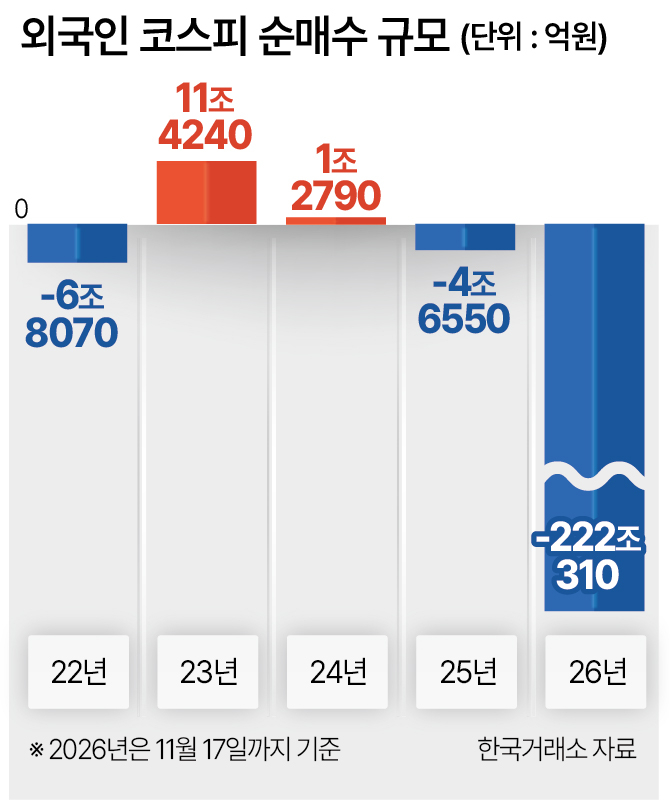
Foreign investors' cumulative net selling on the Kospi from the start of the year through Tuesday reached 222.03 trillion won. SK hynix alone accounted for 99.56 trillion won of that figure, and Samsung Electronics for 90.2 trillion won — together representing 85.5% of total foreign net selling.
Domestic retail investors and institutions absorbed much of the supply, posting net purchases of 99.6 trillion won and 47.67 trillion won, respectively, over the same period, but their buying was not enough to prop up the index.
The scale of this year's selling is without modern precedent. Foreign investors posted net purchases of 11.42 trillion won on the Kospi in 2023 and 1.28 trillion won in 2024, before turning net sellers of 4.66 trillion won last year. This year's net selling of more than 222 trillion won dwarfs all of those figures.
Market participants have cited a range of factors behind the selling — prolonged high interest rates, fears that semiconductor earnings have peaked, debate over an AI bubble, and a shift in fund flows tied to the Anthropic listing. Some analysts now argue the foreign exodus has moved beyond a short-term correction and taken on a structural, trend-driven character.
"The foreign selling pressure on the Kospi has become quite entrenched and trend-like, making it difficult to expect an immediate reversal based on short-term data," said Kwon Jun-hyung, a researcher at Hana Securities.
Kwon added that roughly 85% of foreign net selling on the Kospi this year has been concentrated in Samsung Electronics and SK hynix, which cannot be explained simply by their index weight. "Whether semiconductor share prices rise or fall, foreigners have been selling with the same intensity — it is indiscriminate," Kwon said.
Hana Securities also pointed to mechanical selling by global funds triggered by the MSCI Korea 25% cap rule, which limits any single stock's weight to 25%. Compounding the pressure, the firm said, are foreign investors' tendency to sell Korean semiconductor stocks when earnings growth peaks, as well as a valuation framework that applies lower price-to-book ratios to stocks with high return-on-equity volatility regardless of their profitability.
Some analysts trace the selling — which has diverged sharply from fundamentals — to a deeper distrust of the sustainability of domestic memory chip profits. "We are seeing record net selling that cannot be explained by any conventional yardstick — record trade surpluses, upward earnings revisions, won strength," said Ha Jang-kwon, a researcher at Hanwha Investment & Securities. "Given that more than 90% of cumulative foreign net selling on the Kospi since 2010 has been concentrated in Samsung Electronics and SK hynix, this looks less like a retreat from the Korean market as a whole and more like skepticism about the durability of memory chip earnings," Ha said.
Analysts broadly agree that a sustained return of foreign investors will require extreme market volatility to subside and a convergence of supportive macroeconomic conditions with improved AI investment sentiment. Nvidia's earnings released Wednesday and the Anthropic listing scheduled for Thursday are seen as the first near-term tests.
"Since October, the correlation coefficient between foreign investor flows and the Kospi has reached 0.97 — meaning foreigners are setting the direction of the index, and AI investment sentiment is setting the direction of foreigners," said Lee Kyung-min, a researcher at Daishin Securities. "Foreigners have sold 222 trillion won since the start of the year, but most other headwinds — the exchange rate, interest rates, earnings — have largely eased. The AI events running from Nov. 18 to Nov. 20, including Nvidia's earnings and the Anthropic listing, could be the first catalyst to reduce volatility, with export data, the Monetary Policy Board meeting and the FOMC meeting serving as a second inflection point," Lee said.
Ha said historical data show that foreign re-entry has tended to translate into a sustained inflow during periods of undervaluation and falling real interest rates, but not during semiconductor booms. "Sustained inflows have historically coincided with won strength, dollar weakness and falling real interest rates, so the trigger for a return will likely be a retreat in fears of further US rate hikes," Ha said. Hanwha Investment & Securities expects the United States to raise its benchmark interest rate once in December before holding it steady through the end of 2027.

jiyun@heraldcorp.com