KODEX 200's combined Samsung Electronics-SK hynix weighting rose from 33% at end-2024 to a peak of 62%; the structure is similar across all KOSPI 200 ETFs regardless of fund manager
Imagine putting 100,000 won ($75) into an ETF that spreads its holdings across 200 stocks, only to find that 60,000 won of that money flows into just two companies — Samsung Electronics and SK hynix. That is exactly what has been happening in South Korea's flagship index ETFs. What makes the situation even more striking is that the higher those two stocks climb, the larger a share of any new money coming in they automatically capture.
The problem surfaces when share prices fall. With more than half of the fund's assets concentrated in two names, any turbulence in semiconductor stocks hits the ETF hard. When Samsung Electronics and SK hynix recently tumbled, South Korea's leading index ETFs fell more than 17 percent from the end of last month through Tuesday. The question is: why does this happen in a fund supposedly diversified across 200 companies?

200 stocks in the fund, yet two names top 60%
According to Samsung Asset Management, Samsung Electronics accounts for 34.34 percent of KODEX 200 — which tracks the KOSPI 200 index — while SK hynix makes up 23.34 percent, bringing their combined weighting to 57.68 percent. That is a 24.35 percentage-point increase from the 33.33 percent the two stocks together represented at the end of 2024. The combined weighting, which stood at 45.21 percent at the end of last year, soared to 61.59 percent on Oct. 30 before easing somewhat as semiconductor stocks pulled back.
Analysts attribute the surge in weighting to the sharp rise in both companies' share prices. Compared with end-2024 levels, Samsung Electronics shares were up 254.38 percent and SK hynix shares were up 529.23 percent as of Tuesday, while KODEX 200 itself gained 141.97 percent over the same period. SK hynix's weighting in particular more than doubled, rising from 9.29 percent at end-2024 to 23.34 percent — a more than 2.5-fold increase.
KODEX 200 is the most heavily traded ETF in South Korea. According to Korea Exchange, its cumulative trading value from Jan. 2 through Tuesday reached 482.37 trillion won, roughly 2.9 times that of TIGER 200 — another KOSPI 200-tracking ETF — which logged 166.5 trillion won over the same period. KOSPI 200-tracking ETFs from different fund managers tend to share a broadly similar composition structure.
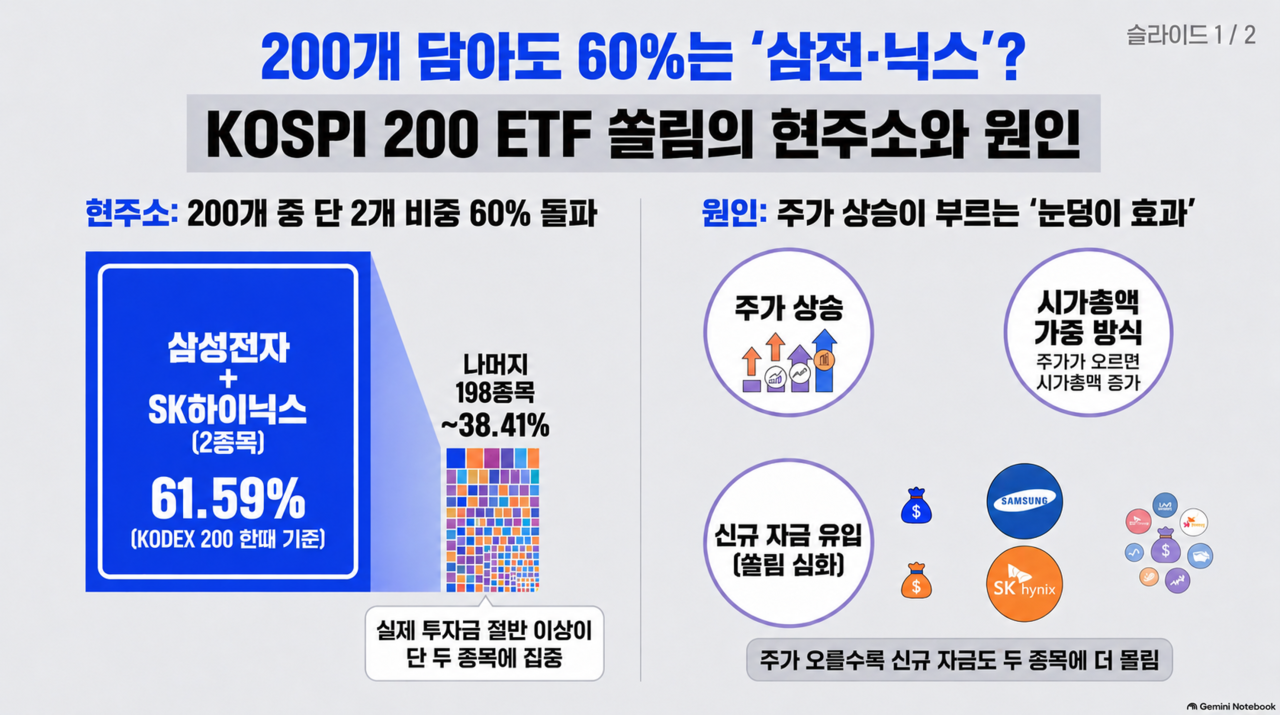
Rising share prices inflate weightings — and funnel new money the same way
This dynamic stems from the KOSPI 200's market-capitalization-weighted methodology. Market capitalization — a company's share price multiplied by its shares outstanding — determines each stock's weight in the index, with the KOSPI 200 specifically using the value of freely tradable shares. The bigger the company, the larger its slice of the index.
Consider a simplified example: an ETF holding only two stocks, Company A (80 percent weight) and Company B (20 percent weight), with 10 million won already invested. That means 8 million won sits in Company A and 2 million won in Company B.
Now suppose Company A's share price rises 50 percent while Company B's stays flat. Company A's value grows to 12 million won, while Company B remains at 2 million won. The ETF's total value rises to 14 million won, shifting Company A's weight from 80 percent to about 85.7 percent and Company B's from 20 percent to about 14.3 percent — even though the ETF bought no additional shares. The price gain alone expanded Company A's weighting.
The issue arises when a new investor adds 1 million won. The ETF deploys that fresh cash according to the current, post-rally weightings. Before the price surge, the new 1 million won would have been split 800,000 won to Company A and 200,000 won to Company B. Now, roughly 857,000 won flows to Company A and only about 143,000 won to Company B.
Stocks that have already risen thus capture an even larger share of incoming money, generating additional buying demand. Passive-investment practitioners call this the "snowball effect."
Equity ETF market grows 4.4-fold, accelerating the tilt toward large caps
The passive-investment snowball effect has become a market-wide variable in large part because the ETF market itself has expanded so rapidly. According to the Korea Financial Investment Association, the net asset value of domestic and overseas equity ETFs grew from 54.17 trillion won at end-2023 to 239.95 trillion won as of Monday — a roughly 4.4-fold increase. As the pool of money tracking indexes has grown, so has the market impact of flows that move in lockstep with index weightings.
The sums flowing in and out of flagship index ETFs already run into the trillions of won. According to ETF Check, KODEX 200 saw a net inflow of 1.13 trillion won during the fourth week of October and a net outflow of 1.47 trillion won during the fourth week of June, illustrating how large sums can surge in or drain out depending on market conditions.
The key moment is when new money translates into purchases of the underlying stocks. Stocks with higher weightings — such as Samsung Electronics and SK hynix — receive a disproportionately large share of those inflows. Conversely, when prices fall, the outsized weightings of those same stocks become a drag on ETF returns. The large-cap-heavy structure produces starkly different outcomes in rising and falling markets.
The composition of the ETF market itself also deepens the concentration in large caps and semiconductors.
"The Korean market has a relatively thin range of ETF themes," said Lee Sang-hyun, a researcher at Meritz Securities. "Among equity ETFs with net assets of 1 trillion won or more, the KOSPI 200 is overwhelmingly dominant with more than 50 trillion won, followed by the S&P 500 and NASDAQ 100, each with around 30 trillion won."
Lee added that "most of the rest — the Semiconductor TOP10, MSCI Korea, KRX Semiconductor, Kosdaq 150, Philadelphia Semiconductor and others — are also concentrated in broad indexes or semiconductors. There are some inflows into thematic products such as secondary batteries, AI infrastructure and dividends, but flows into index-linked products are far larger."

Samsung, SK hynix plunge drags ETFs down 17%, limiting diversification benefits
The recent sharp declines in Samsung Electronics and SK hynix have pulled KOSPI 200 ETFs — where the two stocks carry heavy weightings — sharply lower. From Oct. 30 through Tuesday, Samsung Electronics fell 17.97 percent and SK hynix dropped 28.05 percent. KODEX 200 declined 17.66 percent over the same period.
To be sure, the two stocks alone do not explain the ETF's entire decline — other holdings moved as well. Still, with the two names accounting for more than half of the fund's assets, semiconductor stocks clearly exert an outsized influence on returns.
Does that mean diversifying through a KOSPI 200 ETF is pointless? Not quite. Spreading money across many companies still offers advantages over concentrating it in a single stock. The key caveat is that holding an ETF with 200 names does not mean the investment is spread evenly across 200 companies.
Investors who hold both a KOSPI 200 ETF and a semiconductor ETF may find their money doubly concentrated in Samsung Electronics and SK hynix, even though the two products look different on the surface. Owning multiple ETFs does not by itself constitute true diversification. What investors need to check is not how many products they hold, but what stocks each product actually contains and in what proportions.
hajun825@heraldcorp.com