Uncollected receivables now stand at 14.6 trillion won; CEO says raising rate by 1 won per megajoule would recover 500 billion won
Alaska LNG project 'very difficult' for Korea Gas Corporation
Utility to strengthen average tariff system, pursue cooperation with private direct importers
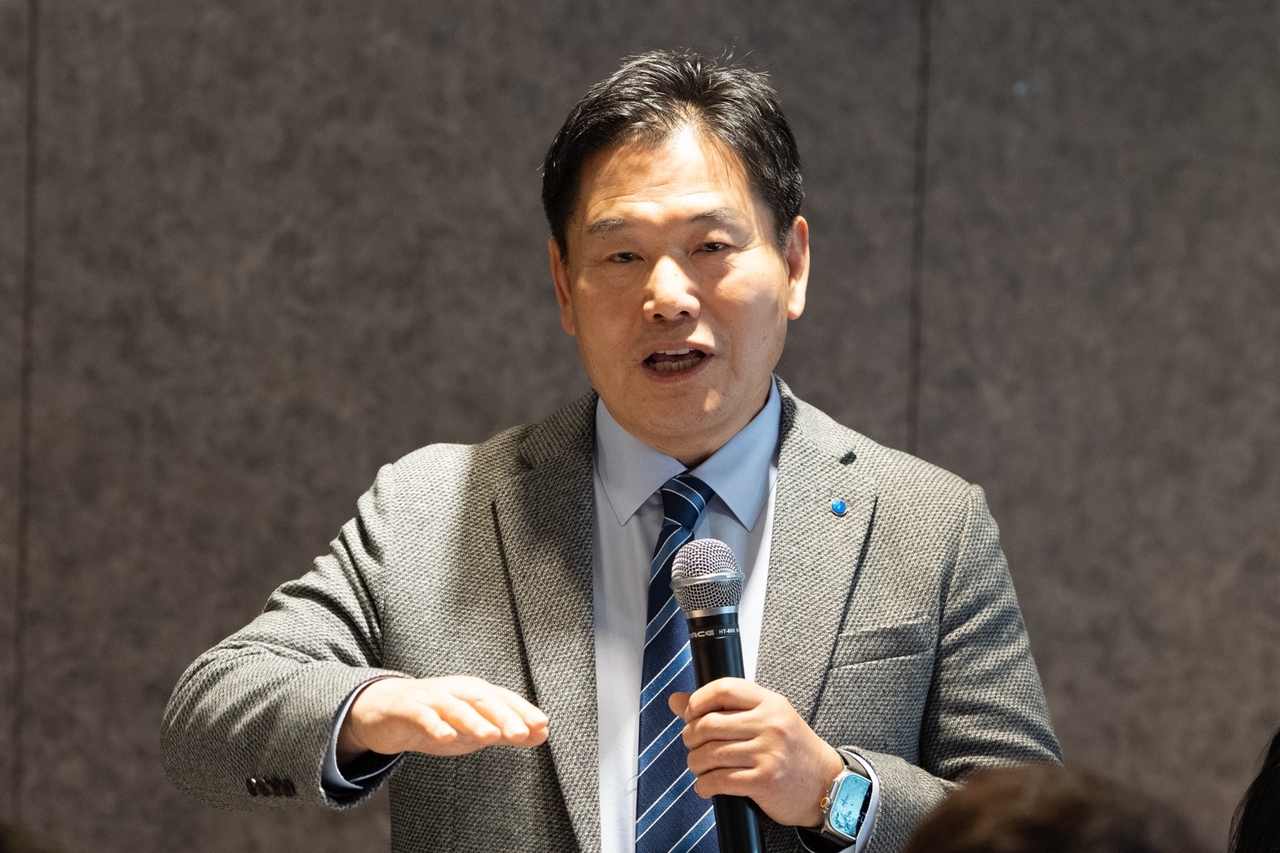
Korea Gas Corporation President Hong Eui-rak said Wednesday that uncollected receivables — money the utility has not been paid for gas supplied below cost — are approaching 15 trillion won ($11.2 billion), and called for an increase in gas rates.
Hong also expressed reservations about the government's plan, announced in September, to merge Korea Gas Corporation with Korea National Oil Corporation, saying it would be difficult to act against shareholders' interests by combining a listed company with an unlisted one.
"There is a need to raise (gas) prices at this point," Hong said at a press briefing in Sejong on Wednesday. "I believe the public will understand."
Hong took office as Korea Gas Corporation president in July and marked his 112th day on the job Wednesday, hosting his first official briefing with the press corps. Hong is from Bonghwa in North Gyeongsang Province and previously served as a lawmaker in the 19th and 20th National Assemblies and as Daegu's deputy mayor for economic affairs.
LNG prices have surged amid conflict in the Middle East, but residential gas rates have been frozen since August 2024.
Against that backdrop, uncollected receivables — arising from the corporation supplying gas below cost — have continued to grow.
Total uncollected receivables stood at 14.65 trillion won as of the third quarter, up 466.9 billion won from 14.18 trillion won in the first half. Of that total, 13.83 trillion won was attributable to residential city gas customers.
"If high energy prices persist as they are now, uncollected receivables could grow by 4 trillion won a year," Hong said. "For example, raising rates by 1,000 to 2,000 won could resolve the problem — there are real harms from suppressing private gas rates too much."
Korea Gas Corporation says raising the gas rate — currently in the 20-won range per megajoule — by just 1 won would allow it to recover 500 billion won in receivables. A 1-won increase would raise the monthly gas bill for a typical household consuming 2,000 megajoules by about 2,000 won.
Hong also voiced concern over the government's push to merge Korea Gas Corporation with Korea National Oil Corporation.
"I hear the government is proceeding with a study, but I don't know exactly how," he said. "Oil and gas share the same origins, but they operate in entirely different arenas. I've been trying to think of how synergies could be created, but no clear direction has emerged."
He added: "I'm not sure what mechanism would allow a listed company and an unlisted company to merge — from my position, it is very difficult to take actions that go against shareholders' interests. We work with BP, ExxonMobil and others across more than 20 sites in 11 countries, and there are many procedural issues, such as having to track them all down and persuade them."
The government formally announced the merger plan at a public institution management committee meeting on Sept. 3. Critics have since warned that a straightforward combination with Korea National Oil Corporation — which has been in a state of complete capital impairment since 2020 — could damage the financial standing of Korea Gas Corporation, a well-rated listed company.
On the Alaska LNG project, a candidate for investment tied to US relations, Hong cited local climate conditions and other factors, saying: "The US will press ahead with the project, but from our perspective it is a very difficult one."
Since taking office in July, Hong has repeatedly stressed that "gas is electricity," pointing to the role gas-fired power generation plays in setting the system marginal price in the wholesale electricity market.
He has argued that finding ways to lower electricity rates through cost-competitive LNG procurement and supply stabilization must also be part of the equation.
Korea Gas Corporation plans to strengthen its average tariff system for power generation in order to improve gas and electricity supply stability. Under the average tariff system, the fuel cost across all of the corporation's import contracts is charged at a uniform rate to all customers, buffering the impact of any single contract or short-term market fluctuation.
Since 2020, the corporation has also operated an individual tariff system under which it signs separate contracts with each power plant and supplies LNG at different prices.
"Introducing the individual tariff system created a competitive dynamic with private direct importers," Hong said. "I think it somewhat undermined the public-service character of the corporation. I have been saying this needs to be normalized."
Korea Gas Corporation plans to pursue four specific initiatives to strengthen the competitiveness of the average tariff system — expanding the share of long-term LNG contracts, diversifying import sources to sharpen procurement competitiveness, and building up trading capabilities.
In addition, the corporation plans to pursue joint purchasing and investment with private direct importers to deepen cooperation, while securing the public-service character and stability of its pipeline infrastructure.
oskymoon@heraldcorp.com