Ministry of Employment and Labor, related ministries hold first joint TF meeting; full probe of smart-device cheating underway
Radio-wave detectors to be deployed at all exam venues once developed; CCTV to expand to leased sites
Score anomaly analysis and answer-sheet re-inspection planned before results announced; disclosure of top scores under review
The government will conduct a comprehensive review of its national licensing exam management system after confirmed cheating using a miniature camera at the tax accountant exam. It is pushing to extend the ban on sitting national technical qualification exams from three years to 10 years for those caught cheating, and will consult with related ministries on lengthening bans and establishing criminal penalties for professional licensing exams such as the tax accountant exam.
The government plans to deploy radio-wave detectors at all exam venues as soon as development is complete, and to analyze score distributions before announcing results — flagging any anomalies before re-inspecting answer sheets.
The Ministry of Employment and Labor held the first meeting of its "National Qualification System Comprehensive Review and Countermeasures Task Force" on Thursday at the Seoul Regional Employment and Labor Office, chaired by Minister Kim Young-hoon. The move follows confirmed cheating using miniature cameras and other smart devices at the 63rd tax accountant exam. The TF will conduct a full investigation into smart-device cheating, develop measures to block the smuggling and use of such devices, and carry out a broad review of the qualification examination system run by the Human Resources Development Service of Korea, which administers the exams under contract.
The TF will be led by the vice minister of employment and labor. Participating agencies include the Human Resources Development Service of Korea, the Ministry of Economy and Finance — which oversees the tax accountant exam — the Ministry of Land, Infrastructure and Transport for the certified appraiser exam, Korea Customs Service for the customs broker exam, and the Korea Intellectual Property Office for the patent attorney exam. Experts in qualification systems and radio and communications technology will also join. Thursday's meeting covered the TF's operating plan and measures to eliminate AI-assisted cheating.
Proctors to collect all devices after power-off checks; radio-wave detectors to roll out across all venues
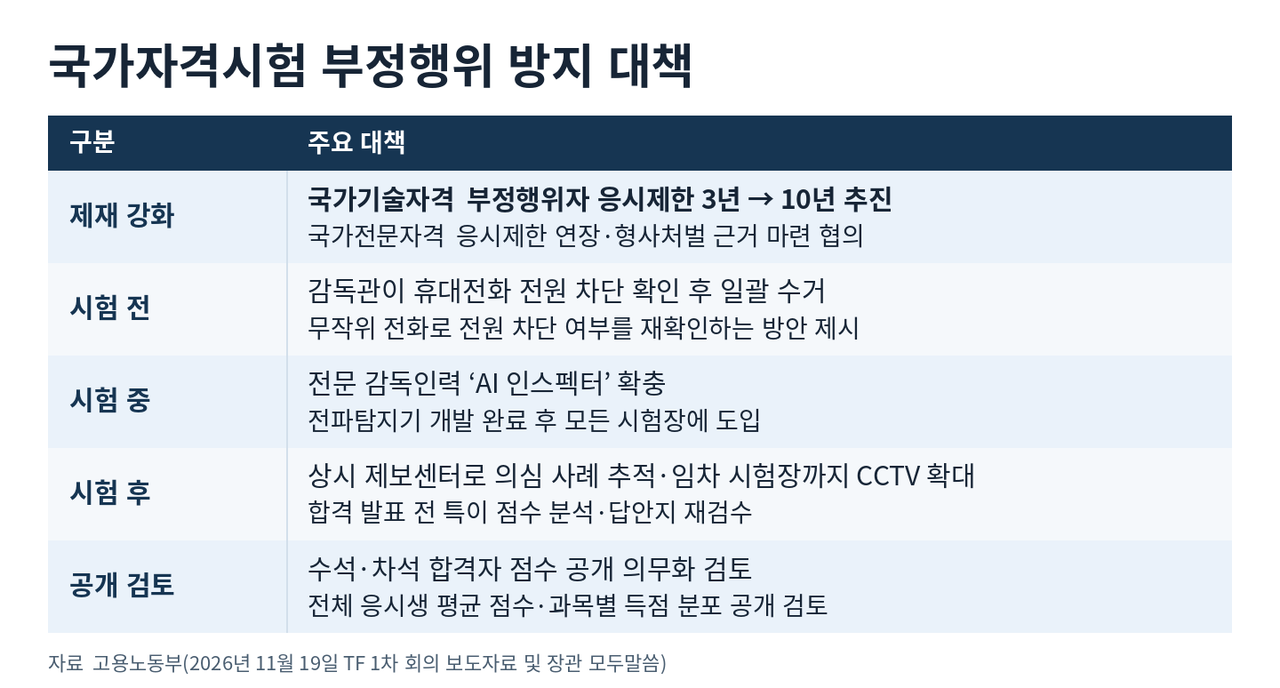
Under the measures announced by the ministry, proctors will verify that mobile phones and other electronic devices are powered off before an exam begins, collect all devices and hold them until the exam ends. A proposal was also put forward to call examinees at random during the exam to confirm their phones remain switched off.
The ministry said it will notify examinees in advance that possessing prohibited items or modifying permitted items for cheating purposes will be treated as a cheating offense. Examinees will also be warned beforehand that using smart devices to cheat could result in a sitting ban or criminal punishment.
During exams, the ministry will significantly increase the number of "AI inspectors" — specialized proctoring personnel deployed since Oct. 25 — who focus on behavior suggesting the use of mobile phones or miniature devices. The ministry plans to build a pool of such specialists through ongoing training and field experience, and is also considering granting proctors legal immunity and offering incentives for catching cheaters. Radio-wave detectors currently under development by the Korea Communications Agency will be introduced at all exam venues as soon as they are ready.
Scores and answer sheets to be re-checked before results; disclosure of top scores under review
CCTV coverage, currently limited to exam venues owned by the Human Resources Development Service of Korea, will be extended to leased venues. A cheating tip-off center will operate year-round to track suspicious cases even after exams conclude.
Before results are finalized, exam data will be analyzed for score patterns that deviate from past trends, and answer sheets will be re-inspected. The ministry is also reviewing whether to require public disclosure of the top two scorers' results, as well as the overall average score and the score distribution by subject for all examinees.
The proposed extension of the sitting ban from three years to 10 years applies to cheaters on national technical qualification exams. Professional licensing exams — covering tax accountants, certified appraisers, customs brokers and patent attorneys — are governed by their own separate statutes. How long the ban will be extended and how criminal penalties will be established for those exams will be decided through consultations with the relevant ministries.
The materials released Thursday did not specify which exams would be covered by the full smart-device cheating investigation, how long the probe would last, how many additional specialist proctors would be hired, or when CCTV would be installed at leased venues.
The ministry plans to strengthen the research capacity of the Human Resources Development Service of Korea so that cheating detection techniques and case findings can be shared with other government agencies that administer national exams. Over the longer term, the ministry is considering a system to certify individuals' accumulated competencies and career achievements, and will pursue broader reform of the national qualification framework, including phasing out credentials that have become less relevant.
"We will prepare thoroughly for every possible scenario — before, during and after the exam — and pursue cases to the end," Kim said. "We will focus all our efforts on restoring the credibility and fairness of national licensing exams."
fact0514@heraldcorp.com