Inertron CEO Cho Hak-rae, a master craftsman, offers anti-cheating solution for test venues
AI-based illegal-camera detection technology aims to ensure fair exam environments
Jointly developed with KETI and the National Police University under a Ministry of Interior and Safety R&D project

As AI technology advances rapidly, cheating methods at exam venues are growing increasingly sophisticated.
Concerns have emerged in particular over the use of AI smart glasses and ultra-compact cameras — devices that blend in with everyday items — to photograph exam questions and transmit them to outside accomplices or receive answers in real time. The trend has made developing effective technical countermeasures an urgent priority for safeguarding exam integrity.
Amid this backdrop, Inertron, a Songdo, Incheon-based company that has built proprietary technology for detecting and blocking illegal hidden cameras, is drawing attention as a potential solution provider.
The cheating methods emerging in recent exams have reached a level where simply adding more proctors or banning mobile phones is no longer sufficient.
Devices such as camera-equipped smart glasses and ultra-compact recording gadgets are virtually indistinguishable from ordinary consumer electronics in appearance, exposing the limits of conventional security screening.
Blocking transmissions from AI smart glasses and ultra-compact cameras
To address these challenges, Inertron is working to apply its existing illegal-camera detection technology to exam hall environments.
The company's detection technology was selected in 2021 for a public-safety R&D project run by the Ministry of Interior and Safety and was jointly developed with the Korea Electronics Technology Institute and the National Police University.
The core of the system lies in using AI to analyze infrared reflections from camera lenses while simultaneously tracking changes in electromagnetic wave intensity to pinpoint the location of suspected devices.
The technology has been commercialized as a system that continuously monitors public facilities such as restrooms for suspected hidden cameras and relays detection results to administrators in real time.
The product has been deployed at more than 400 institutions nationwide. In October, Inertron signed an equipment purchase agreement with the Bucheon Office of Education in Gyeonggi Province to build a permanent hidden-camera detection system for schools and public institutions, further expanding its reach into the public sector.
Inertron expects that applying this technology to exam halls would go a long way toward preventing new forms of cheating involving AI smart glasses and ultra-compact cameras.
Under the proposed operating model, suspected camera-equipped glasses or electronic devices would be screened at the exam venue entrance, and proctors would be supported in verifying flagged items on the spot during the exam.
The company says the system could strengthen anti-cheating frameworks across a wide range of assessments — from the College Scholastic Ability Test and middle and high school exams to university tests and national certification examinations.
Advanced wireless technology to counter new forms of cheating
Cho Hak-rae, Inertron's CEO, was designated this year as Master Craftsman No. 729 in the wireless communications construction category — a national honor recognizing top technical expertise.
Founded in 2002, Inertron is a wireless communications specialist that manufactures its own radio-frequency components, materials and modules for mobile base stations. Building on its accumulated RF and detection expertise, the company has been expanding into public safety and security.
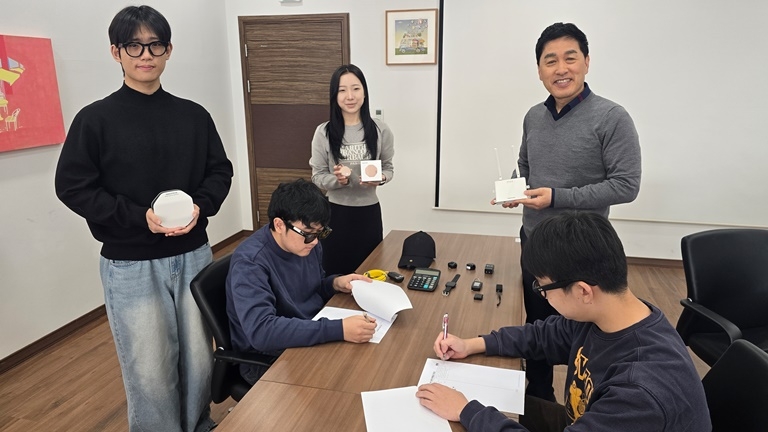
"As AI-powered cheating methods have diversified, it has become increasingly difficult to rely solely on human proctors or simple bans on electronic devices," Cho said. "We need new detection technology capable of identifying devices that are hard to spot by appearance alone — such as AI smart glasses and ultra-compact cameras."
"Applying Inertron's hidden-camera detection technology in exam halls would allow us to screen suspicious devices in advance and support proctors in conducting on-site checks during exams, reducing the likelihood of cheating," Cho added. "We are proposing the technology not only to secondary schools and universities but also to institutions that administer national certification examinations."
Inertron is currently proposing pilot applications to schools and national exam administrators, and is pursuing a demonstration project to verify detection performance and operational procedures in real exam settings.
The company has also set up a demonstration corner at its facility where officials from relevant institutions can observe the technology's principles and operation firsthand, and it is conducting on-site demonstrations for visitors.
Exam cheating expands from individual misconduct to a social problem
Exam cheating has grown beyond individual misconduct into a broader social problem that threatens the credibility of national examinations and the fairness of educational assessment.
As a result, government agencies and public institutions are paying growing attention to the need to introduce AI-based cheating prevention and advanced security technology.
Building prevention systems that leverage advanced detection technology is expected to become an important policy priority, particularly for university entrance exams, national certification tests and public-sector hiring examinations — settings where fairness and objectivity are paramount.
Experts said that as AI technology advances, cheating methods that exploit it will inevitably grow more sophisticated, and called for a shift in exam security from a reactive, post-incident detection model to one centered on proactive detection and prevention.
Against this backdrop, Inertron's exam anti-cheating solution — which has secured a technical foundation through a Ministry of Interior and Safety R&D project and built a track record of deployments at public institutions — is widely seen as a strong candidate to emerge as a new response model.
As technical countermeasures to protect exam integrity rise to the top of the agenda for government and educational institutions, attention is turning to whether Inertron's detection technology can establish itself as a new solution for creating fair assessment environments.
gilbert@heraldcorp.com