11 third-semester 'Yeolmae' gardeners among those appointed across three tiers; graduates transform Muak-dong rest area
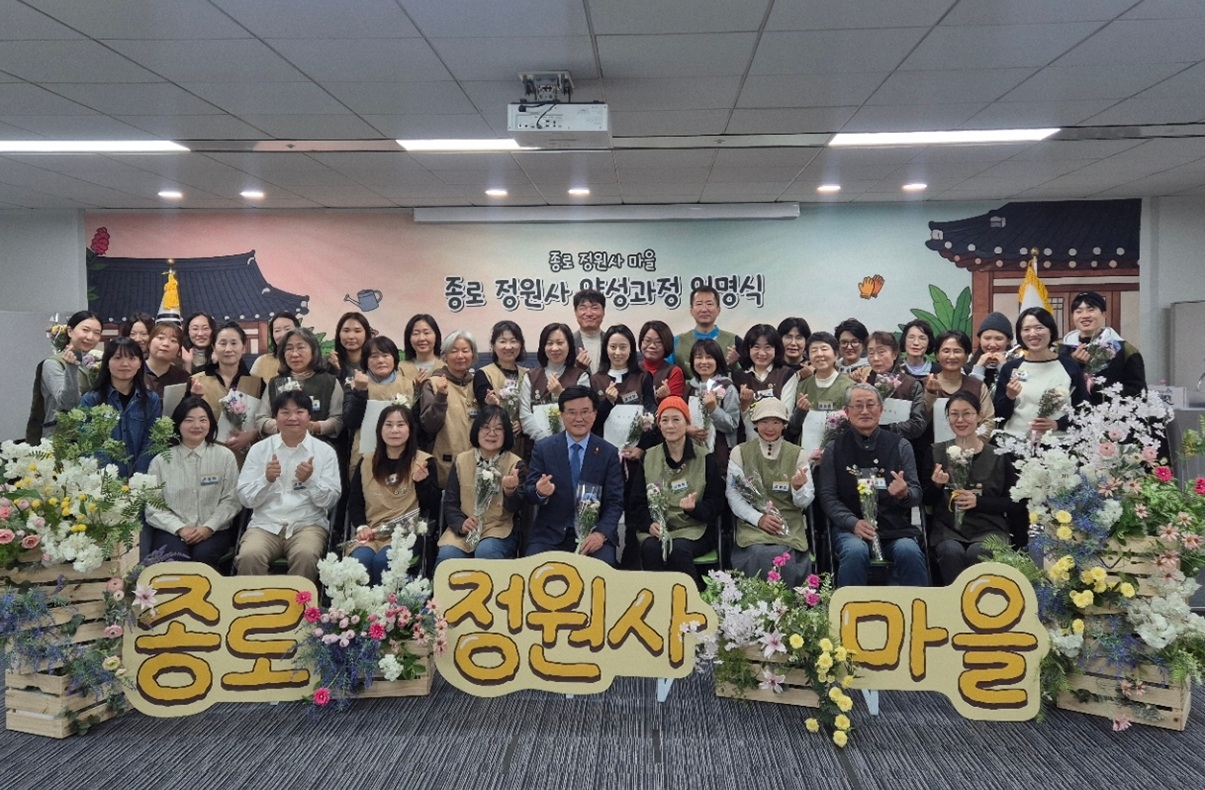
Seoul's Jongno-gu is expanding a resident-led public gardening program that trains local residents as gardening specialists and transforms everyday spaces across the district into green gardens.
Jongno-gu announced Wednesday that it appointed 37 "Jongno Gardeners" for the second half of 2026 at a ceremony held at the district office's open hall.
The "Jongno Gardener Village" program is jointly run by Jongno-gu and the Forest for Life Korea association and funded through corporate social responsibility contributions. Its core mission is to equip residents with the expertise to design and maintain green spaces in their own neighborhoods.
The second-half training course ran for about two months, from Sept. 9 to Nov. 7. Participants built their gardening skills through 10 sessions combining theory and hands-on practice.
In the final stage of the course, trainees carried out a field project to convert a rest area in Muak-dong into a community relaxation space. First-semester newcomers and veterans who had completed three semesters worked together in teams, each taking charge of garden design and planting for their assigned zone — putting into practice a participatory model of gardening in which residents directly reshape public spaces.
Of the 37 newly appointed gardeners, 20 hold the first-tier "Pulip" (grass leaf) designation, six the second-tier "Kkonip" (flower petal) designation and 11 the third-tier "Yeolmae" (fruit) designation. The program uses a five-stage development system in which participants advance from seed (trainee) to grass leaf (first semester), flower petal (second semester), fruit (third semester) and root (fourth semester).
Starting with the ninth directly elected district administration, Jongno-gu expanded the gardener crews' activity area from its existing hubs — Bukchon, Seochon, Sajik-dong, Cheongjin and Insadong — to the entire district. The aim is to move beyond managing gardens at fixed locations and develop a community-embedded model of public gardening in which residents tend alleyways and everyday spaces throughout the neighborhood.
The district plans to strengthen administrative and fiscal support to sustain the gardeners' ongoing activities and will explore ways to turn gardening work into stable employment opportunities. Next year, the district will continue running training courses and operate a range of garden leisure programs centered on Cheongjin Park.
"I am proud of the Jongno gardeners, who learn from and collaborate with one another across generational lines through soil and plants," District Mayor Yoo Chan-jong said. "We will provide support so that the gardeners' efforts can serve as the driving force that makes every corner of Jongno more beautiful and green."
seouldream01@heraldcorp.com