Forum examines impact of EU rules including CBAM, IAA
About 150 from industry, policy bodies and research institutions attend
KITA chief calls on EU to reflect Korean firms' positions in policymaking
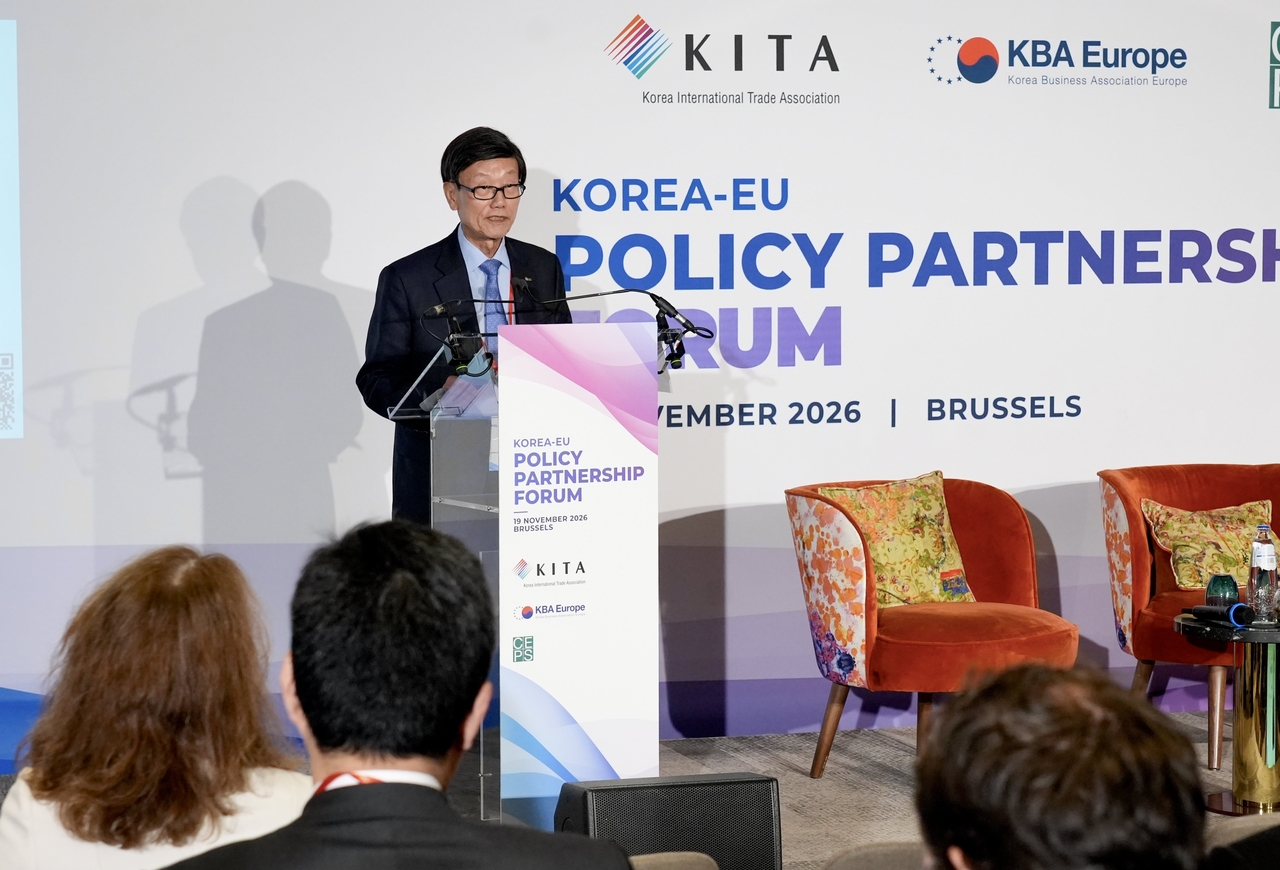
The Korea International Trade Association (KITA) co-hosted the 2026 Korea-EU Policy Partnership Forum in Brussels, Belgium, on Thursday (local time), together with KBA Europe and the Centre for European Policy Studies (CEPS).
The forum was organized to translate the strengthened industrial and trade cooperation between Seoul and Brussels — built on the momentum of the Korea-EU summit last June — into concrete private-sector collaboration. About 150 participants attended, including representatives of Korean companies operating in Europe, EU policymakers, industry groups and research institutions. They reviewed the impact on businesses of major EU industrial and trade policies such as the Industrial Acceleration Act (IAA) and the Carbon Border Adjustment Mechanism (CBAM), and discussed ways to expand investment, technology cooperation and supply chain linkages.
An opening expert dialogue on "Global Perspectives on Korea-EU Competitive Cooperation" featured František Ružička, deputy secretary-general of the OECD; Ahn Chong-ghee, a former South Korean vice foreign minister; and Lee Jae-seung, a Jean Monnet Chair professor at Korea University. The Jean Monnet Chair is a position awarded by the European Commission to university professors recognized for their expertise in EU research and education. Drawing on their experience in multilateral trade and Korea-EU diplomacy, the panelists called for maintaining openness in trade and investment while strengthening supply chain resilience and broadening medium- to long-term economic cooperation.
A corporate dialogue on "Korea-EU Industrial Competitiveness" followed, with Kirstin Jorna, director-general of the European Commission's Directorate-General for Internal Market, Industry, Entrepreneurship and SMEs (DG GROW), exchanging views with representatives from Hyundai Motor Company, Umicore and other companies on both sides. Participants examined how EU industrial and trade policies affect local investment and production decisions, and discussed ways to secure critical raw materials and expand investment cooperation in strategic industries.
Thematic panel discussions covered three areas: economic security, the circular economy, and digital trade and investment. The economic security session addressed supply chain diversification in key industries such as batteries and steel, as well as ways to ease investment regulatory barriers. The circular economy session examined trade conditions for recycled feedstocks and secondary raw materials, and shared case studies on applying recycled materials in European markets. The digital session discussed technology cooperation and investment expansion in AI, next-generation communications (5G and 6G), and connected mobility.
Karel Lannoo, CEO of CEPS, said South Korea and the EU are partners sharing common values in the current geopolitical environment, and that both sides need to cooperate and rely on each other to build a competitive and sustainable future together. "I am pleased that a platform has been created where Korea and the EU can jointly discuss major policy issues in the economic and industrial sphere and generate mutually constructive policy ideas," he said.
KITA President Yoon Jin-sik said strengthening industrial competitiveness is a challenge Korea and the EU must tackle together, and called for deeper strategic cooperation across industries and supply chains as the Korea-EU free trade agreement marks its 15th anniversary. "We share the goals of fair competition and sustainability that underpin EU policies such as CBAM, the Packaging and Packaging Waste Regulation and the IAA," Yoon said. "But as new regulations can place a burden on Korean companies operating in Europe, we will work closely with EU policymakers to find constructive alternatives."
Earlier that day, Yoon also attended a meeting of the European Parliament's Delegation for Relations with the Korean Peninsula (DKOR), where he discussed Korea-EU trade issues with delegation chair César Luena of Spain and lawmaker Vladimir Prebilič of Slovenia. Yoon stressed that cooperation between South Korea and the EU — as trusted partners — has become even more important amid growing external uncertainty, and asked the European Parliament to ensure that Korean companies' positions are adequately reflected in the formulation and implementation of EU trade policy. The lawmakers expressed agreement and pledged to maintain cooperation through ongoing dialogue and joint research.
Earlier in the trip, Yoon met with the president of Poland's Lewiatan Confederation on Nov. 13 to discuss supply chain cooperation in the battery and defense sectors and joint responses to EU policy. On Monday and Tuesday, he held separate meetings with the head of Turkey's Presidential Investment Office and the president of the Union of Chambers and Commodity Exchanges of Turkey (TOBB), exploring ways to expand private-sector economic cooperation and boost trade and investment ahead of the 70th anniversary of Korea-Turkey diplomatic relations in 2027.
eyre@heraldcorp.com