'A peace summit for world stability'
'When great powers cooperate, the world stabilizes; when they fight, chaos follows'
'Shenzhen APEC injects new momentum into Asia-Pacific free trade zone'
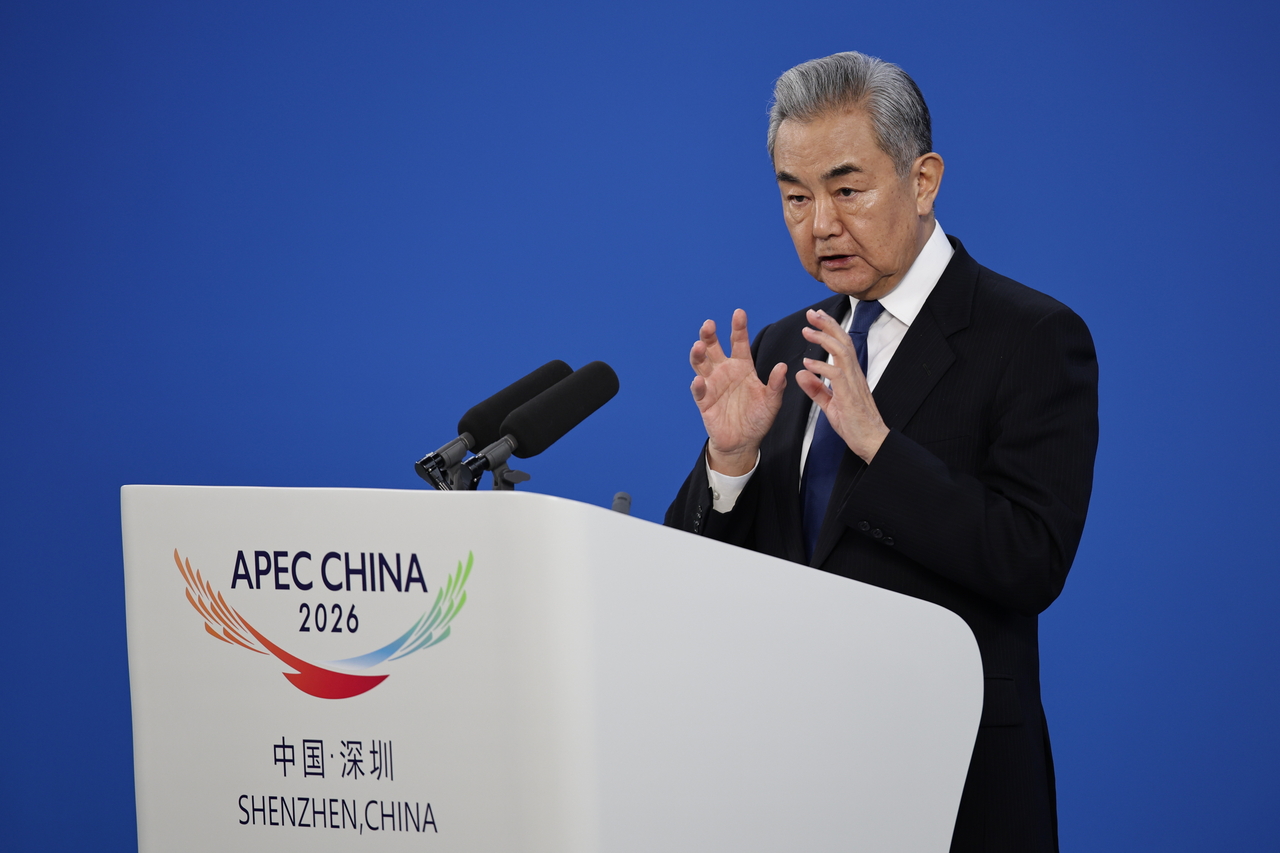
Chinese Foreign Minister Wang Yi described the trilateral summit among the United States, China and Russia held Thursday (local time) as "a symbolic event that will be recorded in the history books."
Speaking at a press conference following the Asia-Pacific Economic Cooperation summit in Shenzhen, Guangdong Province, Wang said the three leaders had "exchanged views in depth on important issues related to world peace, security and stability," according to the state-run Xinhua News Agency.
Wang said the meeting marked the first time in history that the leaders of the three countries had sat down together, calling it "highly significant with far-reaching impact." Wang said the talks "were conducted in a candid and friendly atmosphere, with rich constructive discussions and a series of shared understandings reached."
Wang added that the summit amounted to "a declaration of peace to the world," saying its core purpose was "to jointly safeguard world peace and promote strategic stability in major-power relations — this summit deserves to be called a peace summit."
Wang underscored the importance of major-power relations, noting that the United States, China and Russia are all leading global powers and permanent members of the UN Security Council.
"Major-power relations shape changes in the international order and bear on global strategic stability," Wang said. "This summit opened a new chapter in exchanges among the top leaders of the three countries, established a new paradigm for major-power interaction in the new era, and represented a new practice in advancing a new model of major-power relations — a landmark first attempt in the history of international relations."
Wang said the summit demonstrated the role great powers can play, noting that "the international community's call for strengthened communication and coordination among major powers grows louder by the day." Wang quoted President Xi Jinping as saying: "When great powers cooperate, the world stabilizes; when they fight, the world falls into chaos."
"The three leaders met face to face and discussed each other's strategic intentions," Wang said. "They sought to prevent conflict and confrontation and uphold the bottom line of peaceful coexistence. They looked forward to building a framework of major-power relations characterized by peaceful coexistence, overall stability and balanced development."
Wang said major powers, possessing greater resources and capabilities, must demonstrate the ambition and responsibility that come with that status. Wang said China would work with the United States and Russia to "fully and effectively implement the shared understandings reached at this summit" and would "continue to strive to build a better world through sustained working-level communication."
On the bilateral US-China summit, Wang said it had "provided fresh strategic guidance on how to implement a relationship of constructive strategic stability between the two countries." On the China-Russia summit, Wang said the two sides had "reached new areas of consensus on deepening all-around strategic cooperation."
Wang described the APEC summit as "China's most important host diplomacy of this year" and called the "Shenzhen Outlook" adopted at the conclusion of the meeting "the most important outcome and a milestone for APEC cooperation."
Wang elaborated on the "framework" for an Asia-Pacific community proposed by Xi, describing it as built on four pillars — economy and trade, connectivity, innovation and development — and eight supporting columns: the Free Trade Area of the Asia-Pacific, hardware connectivity, software connectivity, people-to-people connectivity, the digital economy, emerging technologies, capacity building and sustainable growth.
Wang said the summit had injected new momentum into building the Free Trade Area of the Asia-Pacific, citing the passage of the APEC Framework for Trade Digitalization Cooperation and an APEC statement on emerging technologies to promote jobs and prosperity, which addressed AI.
The press conference began later than scheduled. Wang said he had seen off both US President Donald Trump and Russian President Vladimir Putin at the airport as they departed for home.
mokiya@heraldcorp.com