Average annual tax reaches 1.26 billion won per 18 holes; Incheon tops regional list
Industry calls for cut to heavy tax rate on membership courses
Property tax burdens on membership golf courses have risen more than 17 percent over the past decade, with the average annual levy reaching 1.26 billion won ($946,000) per 18 holes, prompting the industry to call for a reduction in the heavy tax rate applied to such venues.
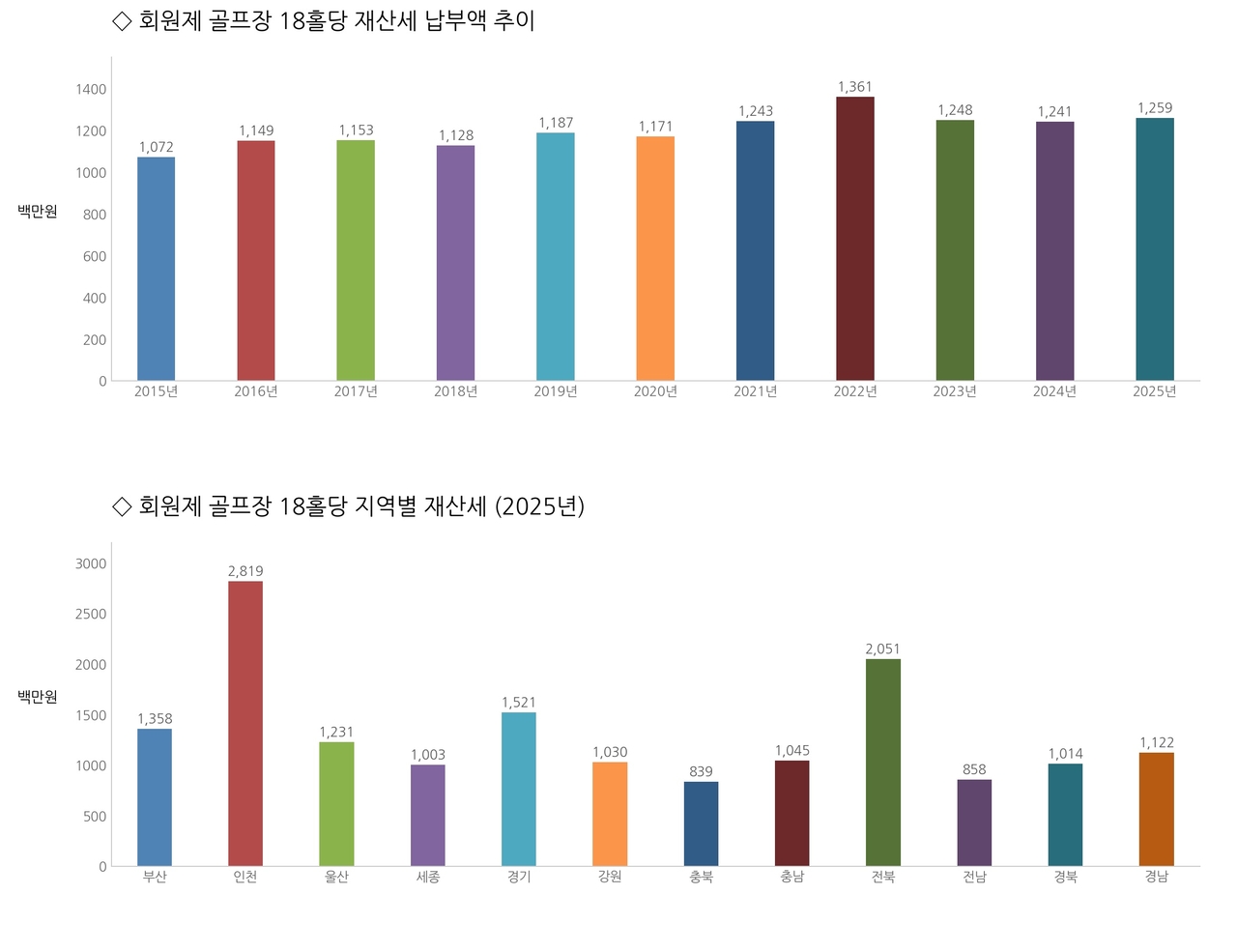
The Korea Leisure Industry Research Institute analyzed the Ministry of Interior and Safety's local tax statistics yearbook and found that membership golf courses paid 1.26 billion won in property tax per 18 holes last year, up 17.4 percent from 1.07 billion won in 2015.
Total property tax paid by all membership golf courses — equivalent to 194 18-hole courses — reached 242.35 billion won last year, a 1.2 percent increase from 2024. Land-based property tax accounted for 228.9 billion won, or 94.5 percent of the total.
By region, Incheon recorded the highest property tax per 18 holes at 2.82 billion won, a figure attributed to the presence of Jack Nicklaus Golf Club Korea in Songdo, where land prices are steep. North Jeolla Province (2.05 billion won), Gyeonggi Province (1.52 billion won) and Busan (1.36 billion won) followed. Daegu posted the lowest figure at 664 million won, while Jeju Island came in at 709 million won.
In terms of total tax paid by region, Gyeonggi Province — home to 69 membership courses — led with 134.6 billion won, accounting for 55.5 percent of the national total. South Gyeongsang Province (20.2 billion won, 8.4 percent) and Gangwon Province (19.6 billion won, 8.1 percent) ranked second and third.
Total property tax from membership golf courses peaked at 329.1 billion won in 2014, fell to 231.8 billion won in 2020, then climbed back to 242.35 billion won last year. The earlier decline is attributed to a growing number of courses converting to public-access operations to avoid the higher tax rate.
As of late October, 114 courses had converted from membership to public-access status. Of those, 44 made the switch through corporate rehabilitation proceedings, while 56 did so because of the heavy tax burden. The number of membership golf courses has fallen from 230 at the end of 2013 to 153 at the end of last year.
Against this backdrop, industry opposition is mounting after the government announced plans to raise the fair market value ratio for property tax on membership golf courses from 70 percent to 100 percent. The 151 remaining membership courses have warned that the increased tax burden could undermine their financial viability.
"They are the same golf courses, yet public-access courses are taxed at the standard rate of 0.2 to 0.4 percent while membership courses face a heavy rate of 4.0 percent," said Seo Cheon-beom, director of the Korea Leisure Industry Research Institute. "To ease the financial burden on 5 million golfers and ensure the sustainable management of membership courses, the property tax rate must be lowered."
yjc@heraldcorp.com