Scouting Seoul for fun: Gangdong, Mapo and Dongjak on the shortlist
Couple builds a PowerPoint deck to settle their upgrade debate
Incheon deposit gap becomes a stumbling block
This article is part of The Herald Business series on how ordinary Korean workers have managed to buy homes in Seoul. Names and some details have been changed to protect the subjects' identities.

The parking garage was as spacious and spotless as a department store floor. There were smart-home systems, a full suite of community amenities — the first home Lee Su-yeon (a pseudonym) ever owned was perfect. More precisely, it was perfect on weekends.
On workdays, Lee spent four hours a day — 20 hours a week — on the subway. The more worn down Lee became, the sharper the goal of upgrading grew. Settling was not an option if Seoul was the target within two years, and building up assets now would mean more choices when the moment came.
► Missed Part 1 of Lee's journey into the Han River belt? Read it here.
Spend less, scout more: 'We just went to Seoul whenever we were bored'

The couple canceled their credit cards the moment they got married. "My husband was the one who pushed hard for us to stop using credit cards altogether," Lee said. "Before I was married I racked up quite a bill every month. Now we only use a card enough to qualify for the preferential loan rate."
They managed their living expenses by keeping their account balance deliberately tight. Depositing a full month's budget at once, Lee reasoned, only invited overspending. Instead, they transferred 100,000 won ($75) into their household account every week, adding more only in a pinch. There were times Lee did not realize the week's allowance was gone until already at the checkout. Once the inconvenience became habit, overspending felt foreign to them.
Every won that flowed in and out was recorded in what the couple called a household balance sheet — tracking debt and equity the way a company would, steadily logging the state of their finances.
"Home prices were rising, so our assets were growing fast too. My husband was excited, but we did not let it go to our heads. We had already seen how dangerous easy money could be. We kept telling ourselves: don't get complacent, just keep going in the right direction."
Even as their assets grew, the couple kept moving. From early 2024, their hobby was scouting apartments in Seoul. They had no immediate plan to buy, but this time they wanted to learn by walking the streets rather than reading books. Whenever a complex worth upgrading to caught their eye, they saved it and dropped by a real estate agency whenever they had time.
"The first filter was always price — something we could actually reach," Lee said. "Selling our Incheon place would not be enough for a new Seoul apartment, so we focused on older buildings in good locations."
'Mapo for schools vs. Dongjak for redevelopment': the first time the couple disagreed
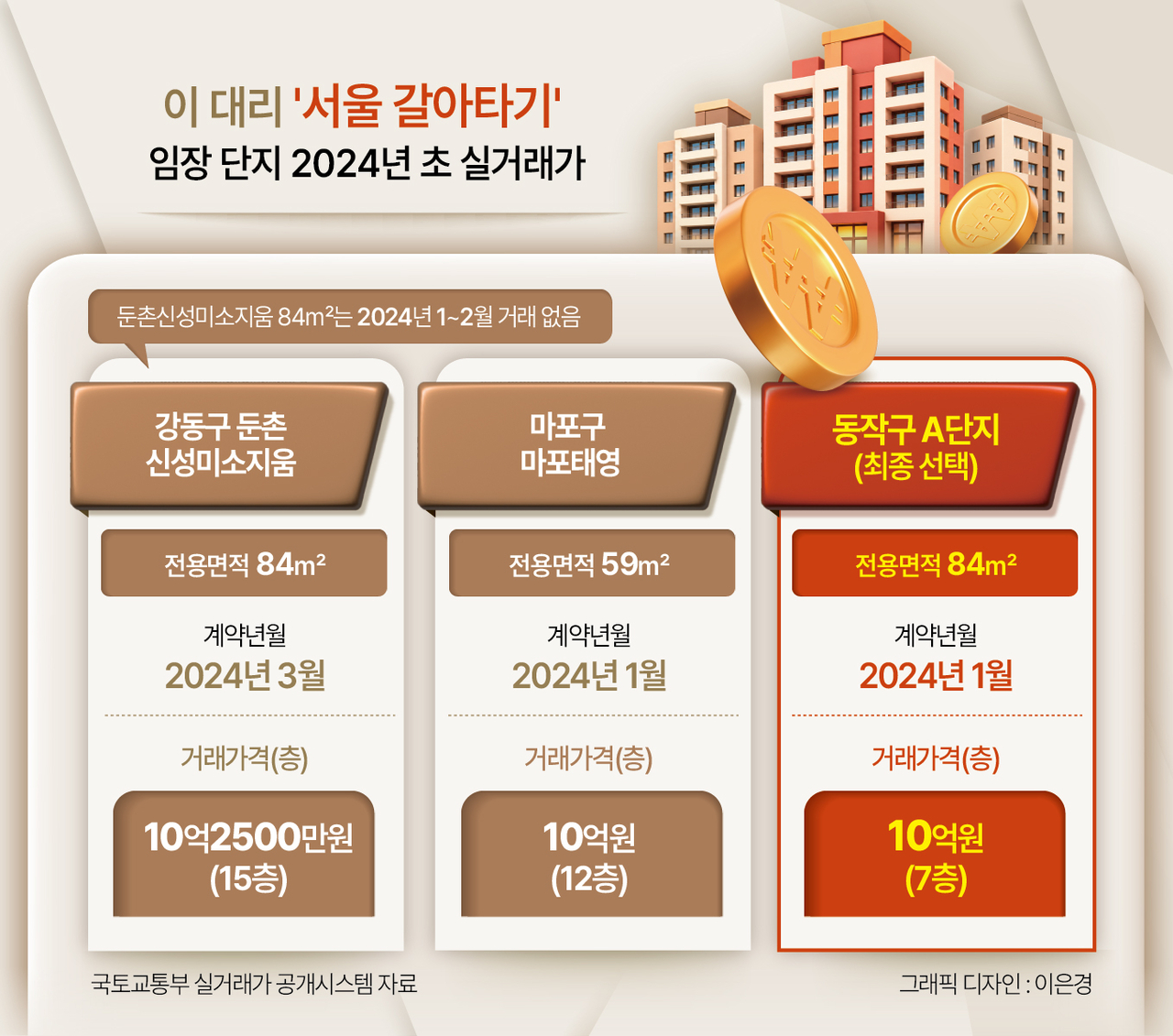
That process narrowed the field to three districts: Gangdong-gu, Mapo-gu and Dongjak-gu. Once the areas were set, the couple toured complex after complex, checking nearby development plans, school catchments and commute times. Three finalists emerged: Dunchon Shinsung Misozium in Gangdong-gu, Mapo Taeyoung (also known as Daeheung Taeyoung) in Mapo-gu, and Complex A in Dongjak-gu, where they now live.
"We found Complex A by accident. We were scouting somewhere else when I looked out the window and saw a neighborhood packed with apartments and great infrastructure. I opened a real estate app on the spot and marked it as our next stop."
In early 2024, all three complexes were trading in the low 1 billion won range. A 59-square-meter unit at Mapo Taeyoung changed hands in January on the 12th floor for 1 billion won, while an 84-square-meter unit at Dunchon Shinsung Misozium sold in March for 1.025 billion won. An 84-square-meter unit at Complex A also traded at 1 billion won in January.
Beyond the shared trait of being more than 20 years old, each complex had its own distinct pros and cons. Dunchon Shinsung Misozium sits adjacent to Olympic Park Foreon, a development of about 12,000 units, giving residents access to convenient transport links and a thriving commercial district. The complex itself, however, has fewer than 500 units — a drawback for a couple who preferred large-scale developments, and it slipped down their list accordingly.

That left Mapo and Dongjak. For the first time, the couple who had always moved as one found themselves on opposite sides.
"Honestly, I was firmly in the Mapo camp. The biggest reason was Yeomni Elementary School right next to the complex — it has a strong academic reputation. Even if prices fell, I thought I could happily raise children there for 10 or 15 years."
While Lee was focused on the neighborhood, her husband zeroed in on the units themselves. Staying within budget in Mapo-gu meant settling for a relatively small unit of about 66 square meters, and the corridor-style layout of the building also gave him pause — he worried about rain and wind blowing in during heavy storms, and about insects getting inside.
Her husband pinned his hopes on the future value of Dongjak-gu, home to the Noryangjin New Town project. The Noryangjin New Town, covering the Noryangjin-dong and Daebang-dong areas of Dongjak-gu, was designated a second-round redevelopment zone in November 2003. Eight sub-zones were designated between 2009 and 2010, and a redevelopment project covering roughly 9,300 units is now under way.
With both complexes on the final shortlist, the couple entered an intense round of persuasion. They rarely clashed over financial decisions, but Lee treated this one like a work project — building a full PowerPoint presentation. "I was so desperate that I made a slide deck titled 'Upgrade Project,'" Lee said. "I put in a map showing where National Assembly members live and argued hard: 'Why do you think all these people choose Mapo?'"
Then, in December 2024, the couple flew abroad to mark their first wedding anniversary. On that trip, Lee — who had already planned to move as soon as the two-year residency required for a capital gains tax exemption was complete — began to feel the move needed to happen sooner.
"Right up to the end I was still torn between the two complexes, but then Mapo prices suddenly surged and moved out of reach," Lee said. "The destination chose itself." By early 2025, a 59-square-meter unit at Mapo Taeyoung was trading in the low-to-mid 1.2 billion won range — about 100 million won more than an 84-square-meter unit at Complex A.
The couple listed their Incheon apartment the moment they landed back in Korea. They also sold a Dongtan apartment in Hwaseong that her husband had bought before the marriage as a gap investment. The Incheon unit found a buyer within a week, netting a profit of 50 million to 60 million won — but a separate problem was waiting. They called it "fund Tetris."

"The interim payment amount is something the buyer and seller can negotiate, but back then apartments in Incheon and Gyeonggi Province were priced in the 500 million to 600 million won range, so interim payments were at most around 100 million won. There was not even a clear convention around them — most sellers just did not ask for one."
That was why Lee and her husband barely gave it a second thought when the newlywed buyers who came to see their Incheon apartment said they could not afford an interim payment. What they did not expect was that every seller they met the following week at real estate agencies in Dongjak-gu was asking for 200 million to 300 million won as an interim payment.
"Our plan was to combine the roughly 500 million won from selling the Incheon and Dongtan properties with a 600 million won loan, but the timing of when the Incheon sale proceeds would arrive and when we needed to pay the deposit and interim payment to the seller started to fall out of sync," Lee said. "Our financing plan suddenly fell apart, and we had to go hunting for a seller who could give us more flexibility on the interim payment schedule."
Another frantic week passed. The couple, anxious not to lose the home they had spent a year finding on foot, finally exhaled once they worked out a payment schedule with the seller. The very week after selling their Incheon home, they signed the purchase contract for Complex A in Dongjak-gu — just two weeks after their vacation had ended.
But making it into the Han River belt was not Lee's final destination.
The next installment features Lee's hands-on investment advice after achieving the dream of owning a home in Seoul — including clear-cut answers whenever friends come with real estate questions. What are the investment principles built up over six years, from pre-sale rights to upgrading into Seoul?
shy@heraldcorp.com