The UN Working Group on Enforced or Involuntary Disappearances says the South Korean government's answers fall short in the case of No Jin-su, a Seoul National University law student from Daegu who vanished 44 years ago
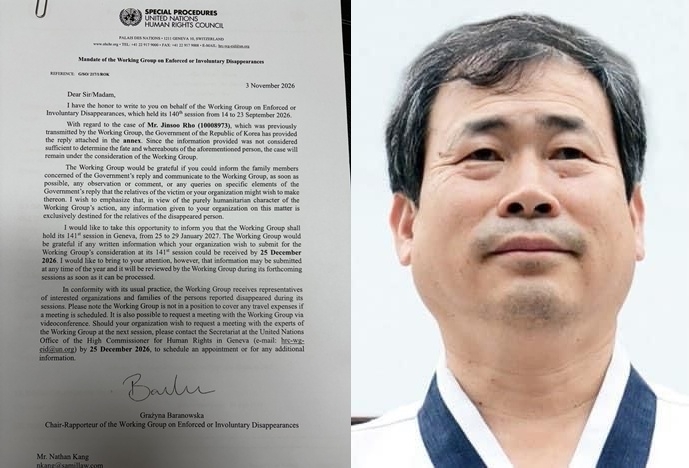
The UN has determined that South Korea's response is insufficient in the case of No Jin-su, a Daegu-born first-year Seoul National University law student who disappeared in 1982 after being taken away by plainclothes men near the campus, and will continue reviewing the matter.
An official letter from the UN Human Rights Council's Working Group on Enforced or Involuntary Disappearances (WGEID), obtained Friday, shows the group notified the victim's legal representative on Tuesday that "the response submitted by the Government of the Republic of Korea is not sufficient to determine the fate and whereabouts of Mr. No Jin-su" and that it would "maintain the case under active consideration."
The reply comes more than seven years after attorney Choi Bong-tae — a classmate of No's at Seoul National University — and attorney Kang Na-dan of the same law firm submitted the case to the UN in 2019.
The working group discussed the case at its 140th session in September. In a response submitted Aug. 13, the South Korean government said it had already provided relevant information in 2019 and had no additional materials to submit.
In 2019, the government submitted a ruling by the Commission on Suspicious Deaths stating that the truth of the case could not be determined, and said checks conducted through prosecutors and police had found no records of any investigation or surveillance involving No.
The UN, however, judged the government's additional explanation insufficient and decided to keep the case open.
No disappeared on May 22, 1982, after three plainclothes men believed to be government agents took him from a private study room near Seoul National University in Sillim-dong, Gwanak-gu, Seoul. His fate has remained unknown for 44 years.
No had been involved in academic club activities and participated in a memorial event marking the first anniversary of the May 18 Gwangju pro-democracy uprising. The Commission on Suspicious Deaths acknowledged a connection to the pro-democracy movement but concluded there was insufficient evidence to prove he had been forcibly taken by state authorities or that he had died, and issued a ruling that the truth could not be established.
Choi said he had recently delivered the UN letter to No's older brother, No Jin-ho. "It is frustrating that there is no clear answer — whether he died, whether he is alive, whether he was abducted by North Korea, or whether he was killed by state authorities," Choi said, adding that classmates from the Seoul National University law school are analyzing how to respond.
The working group will hold its 141st session in Geneva from Jan. 25 to Jan. 29 next year. The victim's family has been informed that additional written materials and requests for interviews must be submitted by Dec. 25.
kbj7653@heraldcorp.com