Trade surplus of $43.3 billion recorded from January to October
Non-semiconductor trade deficit expands to $41.5 billion
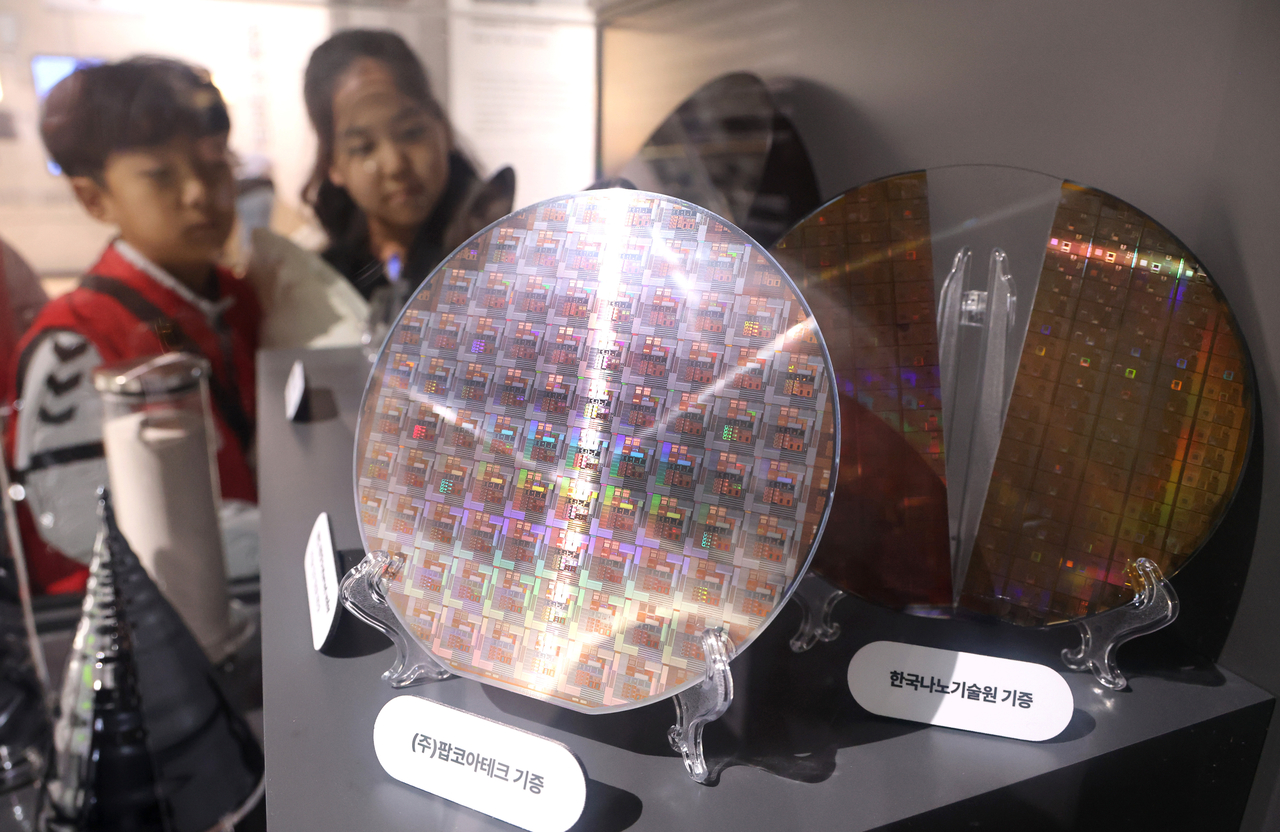
South Korea's trade balance with China swung to a surplus for the first time in four years, but the deficit deepened once semiconductors are stripped out. With chips accounting for more than 60 percent of exports to China, analysts say the country must diversify its export structure away from its dependence on a single category.
According to the Korea International Trade Association (KITA) and the Ministry of Trade, Industry and Energy, South Korea recorded a $43.3 billion trade surplus with China in the January–October period. That marks a turnaround from a $10.5 billion deficit in the same period last year. The trade balance with China had been in deficit since 2023, but strong semiconductor exports drove the reversal this year.
Semiconductors (based on the MTI 831 classification) accounted for $124.3 billion, or 63 percent, of the $198.5 billion in total exports to China during the first 10 months of the year. The semiconductor trade surplus reached $84.8 billion over the same period — roughly 4.6 times the $18.6 billion recorded a year earlier.
Strip out semiconductors, however, and the trade balance turns sharply negative: the deficit on non-semiconductor goods widened to $41.5 billion, up $12.4 billion from the $29.1 billion deficit in the same period last year. The overall surplus, in other words, masks a deterioration in competitiveness with China across most other industries.
The deficits widened across several major product categories. The automotive trade deficit nearly doubled, rising from $2.2 billion in the year-earlier period to $4.2 billion this year. Deficits in secondary batteries and electrical equipment reached $4 billion and $5.7 billion, respectively — each expanding by $1 billion compared with the same period last year.
Kang Gam-chan, director general for trade and investment at the Ministry of Trade, Industry and Energy, said imports of Chinese electric vehicles have increased while South Korean car exports to China have declined. "In the case of secondary batteries, domestic production costs are high, so companies sometimes manufacture products at their factories in China and then import them for use," Kang said.
At a recent press briefing, Kang said the trade surplus with China should not be read as a broad recovery in industrial competitiveness. "It is essentially a semiconductor surplus across the board," he said. "How to respond to China is the most important challenge — not just from a trade and commerce perspective, but from an industrial policy perspective."
Experts say South Korea needs to overhaul its export strategy toward China in response to the country's push for technological self-reliance and industrial upgrading.
Park Sol, a research fellow at KITA, said China has been reducing its share of processing trade since the mid-2000s, which has slowed intermediate-goods exports from South Korea and other countries alike. "The widening trade deficit is not a problem unique to South Korea," Park said.
Park added that China has become a market undergoing industrial upgrading, and that South Korea needs to expand exports in competitive areas such as advanced equipment, new materials and medical devices. As an example, Park pointed to Japanese companies that have grown their share of China's industrial robot import market by leveraging core components and control technology, even as China pursues domestic robot production.
The government is also working to diversify the semiconductor-heavy export structure by pushing consumer goods exports. After several years of decline, South Korean consumer goods exports to China rose 8.7 percent year-on-year to $3.44 billion in the first half of this year.
Cosmetics exports to China totaled $1.8 billion in the January–October period, up 2.7 percent from a year earlier, while agricultural and fishery product exports reached $1.9 billion, a gain of 11.9 percent. Those gains look modest compared with the 32.3 percent increase in South Korea's overall cosmetics exports during the same period, suggesting China-bound shipments have underperformed.
The Ministry of Trade, Industry and Energy is supporting companies seeking to enter regional consumer goods markets in China through KOTRA and other affiliated agencies. The ministry plans to expand the export base through online and offline marketing, distribution network development and logistics support.
Park said regulatory hurdles remain a significant obstacle. "For products like medical devices, cosmetics and food, local certification requirements in China can be demanding, and small and medium-sized enterprises may not have enough information about the process," Park said. "If the government strengthens support in these areas, it will help expand exports."
quq@heraldcorp.com