Daily average exports up 95.2% when adjusted for working days
Car exports fall 5.6% despite more working days than a year ago
Trade surplus reaches record $27.1b for Nov. 1–20 period
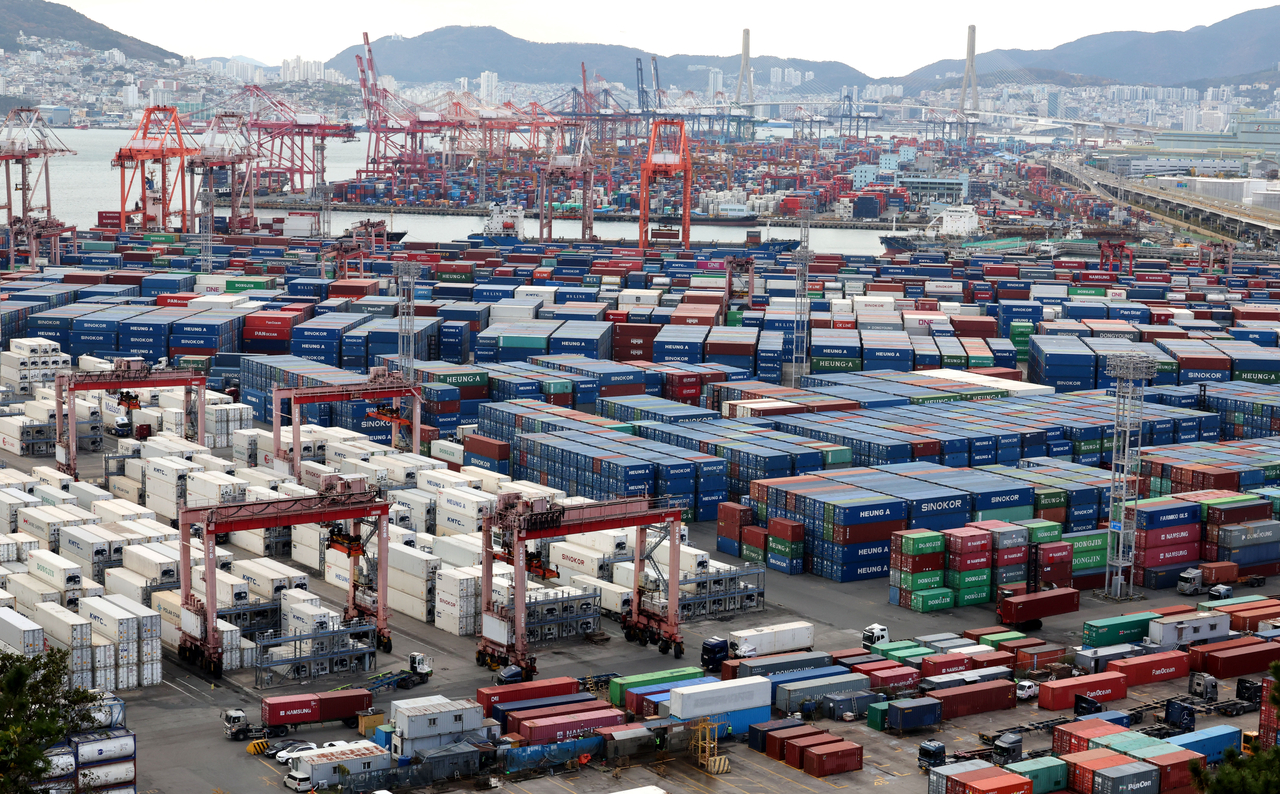
South Korea's exports continued to set records in the first 20 days of November, days after the country crossed the $1 trillion mark in annual cumulative exports for the first time in history on Thursday. Semiconductor shipments — the primary driver — surged nearly fourfold from a year earlier, accounting for nearly half of all exports. Passenger car exports, meanwhile, fell about 6 percent despite having 0.5 more working days than the same period last year.
Exports from Nov. 1 to Nov. 20 reached $77.4 billion on a customs-clearance basis, up 101.5 percent from the same period a year ago, the Korea Customs Service said Monday. The figure is the largest ever recorded for the Nov. 1–20 period.
There were 16.0 working days during the period, 0.5 more than the 15.5 logged a year earlier. Adjusted for working days, the daily average export value came to $4.84 billion, up 95.2 percent from a year ago.
Cumulative exports from January through Nov. 20 totaled $1.01 trillion. South Korea crossed the $1 trillion threshold on Thursday, becoming the first country to join the "trillion-dollar export club" since China did so in 2007 — a gap of 19 years. Germany and the United States had reached the milestone in 2006. South Korea is now one of four countries worldwide to record annual exports of $1 trillion or more.
By product category, semiconductor exports led the way at $38.5 billion for the Nov. 1–20 period, also a record for that stretch. The year-on-year growth rate was 294.4 percent, nearly quadrupling from a year earlier.
Semiconductors' share of total exports rose to 49.7 percent, up 24.3 percentage points from a year ago, meaning nearly half of all export revenue came from chips. The surge is attributed to soaring demand for semiconductors, computing infrastructure and related electronics driven by the spread of AI.
According to the Ministry of Trade, Industry and Resources, the growth rate of global trade in AI-enabled products has outpaced overall goods trade growth since 2024, accounting for 47 percent of the increase in goods trade in the first half of this year.
Petroleum products (up 91.9 percent) and computer peripherals (up 330.6 percent) also posted gains, while passenger car exports fell 5.6 percent.
By destination, exports grew to China (up 145.6 percent), the United States (up 142.7 percent), Vietnam (up 85.8 percent), Taiwan (up 149.7 percent) and the EU (up 25.7 percent).
The top three destinations — China, the United States and Vietnam — together accounted for 55.5 percent of total exports.
Imports came to $50.3 billion, up 39.4 percent from a year earlier. By category, semiconductors (up 103.4 percent), crude oil (up 83.4 percent), gas (up 93.9 percent) and machinery (up 13.8 percent) all increased.
Energy imports, including crude oil, gas and coal, rose 78.5 percent.
By country of origin, imports increased from China (up 52.5 percent), the United States (up 45.2 percent), the EU (up 17.0 percent), Taiwan (up 81.5 percent), Japan (up 27.0 percent) and Russia (up 20.4 percent).
With exports outpacing imports, the trade balance posted a surplus of $27.1 billion — the largest ever recorded for the Nov. 1–20 period.
oskymoon@heraldcorp.com