Deputy PM to visit wage reform sites Wednesday ahead of ruling party committee meeting Friday
Labor pushes for year-end legislation while business groups call for rehiring, wage restructuring
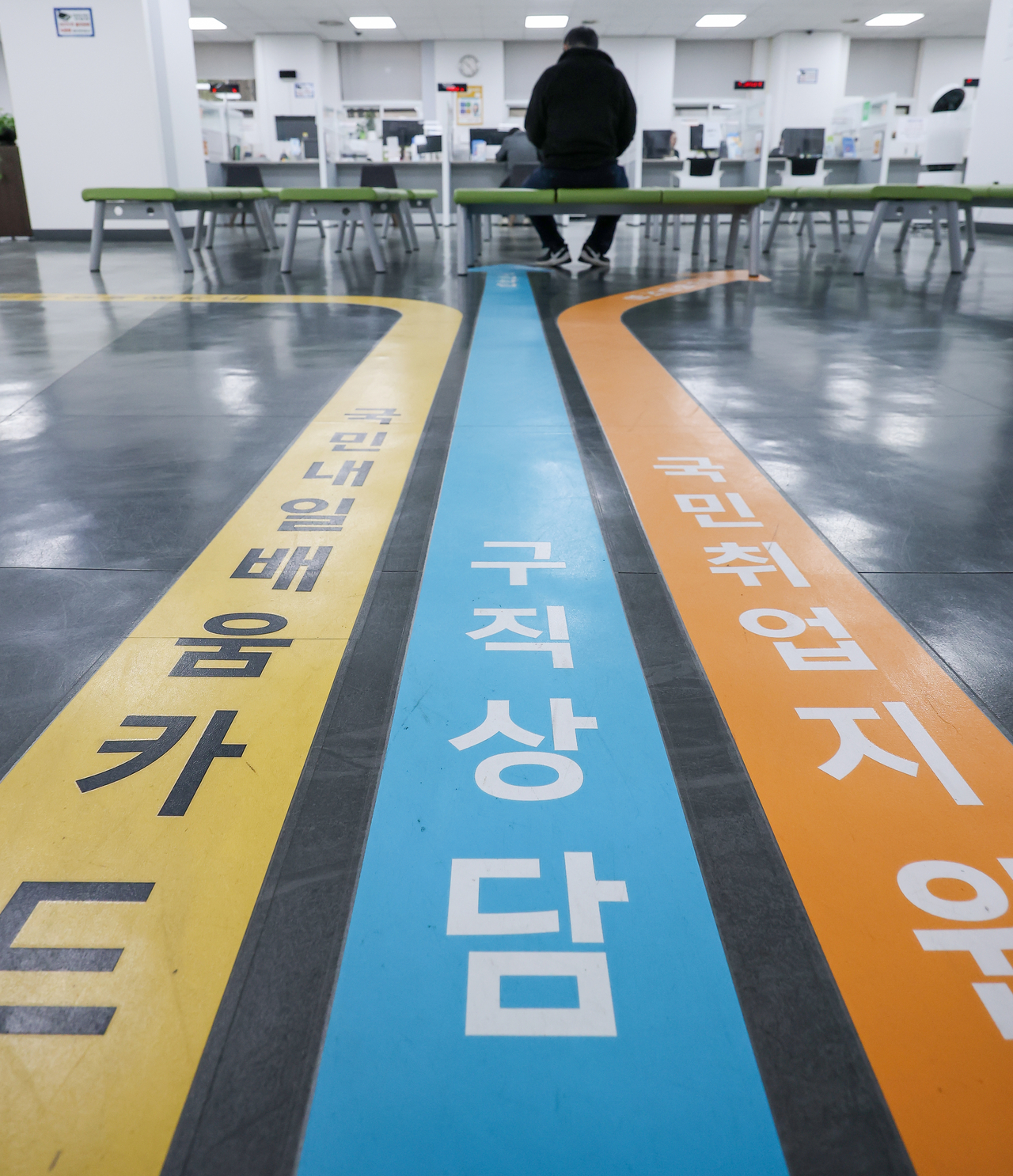
As the government signals it may take a direct role in discussions on raising the mandatory retirement age, the deputy prime minister is set to visit sites that have already restructured their wage systems. The move comes as how to manage wages and labor costs over an extended employment period has emerged as the central issue in the retirement age debate. The key question is whether a compromise addressing both retirement age and wages can be reached, amid pressure from labor unions for year-end legislation and concerns from the business community over corporate costs and youth employment.
According to the Ministry of Economy and Finance, Deputy Prime Minister and Finance Minister Lee Hyung-il plans to make a private visit Wednesday to workplaces that have reformed their wage structures. The visit comes two days before a subcommittee meeting of the Democratic Party of Korea's special committee on retirement age extension, scheduled Friday. It has not been confirmed whether the visit is directly linked to preparation of a government proposal on extending the retirement age.
Given that wage structure reform is the central issue in the retirement age debate, the visit is widely interpreted as an effort by the government to examine real-world cases of wage and labor cost adjustments tied to longer employment. The government faces the challenge of determining not only how far and how quickly to raise the retirement age, but also how to adjust wages and costs over the extended employment period.
Earlier, Minister of Employment and Labor Kim Young-hoon said Sunday in a broadcast that he believed "the time is approaching for the government to announce its position around the time of the committee meeting." His remarks signaled that while the government would do its utmost to facilitate labor-management agreement, it was prepared to step in responsibly if no agreement was reached.
The Ministry of Employment and Labor has yet to release a specific government proposal. Given that the national policy agenda focuses on a phased extension of the statutory retirement age through social dialogue, the government's plan is widely expected to follow that approach. The ministry has also told the National Human Rights Commission of Korea that it intends to prepare measures to ease the burden on businesses and support youth employment alongside phased retirement age extension legislation.
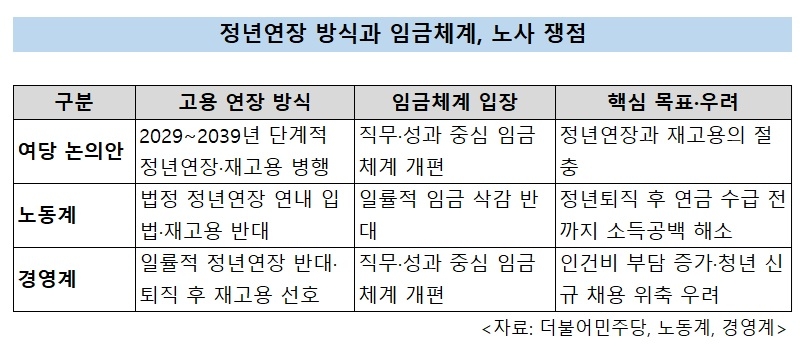
Labor unions are pressing for legislation before the end of the year. Kim Dong-myung, chairman of the Federation of Korean Trade Unions, said at a national workers' rally Nov. 7 that the federation might not maintain its policy alliance with the ruling party if no legislative progress was made on labor issues, including retirement age extension, by year's end. The two major union federations are calling for a statutory extension of the retirement age to close the income gap between mandatory retirement and the start of national pension benefits, while opposing rehiring arrangements and across-the-board wage cuts.
Business groups, by contrast, favor rehiring over a statutory extension, citing concerns about rising labor costs and a potential chilling effect on new hiring. If a statutory extension proves unavoidable, they argue it must be accompanied by a shift to job- and performance-based wage systems. The Korea Enterprises Federation told the National Assembly Nov. 10 that an across-the-board retirement age extension could worsen youth unemployment and concentrate benefits among full-time workers at large unionized companies, deepening the dual structure of the labor market.
Ultimately, the difference between a retirement age extension and a rehiring scheme comes down to more than the length of employment — it also involves wages and job security. A statutory extension maintains the existing employment relationship while lengthening the employment period, whereas rehiring involves signing a new labor contract after retirement. Even if both approaches allow workers to remain employed until 65, wage levels and employment conditions can differ significantly. This is why the ruling party has been floating a compromise that combines a phased retirement age extension with a rehiring option.
Some analyses warn of the potential impact on youth employment. In a report last year on super-aged society and continued employment for older workers, the Bank of Korea analyzed the effects of the 60-year mandatory retirement age introduced in 2016 and estimated that for every additional older worker employed, the number of young workers fell by 0.4 to 1.5. The finding suggests that when employment periods were extended without adjusting wage structures, companies may have reduced new hiring to contain costs.
A survey of 210 professors of business, economics and law released by the Korea Enterprises Federation in July last year found that 62.4 percent of respondents identified a reduction in new youth hiring as the most likely negative effect of raising the retirement age to 65. Lee Sang-cheol, head of the federation's employment and social policy division, said "flexible system design centered on rehiring is urgently needed."
Most experts share that view. Park Ji-soon, a professor at Korea University School of Law, said that "extending the retirement age without improving the wage structure and workforce management flexibility will accelerate large-scale corporate restructuring," adding that factors such as job duties, responsibilities, working hours and performance should be considered rather than uniform wage cuts based on age.
fact0514@heraldcorp.com