
New headquarters construction cost estimated at over 300 billion won; total advisory fees reach 11.2 billion won
Questions raised over budget appropriateness as advisory costs hit record high
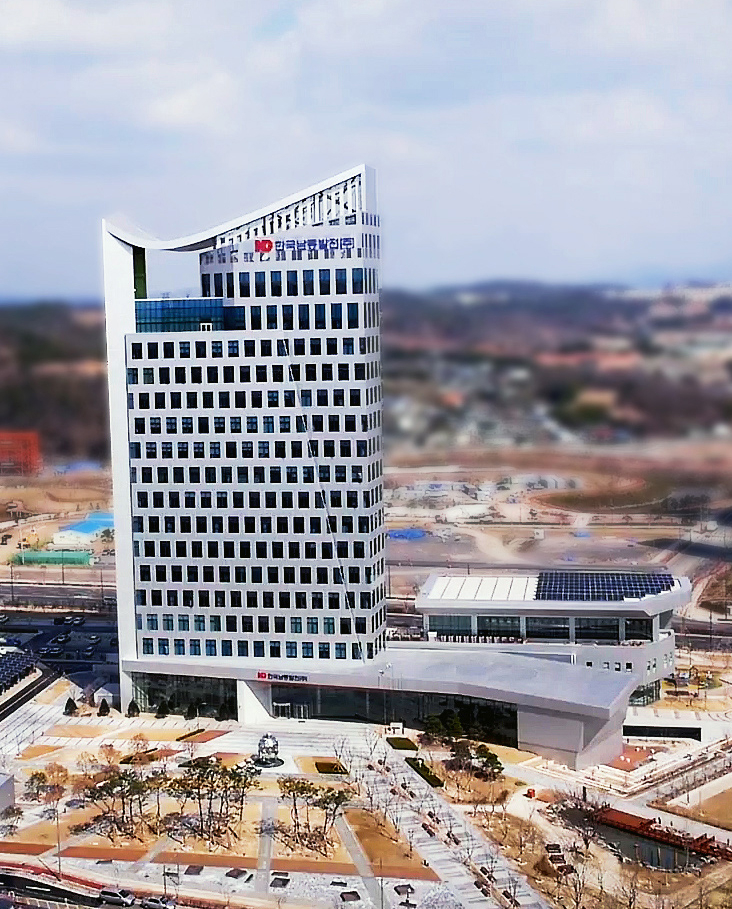
A consortium of law firm Lee & Ko and Samil PwC has been selected to lead advisory and support services for the planned merger of five state-owned power generation companies under Korea Electric Power Corporation — Korea South-East Power, Korea Midland Power, Korea Western Power, Korea Southern Power and Korea East-West Power. The consortium will be responsible for drawing up the blueprint for the integration, which is set to officially launch on Oct. 1 next year.
The advisory fee was finalized at 10.9 billion won ($8.11 million), equivalent to 80 percent of the original contract value of 13.67 billion won (or 12.42 billion won excluding value-added tax). The five power companies will jointly bear the cost.
According to sources in the power generation and legal industries, the five companies jointly issued a tender for "advisory and support services for the integration of five state-owned power generation companies," with a submission deadline of Nov. 17. After evaluation, the Lee & Ko–Samil PwC consortium was selected Wednesday.
The contract runs from the signing date through December next year, a period of approximately 13 months. Korea South-East Power, which has been handling integration planning work this year, is the contracting authority.
The contract is the largest advisory fee ever awarded in a power company-related tender. Two consortiums competed in the bidding — one pairing Lee & Ko with Samil PwC, and another pairing Bae, Kim & Lee with Deloitte. KPMG Samjong was reportedly excluded from the competition due to a conflict of interest, as it is currently providing financial management consulting to Korea Electric Power Corporation and other power group affiliates.
Lee & Ko counts several former officials from the Ministry of Trade, Industry and Energy — now reorganized as the Ministry of Trade, Industry and Resources and the Ministry of Climate, Environment and Energy — among its ranks, including advisers Im Chae-min and Han Jin-hyeon, and attorney Jo Yeong-jae.
Im passed the civil service examination in its 24th cohort and held posts including director of the steel and metals division, spokesperson and director of the industrial technology bureau at the Ministry of Commerce, Industry and Energy, before rising to vice minister of the Ministry of Knowledge Economy, chief of the Office for Government Policy Coordination and minister of the Ministry of Health and Welfare. Han, a native of Boseong in South Jeolla Province, passed the civil service examination in its 25th cohort and served as director of the petroleum industry division, director of the gas industry division and director of energy industry policy, before becoming vice minister and later a standing vice chairman of the Korea International Trade Association (KITA).
Questions are being raised about the appropriateness of the budget, with advisory fees for the merger alone reaching 11.2 billion won. The Ministry of Climate, Environment and Energy had earlier commissioned Samil PwC to conduct a research study on integration plans for the five power companies at a cost of about 300 million won. On top of that, approximately 10.9 billion won has been allocated solely for advisory and support services to establish the merged entity, bringing the combined total for both contracts to about 11.2 billion won.
When the cost of constructing a new headquarters for the merged company is added, observers note that the overall fiscal burden arising from the integration process could be substantial.
South Gyeongsang Province recently estimated the cost of building a new headquarters at more than 300 billion won as part of a study on the social costs of the government's plan to consolidate the five power companies. The figure covers only the pure construction costs — including building, design and supervision fees — and does not include land acquisition for the site. Analysts say the actual cost could rise further once land purchase expenses are factored in.
The government, however, maintains that merging the five companies will streamline overlapping organizational structures and reduce costs over the long term. It is pursuing a plan to establish a unified entity called Korea Power next October as a wholly owned subsidiary of Korea Electric Power Corporation. The vision is to consolidate dispersed organizations and workforces across the individual companies, cut costs through joint procurement of fuel and materials, and concentrate investment capacity to drive the energy transition — including expanding renewable energy and phasing out coal-fired power generation.
oskymoon@heraldcorp.com





