
Choi Jin-seok, Seoul's disaster and safety director, outlines five urban-space policy concepts for the autonomous driving era — from time-based road use to purpose-built mobile vehicles delivering healthcare and public services
As self-driving cars move closer to everyday reality, Seoul is asking whether its roads can be transformed from spaces reserved for vehicles into places where pedestrians, green space and everyday services coexist.
The Seoul Metropolitan Government has begun examining in earnest the potential for a sweeping transformation of urban space driven by advances in autonomous driving technology — a city where parking lots give way to parks, and medical, cultural and commercial services come to residents aboard vehicles rather than waiting inside fixed buildings.
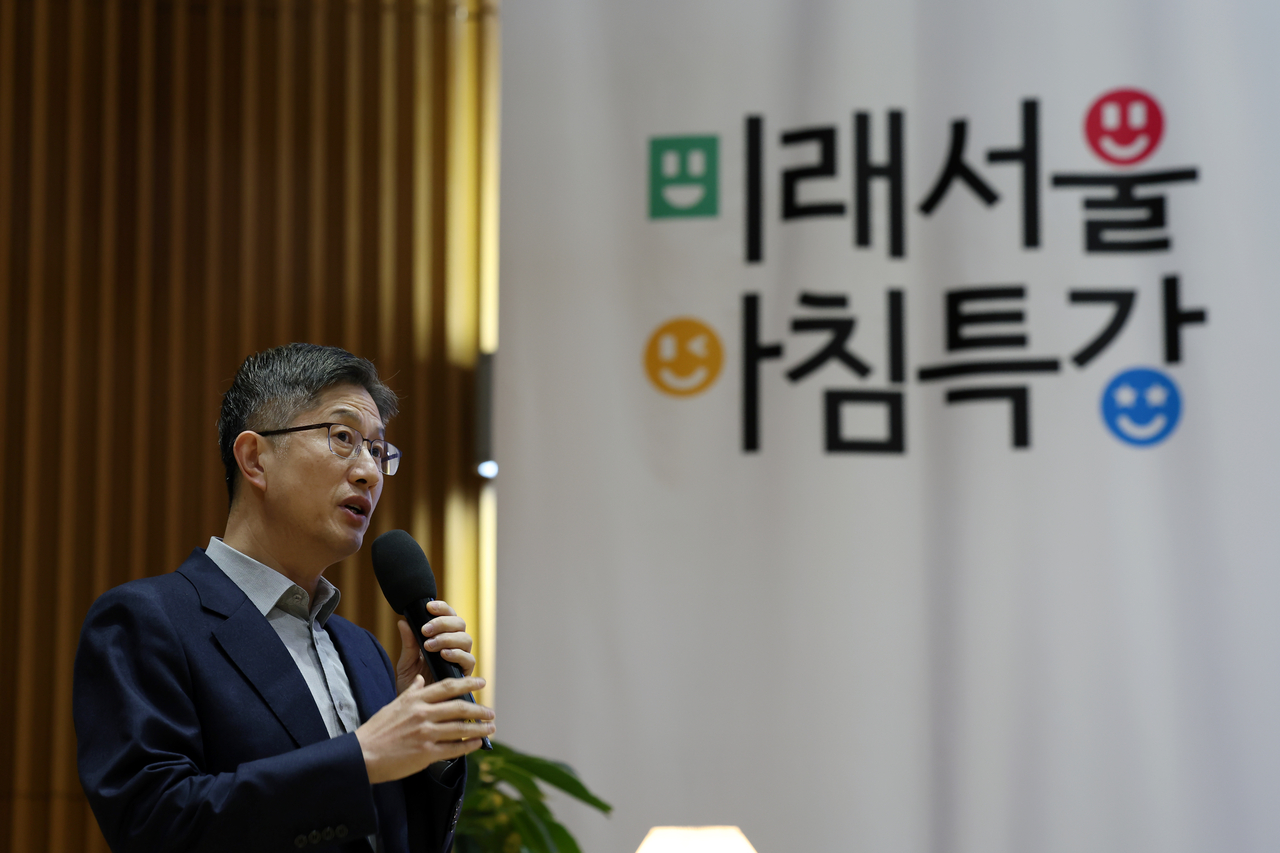
The city held an internal relay lecture Friday morning at the multipurpose hall on the eighth floor of Seoul City Hall under the theme "Urban Spaces Seoul's Autonomous Driving Will Change," part of its "Future Seoul Morning Lecture" series. About 200 people attended, including Seoul Mayor Oh Se-hoon, deputy mayors, directors-general and bureau chiefs, and section-chief-level civil servants.
Last month, Transportation Director Yeo Jang-kwon examined how mobility and traffic systems would change in the autonomous driving era. This lecture, delivered by Disaster and Safety Director Choi Jin-seok, focused on how the city's physical spaces — roads, parking lots, pedestrian areas and housing redevelopment projects — could be transformed.
Choi, who previously served as housing director, head of the urban infrastructure headquarters and head of the urban planning bureau, drew on that experience to outline the policy direction for Seoul's urban spaces in the autonomous driving era.
The central argument of the lecture was that autonomous driving represents not merely a change in transportation technology but a potential catalyst for rethinking the premises of urban planning, city infrastructure and housing redevelopment. As the way vehicles move and park changes, so too will the function of roads and parking lots — and with them, the way the city views zoning and urban planning facilities.
Choi presented five policy concepts for urban space in the autonomous driving era: algorithm zoning, time-based road operations, capillary transit-oriented areas, superblocks and machine-readable landscape districts.
The first concept examined how the basis of urban planning could expand from fixed spaces to time and algorithms. Where current urban planning sets zoning based on land-fixed functions — residential, commercial, business — autonomous vehicles in the future could themselves become "moving buildings" capable of performing a range of functions including commerce, office work, healthcare and leisure.
Adapting to such changes would require new urban planning management to prevent city services from concentrating in specific commercial districts. Choi proposed guiding autonomous vehicles to rotate through non-core commercial areas to prevent them from clustering in high-demand zones in pursuit of profitability and efficiency, and suggested creating docking stations on underused parcels of land.
The way roads are used could also change. Under the time-based road operations concept, a road focused on vehicle traffic during the morning commute could serve as a pedestrian space at lunchtime and a logistics and lifestyle services corridor late at night — redistributing road use flexibly according to demand at different hours of the day. The lecture also proposed minimizing median barriers and pedestrian fences and introducing barrier-free, variable road cross-sections.
The concept of a transit-oriented area could also be broadened. As autonomous mobility support and medical, commercial and lifestyle-cultural services spread to areas outside existing transit zones, accessibility could improve for hillside neighborhoods and low-rise residential areas far from subway stations. Citing lecture materials showing that 32 percent of Seoul's total area is hillside terrain and 18 percent is low-rise residential land distant from stations, Choi proposed that autonomous driving could ease the concentration of city services around transit hubs and expand housing development possibilities.
Development patterns for low-rise residential areas and large-scale redevelopment projects could also change. Under this concept, self-driving cars would drop passengers at shared drop zones on the perimeter of a block, with residents traveling to individual homes by micromobility. Roads and parking spaces designed around per-lot vehicle access could be reduced, and existing roads converted into parks or green corridors.
Using shared drop zones and external or below-ground parking could reduce the amount of parking infrastructure within housing complexes and minimize the scale of underground construction. Rather than bearing the cost of building parking facilities, the approach would involve constructing future mobility infrastructure such as pick-up and drop-off spaces, wireless charging pads and logistics robot tunnels.
New standards for the city's appearance and street design would also be needed, since streets that look beautiful to the human eye may differ from those that autonomous vehicle sensors can read easily. Because signage and highly reflective exterior walls can cause sensor recognition errors, Choi introduced the concept of machine-readable landscape districts — applying non-reflective materials and standardized digital markers on lower floors while allowing varied streetscapes such as media facades and greenery on upper floors.
New urban spaces proposed for the autonomous driving era included curb space, mobility hubs, metropolitan edge transit centers, digital right-of-way, underground space conversion and purpose-built vehicles, or PBVs.
Curb space — where drop-off, delivery and pickup functions become more important than parking — could become a new city asset. The proposal envisions managing limited curb space by the minute for passenger drop-off, logistics and lifestyle services, with differentiated fees based on time of use and purpose, turning it into a public revenue-generating space.
Mobility hubs were also identified as a key priority to reduce so-called ghost traffic — empty self-driving cars circulating slowly through the city center. The idea is to place hubs on the city's outskirts where vehicles can wait, charge, receive unmanned car washes and undergo light maintenance, reducing the problem of empty vehicles occupying downtown roads.
On Seoul's outskirts, the lecture proposed building metropolitan edge transit centers to accommodate autonomous vehicles arriving from the greater Seoul area and other regions and to encourage transfers to public transit. As autonomous driving reduces the burden of long-distance travel, more vehicles could flow into Seoul, making a transfer system at the city's boundaries necessary to absorb that traffic and improve access to the city center.
To address potential traffic deadlock caused by autonomous vehicles repeatedly stopping when they detect pedestrians, the lecture introduced street design approaches using signal-free systems, ecological waterways and stepped planters to accommodate both pedestrian movement and vehicle flow simultaneously.
The conversion of underground space as parking demand declines was also raised as a new challenge. In anticipation of deep basement floors in large office buildings and apartment complexes becoming vacant, the proposal calls for converting existing underground spaces into energy and data hubs.
PBVs were highlighted as a particularly promising alternative for transforming how city services are delivered. Vehicles with spaces and functions customized to their purpose — medical, commercial, office or logistics — would serve as mobile businesses or public facilities. Rather than constructing new public buildings, the concept envisions loading public services such as libraries, health management, care and senior welfare onto vehicles and deploying them where needed.
In housing redevelopment projects, the lecture also introduced the idea of providing PBV-based community services tailored to residents' needs instead of constructing and operating large fixed community facilities. This approach could reduce the cost of building and managing facilities while responding to shifting demand across different neighborhoods and time periods.
The autonomous driving era, however, will not arrive all at once. Lecture materials projected that self-driving vehicles would account for 5 to 15 percent of traffic during an initial mixed-traffic period from 2028 to 2033, rising to 20 to 50 percent during a full mixed-traffic period from 2033 to 2040, and reaching 60 to 80 percent after 2040 when autonomous driving becomes dominant. The materials also noted that traffic speeds could fall by about 30 to 40 percent during the period when conventional and autonomous vehicles share the road.
To address that transition, the lecture stressed the need for infrastructure improvements including dedicated autonomous vehicle lanes with revised road operating rules, ultra-dense platooning through underground roads, 3D city mapping and high-definition road map construction, and information linkages among vehicles, traffic signals and pedestrians. It also raised the possibility of using street furniture, road surfaces and underground spaces for energy production, and converting gas stations into energy production, storage and supply hubs to meet the growing power demands of autonomous vehicles.
In its G3 Seoul Plan — the top-level blueprint for the city's ninth elected administration — the Seoul Metropolitan Government has announced plans to expand its autonomous bus fleet to 500 by 2030 and to begin Level 4 robotaxi demonstrations in the second half of this year. Night operations of an autonomous bus along Cheonggyecheon also began in October.
The Seoul Metropolitan Government launched its Future Seoul Morning Lecture series in 2021 and introduced an internal relay format in October. Under the format, directors-general and bureau chiefs with more than 20 years of field experience address a single future agenda item in turn, each from their own department's perspective. The city plans to regularize the relay lectures going forward, using them to share field experience and policy ideas across bureaus and to discuss Seoul's future vision and concrete policy directions together.
"The commercialization of autonomous driving demands a redesign not just of transportation but of road and underground infrastructure and the entire urban space," Seoul Mayor Oh Se-hoon said. "When directors-general and bureau chiefs who have built long careers in their respective fields share their visions with one another and break down the boundaries between bureaus to put their heads together proactively, the future city of Seoul we envision will come to citizens' daily lives that much sooner."
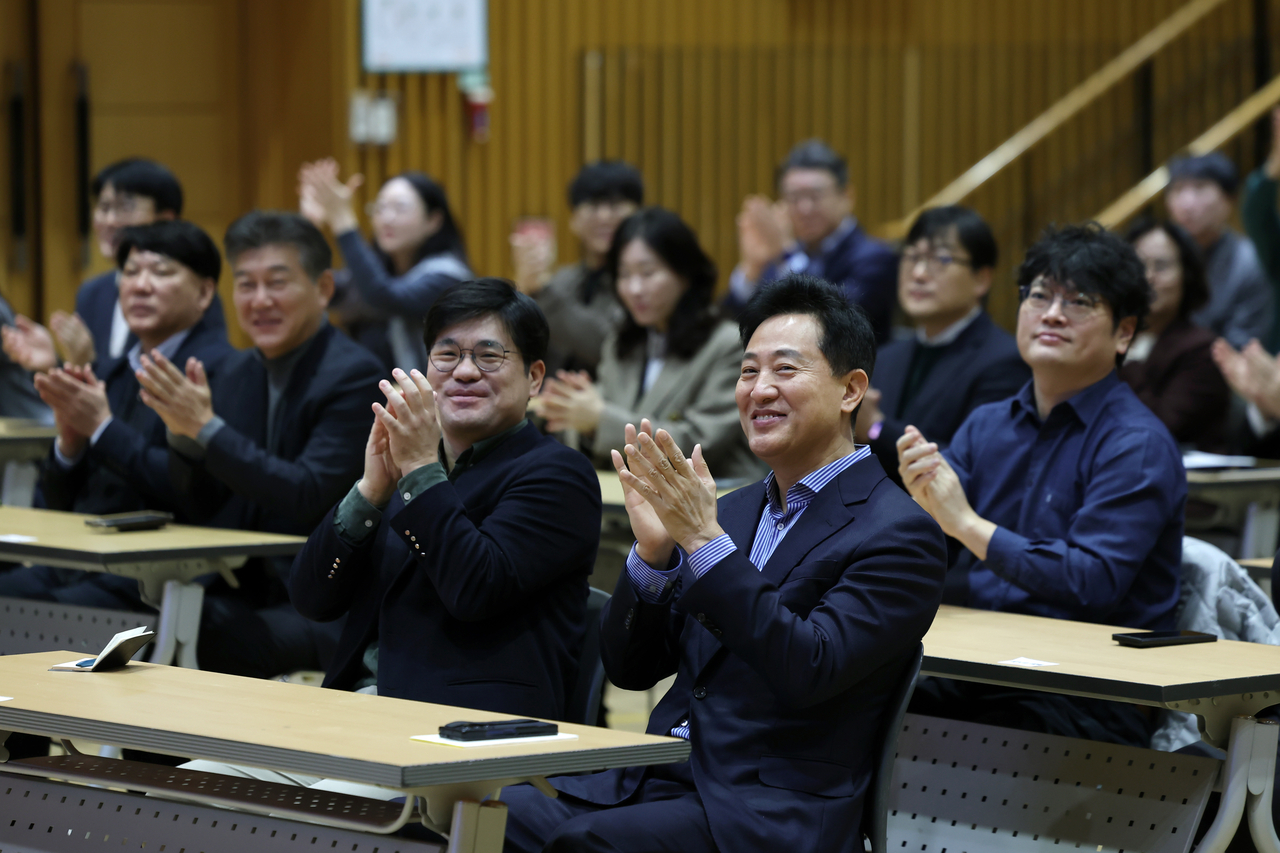
Choi's lecture concluded to applause from Mayor Oh, First Administrative Deputy Mayor Jeong Sang-hun, and other directors-general, bureau chiefs and section chiefs in attendance.
seouldream01@heraldcorp.com





