Buildings account for 75% of greenhouse gas emissions; district focuses on green remodeling, solar power and AI energy management
Designated environmental education city; three of six Seoul innovation technology pilot projects awarded to Nowon-gu
Bicycle culture center, cycling mileage rewards and 1 million-tree urban forest drive everyday carbon reduction
Seoul's Nowon-gu has been stepping up the implementation of its carbon neutrality policy since the start of the ninth elected-term administration, pushing ahead with a broad green transition across the district. From building energy efficiency and AI-based energy management to cycling promotion and urban forest development, the district is weaving carbon-reduction measures into daily life and city infrastructure.
Nowon-gu was designated a carbon-neutral pioneer city in 2024 and this year was selected as a "2026 Environmental Education City" by the Ministry of Climate, Energy and Environment. The district also secured three of six projects under Seoul's Climate Change Response Innovation Technology Pilot Support Program — the highest count among all autonomous districts in the city.
Building on those achievements, the district is pursuing carbon neutrality policies aimed at cutting greenhouse gas emissions by 350,000 tons by 2034. It has identified the building sector — which accounts for roughly 75 percent of total emissions — as the primary area for reduction, concentrating efforts on improving energy efficiency, expanding renewable energy and building resident-participatory green infrastructure.
**Building energy efficiency — cuts spanning public and private sectors**
Given Nowon-gu's character as a densely residential district, officials consider progress in the building sector decisive for the success of its carbon neutrality drive. The district is strengthening green remodeling of public buildings and integrated energy management.
A project is underway to raise the building energy disclosure rating of the Nowon Lifelong Education Institute from C to B or above by 2027. The number of public buildings covered by integrated energy management will also expand from 20 sites in 2026 to 60 in 2027, with a target of reducing energy consumption by 10 percent compared with 2025 levels.
Cost savings from efficiency improvements have already materialized. The Green Building Support Center adjusted contracted electricity capacity at 10 sites, cutting annual basic electricity charges by 58 million won ($43,200).
The district is also pushing to expand renewable energy. A building-integrated photovoltaic installation project for the district office will proceed through structural review and preliminary design in 2026, with completion targeted for 2027. Solar panels will be newly installed at 16 public buildings and public parking lots, and a mandatory solar installation requirement for public parking lots of 1,000 square meters or more will be proactively incorporated into planning.
A "Nowon-style Green Home Package" will support energy efficiency upgrades in private housing. Targeting homes more than 20 years old, the program bundles high-efficiency insulated windows and heat-recovery ventilation units; recipients on basic livelihood assistance or the near-poverty tier can receive support covering up to 80 percent of total construction costs. Green remodeling of early childhood and youth education facilities and an energy efficiency improvement program for low-income households will run in parallel.
**Environmental education city designation and innovation technology pilots strengthen policy foundation**
Nowon-gu is expanding its carbon neutrality policy beyond administrative initiatives toward resident participation and hands-on practice.
Having been selected as a "2026 Environmental Education City" under a program run by the Ministry of Climate, Energy and Environment, the district will hold that designation for three years. Under the vision of "Nowon — a sustainable environmental learning city built together through connection and practice," the district is pursuing three strategic pillars: strengthening the foundation of a sustainable educational community, building residents' capacity to practice carbon neutrality, and expanding access to environmental education.
The Nowon Eco Center, the Jungnangcheon Environment Center and the Nowon Energy Zero Housing EZ Center will serve as environmental education hubs. Participatory programs — including "Our Village Carbon Zero Living Lab," "Green Living Practice School" and "10 Pledges for Carbon Neutrality by Citizens" — are designed to encourage residents to reduce carbon emissions in their daily lives.
On the technology front, three projects selected under Seoul's Climate Change Response Innovation Technology Pilot Support Program secured a combined budget of 530 million won.
The three selected projects are: "AI Power Management for Public Buildings," targeting a 30 percent reduction in energy use and electricity bills at the Hannae Forest of Wisdom small library; an "Urban Virtual Power Plant" linking the Nowon EZ House and Seoul National University of Science and Technology to store surplus solar power in electric vehicle batteries and feed it back to buildings; and "AI-Edge Lighting Upcycling," which replaces control devices on existing streetlights and park lights at Sanggye Nadeuri Azalea Garden to enable automatic control.
The district said it achieved the highest project-selection count among autonomous districts by identifying and proposing projects suited to local conditions from the demand-survey stage Seoul conducted in March.
In September, about 1,000 residents and 50 organizations took part in the "2026 Nowon Carbon Neutrality Citizens' Declaration" along the stretch from Nowon Station intersection to the district office. Participants declared 10 carbon neutrality agenda items, including expanding youth participation in climate policy, guaranteeing rest rights for outdoor workers during heat waves, supporting urban solar installations, promoting reusable containers and eco-friendly stores, incorporating carbon neutrality budgets into festivals and pursuing a waste-free election culture.
**Bicycle culture center and cycling mileage rewards spread a carbon-cutting transport culture**
In the transport sector, promoting bicycle use is a core policy priority.
Nowon-gu, which in 2015 became the first autonomous district in Seoul to enroll residents in a bicycle safety insurance program, is preparing to officially open the Nowon-gu Bicycle Culture Center in the first half of next year — the first multipurpose bicycle cultural space in Seoul.
The center will feature a bicycle café on the second floor, a bicycle experience hall on the third floor, a multipurpose education hall on the fourth floor and a rooftop rest area. It is intended to serve as a hub for spreading cycling as a lifestyle, combining bicycle experience content, riding safety education and instruction on cycling culture and carbon neutrality.
In 2027, the district will also become the first autonomous district in Seoul to launch a "Bicycle Riding Mileage" program, which uses a smartphone app to track cycling distance and awards incentives such as local currency based on accumulated kilometers.
Bicycle parking infrastructure is being expanded as well. Parking capacity has been secured at major subway stations: 391 spaces at Nowon Station, 353 at Sanggye Station, 323 at Junggye Station, 241 at Madeul Station and 164 at Taereung Ipgu Station. Because parking near Sanggye Station falls short of demand, an existing bicycle rental facility there will be converted into a parking facility by January 2027 to address illegal parking and improve the pedestrian environment.
**1 million trees for a living forest — green spaces planted and tended by residents**
A "Plant 1 Million Trees" project to expand carbon absorption is another pillar of the district's carbon neutrality policy.
Since 2025, Nowon-gu has been carrying out a five-year mid-to-long-term project to develop neighborhood and school forests as part of a broader urban living-forest initiative. The second phase proceeded this year, and the third phase will follow next year.
The project takes a resident-participatory approach, with residents, students and parents planting and tending trees in unused spaces at apartment complexes, schools, kindergartens and daycare centers. Sites are prioritized where the planting area is at least 50 square meters and where large trees with high carbon-absorption capacity can be planted.
After the forests are established, resident association representatives or school principals are required to serve as maintenance managers for five years, ensuring the project builds a sustained management system rather than stopping at planting.
Sites are selected based on criteria including openness, public accessibility, utilization potential, the urgency of climate-change response, site suitability, resident participation potential and maintenance plans. Areas where voluntary gardening clubs or volunteer groups have already formed are given priority, with the aim of spreading a resident-led green space management culture.
**14 projects through 2030 — setting a standard for carbon-neutral governance**
Nowon-gu completed a master-plan consulting project for its carbon-neutral pioneer city initiative in March 2026 and passed a central investment review in July. Detailed design and preliminary development work began in September, and on that basis the district will move into full implementation of 14 carbon-neutral pioneer city development projects through 2030.
In the resource-circulation sector, the district will foster social enterprises specializing in reusable containers. It will also identify and pilot carbon-reduction ideas from everyday settings through a "Carbon Neutrality Green Society Transition Donut Action" — which links citizen-expert training with participation in reduction projects — and a "Carbon Transition Living Lab" involving seven universities and neighborhoods within the district.
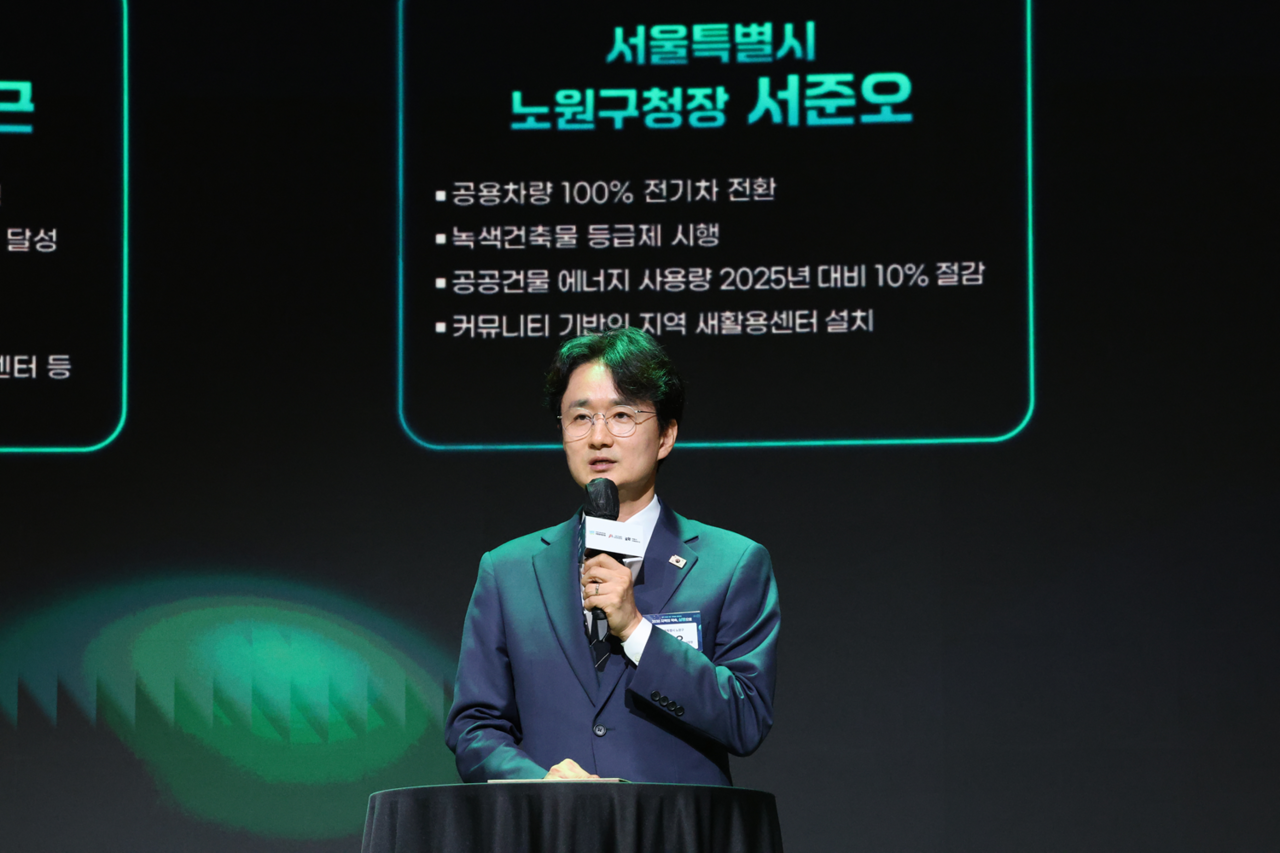
At the citizens' declaration in September, District Mayor Seo Jun-o said the district would "lead real change together with residents across every area of the city — architecture, energy, transport and resource circulation — to realize a carbon-neutral pioneer city that represents the Republic of Korea."
When the innovation technology pilot projects were selected in November, Seo said the district would "present a standard for carbon neutrality policy in the Republic of Korea by achieving successful pilots that allow innovation in carbon neutrality and energy management to perform at its fullest."
Nowon-gu intends to translate carbon neutrality from a declaration into concrete urban policy by linking building energy efficiency, innovation technology pilots, resident participation, green transport and urban forest development into a coherent whole.
seouldream01@heraldcorp.com