
2026 BOK International Conference
Princeton professor Markus Brunnermeier presents
A trilemma in the age of cashless digital payments
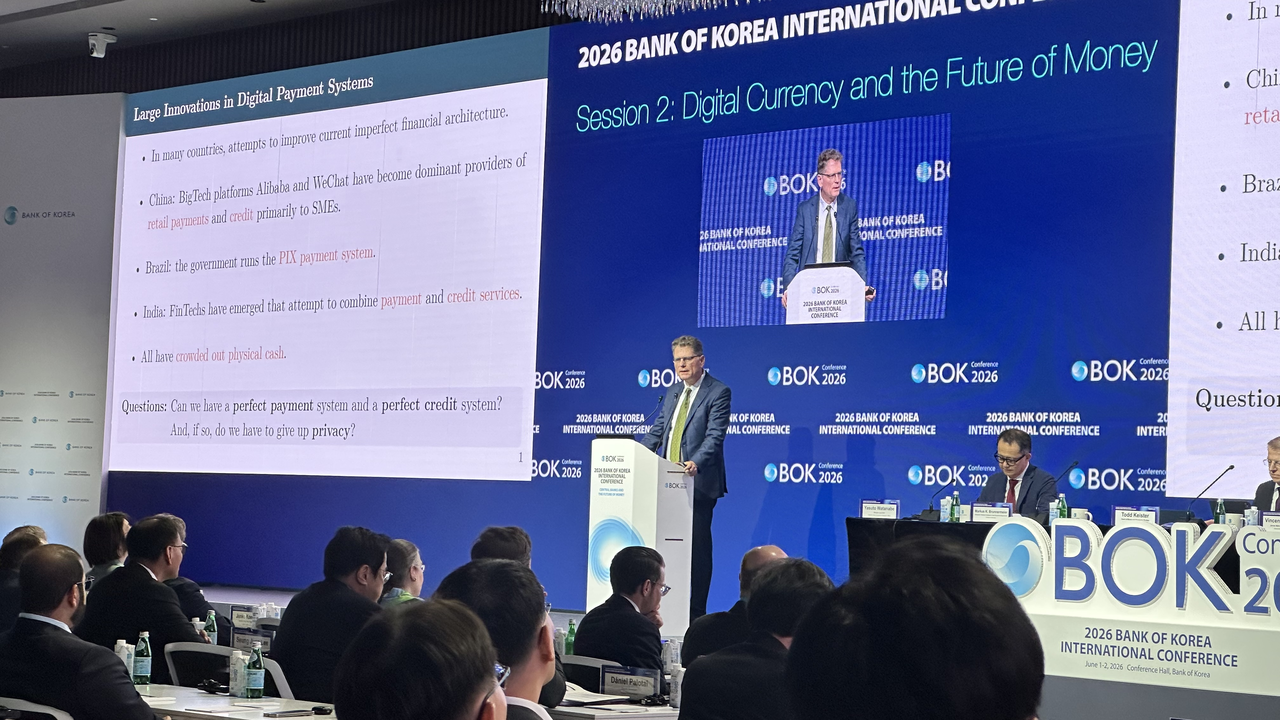
"Payment system innovation is advancing worldwide. Stablecoins are part of that conversation, but physical cash is steadily being pushed aside."
Princeton professor Markus Brunnermeier made the remarks Monday at the 2026 BOK International Conference, held at the Bank of Korea annex conference hall in Jung-gu, Seoul.
Presenting on the theme of "The Trilemma of Payments, Credit and Digital Currency," Brunnermeier said that in a digital payments environment, three goals — perfect payment efficiency, perfect credit supply and perfect privacy — cannot be achieved at the same time.
Brunnermeier said digital payment systems have evolved beyond simple transaction tools into core financial infrastructure that integrates credit assessment and lending functions. Big tech platforms such as China's Alibaba and WeChat already bundle payments with loan services, and Brazil's Pix and India's fintech sector are moving in a similar direction, he said.
The trade-offs vary sharply depending on who operates the system. Big tech platforms can expand unsecured credit supply by leveraging internal payment data and transaction records, but that comes with risks of monopolization and privacy violations. Competitive private payment systems, by contrast, can lower transaction costs and promote competition, but may weaken credit supply because enforcing loan repayment becomes more difficult.
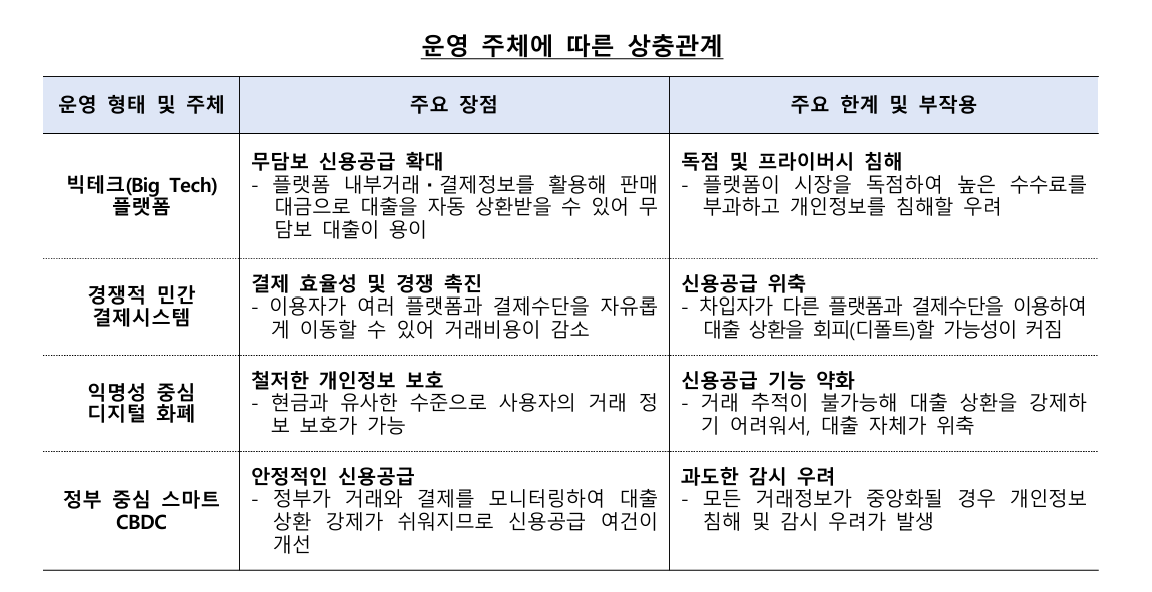
Anonymous digital currencies offer stronger privacy protections, but Brunnermeier said that comes at the cost of weaker credit supply. The harder it is to trace transactions, the greater the risk of default and the more difficult it becomes to enforce loan repayment.
Government-issued smart central bank digital currencies, or CBDCs, also carry trade-offs, he said. Centralized management of transactions and payments can improve credit supply conditions, but concentrating all transaction data in one place raises concerns about excessive surveillance and privacy violations.
"The key questions are how much interoperability to allow between payment systems, how much privacy to guarantee, and how tightly to link the credit system with the payment system," Brunnermeier said. He argued that these trade-offs among competing goals must be fully considered when designing future CBDCs and public digital payment systems, and when setting policy for private payment systems.
Brunnermeier illustrated how a unified digital payment system can strengthen credit supply by comparing it to an automatic repayment structure linked to a salary account. Just as automatic deductions from the account where a borrower's wages are deposited make repayment hard to avoid, a similar enforcement mechanism can operate within a digital ledger, he said.
Conversely, he said the emergence of additional digital payment instruments — such as CBDCs alongside existing systems — could weaken the credit mechanism. Borrowers could issue IOUs within the digital ecosystem to obtain funds and then receive actual payments through an alternative means of settlement. In that case, the flow of funds would bypass the existing digital ledger, making loan repayment harder to enforce. "Higher interoperability could actually be a problem if the goal is to expand unsecured lending to small and medium-sized enterprises," Brunnermeier said.
He also pointed to the practical limits of anonymity in digital payments. Most systems amount to a "black box" arrangement in which governments or platform operators retain data but do not disclose it — making it difficult to achieve the same level of anonymity as physical cash. "Privacy in the real world is not 100 percent privacy," he said, adding that the black box can be opened in exceptional circumstances, such as for anti-money laundering purposes.
![“네이버·카카오·토스 기술력은 충분한데” AI가 사람 대신 결제, 한국서 늦어지는 이유는? [크립토360]](https://wimg.heraldcorp.com/news/cms/2026/05/30/news-p.v1.20260529.416410f041d149fba659367d3a96d7b6_T1.png)
kyoung@heraldcorp.com





