May collective building multi-ownership index falls to 16.137%
Ownership index, meanwhile, reaches all-time high since records began
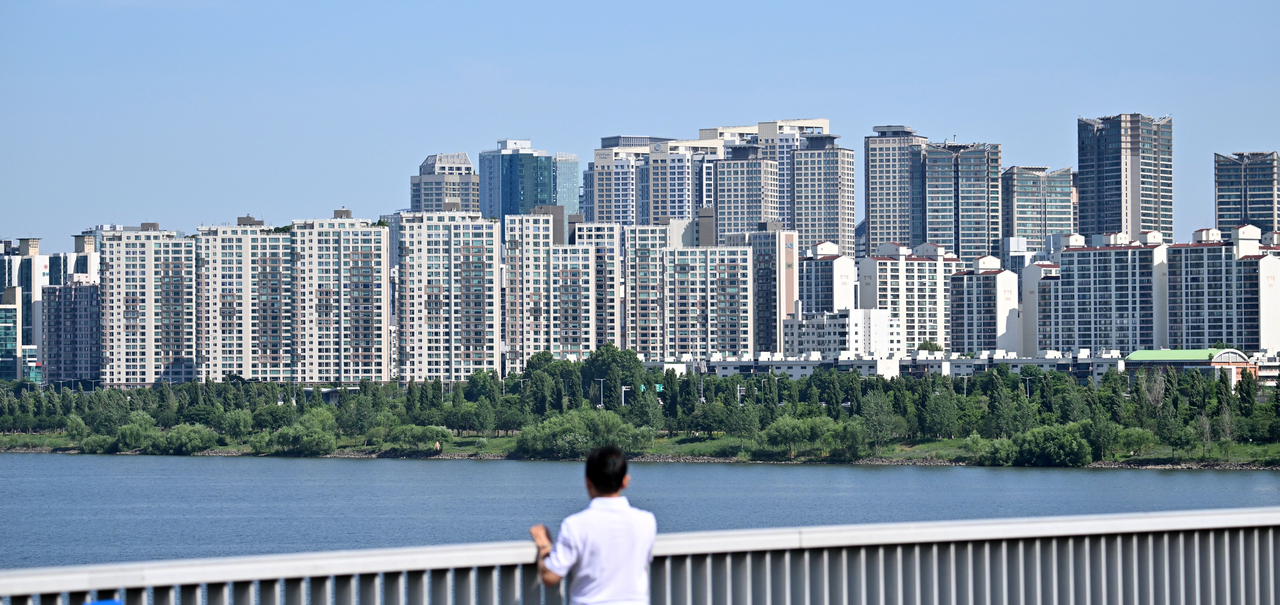
The share of multiple-home owners fell to its lowest level since January 2022 in May, as the capital gains tax surcharge on multi-home ownership took effect May 10. Analysts say owners moved to sell ahead of the surcharge, steadily pushing the ratio down. At the same time, the share of people who own at least one home hit an all-time high, as first-time buyers and upgrade purchasers snapped up properties that multi-home owners had listed.
According to the Court Registry Information Plaza on Sunday, <style ref="s0">the national collective building multi-ownership index — covering apartments, townhouses, multi-family homes and officetels — stood at 16.137% in May</style>. The index measures the share of collective building owners who hold two or more units. Because the data are based on registered transactions, the May figure is understood to reflect contracts signed between February and April, when the announced surcharge began driving selling activity.
Last month's multi-ownership rate of 16.137 percent was down from the previous month's 16.211 percent, making it the lowest since January 2022 (16.131%), when the Moon Jae-in administration was tightening regulations on multi-home ownership. The collective building multi-ownership index stood at 16.469% in the same month last year, edged up slightly to 16.475% in June, then fell for 11 consecutive months through last month. The sustained decline reflects multi-home owners moving preemptively to sell since the Lee Jae Myung administration took office last June, amid concerns over an expanding tax burden.
The share of two-home owners fell to 11.155 percent last month, down 0.189 percentage points from 11.344 percent in the same month last year. The share of three-home owners also shrank, from 2.599 percent to 2.536 percent, a decline of 0.063 percentage points over the same period.
The collective building ownership index, by contrast, reached its highest level since the statistic began being compiled in January 2010. The index measures the share of the population that owns at least one collective building unit. It rose to 28.26 percent last month, up 0.69 percentage points from 27.57 percent in the same month last year.
The increase reflects purchases by both existing single-home owners trading up and first-time buyers absorbing properties that multi-home owners had listed. First-time collective building buyers in Seoul numbered 7,341 in April, up 12 percent from 6,554 in January. In Gyeonggi Province, first-time buyers jumped 26.9 percent over the same period, from 10,308 to 13,076.
In addition, soaring apartment prices have concentrated homebuying demand in villas — low-rise multi-family homes — where redevelopment projects are under way, also contributing to the rise in the ownership index.
Analysts expect the multi-ownership index, which has been falling, to stabilize for now, while the ownership index continues to climb. With the capital gains tax surcharge now fully in force, multi-home owners who did not sell before the deadline are expected to hold their properties, while the jeonse and monthly rent shortage is seen as keeping first-time buyer demand persistently high.
Seoul apartment listings stood at 61,630 as of Saturday, according to real estate platform Asil — nearly 20,000 fewer than the year's peak of 80,080 on March 21, a drop of close to 20,000 in roughly two months. The government expanded eligibility for "tenanted-unit sales" to include single-home owners in an effort to ease the listing shortage caused by the surcharge, but available inventory has continued to fall.
"Multi-home owners currently have no reason to list their properties, while demand from people seeking to buy their first home is rising — so the ownership index has room to keep climbing," said Yoon Su-min, a senior real estate specialist at NH NongHyup Bank. "Expectations for villa redevelopment projects in Seoul, sustained by the local election results, are also drawing more buyers into that segment, which is another factor pushing the ownership index higher."
hwshin@heraldcorp.com