Nvidia CEO visits Hyundai Motor Group's Yangjae headquarters Monday after Sunday naengmyeon lunch
Fourth meeting between the two in less than a year since last year's 'Kkanbu' dinner
Talks expected to cover autonomous driving, AI factory and robotics cooperation
In-vehicle AI chips, digital twins and Atlas humanoid robot upgrades also on the agenda
![Nvidia CEO Jensen Huang and Hyundai Motor Group Chairman Euisun Chung make their way to a lunch meeting at Woo Lae Oak in Jung-gu, Seoul, on Sunday. [Newsis]](https://wimg.heraldcorp.com/news/cms/2026/06/08/news-p.v1.20260608.94594d9871314f70a0c041f171320660_P1.jpg)
Nvidia CEO Jensen Huang is meeting Hyundai Motor Group Chairman Euisun Chung on consecutive days during his visit to South Korea. After a private meeting Sunday at Woo Lae Oak restaurant in Jung-gu, Seoul, Huang is scheduled to visit Hyundai Motor Group's headquarters in Yangjae-dong, Seocho-gu, on Monday. The two executives, who drew wide attention last year with their so-called "Kkanbu dinner," are meeting again at Hyundai's main campus, raising expectations that their partnership spanning autonomous driving, robotics and smart manufacturing could move into a more concrete phase.
According to industry sources, Huang will visit Hyundai Motor Group's Yangjae office in Seocho-gu on Monday afternoon to meet with Chung.
The Yangjae headquarters underwent a full renovation of its common areas over roughly 23 months. About 36,000 square meters of space — from the first basement level to the fourth above-ground floor — were redesigned, transforming the building into a "robotics-friendly" facility where robots tend indoor gardens, deliver beverages and patrol the premises. The campus effectively serves as a testbed for Hyundai Motor Group's software-defined vehicle, robotics and physical AI strategies.
If the Yangjae meeting goes ahead, it will mark the fourth time Chung and Huang have met in less than a year since October last year. The two first came together that October, when Huang visited South Korea and joined Samsung Electronics Chairman Lee Jae-yong for dinner at Kkanbu Chicken in Samseong-dong, Gangnam-gu, Seoul.
![The atrium at the center of the lobby at Hyundai Motor Group's Yangjae headquarters [Hyundai Motor Group]](https://wimg.heraldcorp.com/news/cms/2026/06/08/9/news-p.v1.20260515.ab4f6db3d0bd4f649916df7d8f46db49_P1.jpg)
Since that dinner, Hyundai Motor Group and Nvidia signed an MOU to strengthen domestic physical AI capabilities, then reunited at CES 2026 in Las Vegas in January to significantly broaden the scope of their cooperation. On Sunday, Huang and Chung shared a meal at Woo Lae Oak in Jung-gu, Seoul.
The two companies plan to invest approximately $3 billion to establish an Nvidia AI technology center, a Hyundai Motor Group physical AI applications center and a regional data center in South Korea. The initiative aims to deepen exchanges between Nvidia engineers and Hyundai Motor Group's technical staff while contributing to the development of next-generation physical AI talent in Korea.
At the core of the partnership is integrating Nvidia's high-performance GPUs and AI software platforms into Hyundai Motor Group's real-world industrial assets — vehicles, factories and robots.
Operational cooperation moves to Yangjae: autonomous driving platform upgrade on the table
Industry watchers expect Monday's Yangjae meeting to review progress on existing commitments and explore concrete steps to expand cooperation in autonomous driving and robotics.
The most immediate item on the agenda is upgrading the autonomous driving platform. Hyundai Motor Group is pushing ahead with its transition to software-defined vehicles while accelerating in-house development of autonomous driving technology. A key focus is expected to be how Nvidia's automotive AI computing platform and autonomous driving reference architecture can shorten development timelines and strengthen safety verification frameworks.
![A Dali Delivery robot delivers beverages at Hyundai Motor and Kia's Yangjae headquarters. [Hyundai Motor Group]](https://wimg.heraldcorp.com/news/cms/2026/06/08/news-p.v1.20260514.0c8e1de3ca224358a349adf7780d31c7_P1.jpg)
Nvidia's Drive Hyperion platform is particularly relevant to Hyundai Motor Group's next-generation autonomous driving development. Drive Hyperion bundles high-performance automotive computing chips, sensors including cameras, radar and lidar, and a vehicle operating system with an autonomous driving software stack into a single platform. Hyundai Motor Group is working to build an autonomous driving architecture based on Drive Hyperion that can scale from Level 2-plus advanced driver assistance systems to Level 4 robotaxis over the medium to long term.
Hyundai Motor Group is also reviewing the adoption of Nvidia's autonomous driving software platform Alpha Mayo. Alpha Mayo uses virtual driving data and inference-based AI models to sharpen autonomous decision-making. Analysts say pairing it with Hyperion 10 could accelerate Hyundai Motor Group's post-L2+ strategy.
![A Dali Gardener robot waters plants in the lobby of Hyundai Motor and Kia's Yangjae headquarters. [Hyundai Motor Group]](https://wimg.heraldcorp.com/news/cms/2026/06/08/news-p.v1.20260515.d2b934a6e44448cca6b3a7ec788885b4_P1.jpg)
Motional, Hyundai Motor Group's autonomous driving joint venture in the United States, is also expected to feature prominently in the discussions. Hyundai Motor Group is combining its own software-defined vehicle capabilities with Motional's robotaxi technology and 42dot's software development expertise to sharpen its autonomous driving edge. Adding Nvidia's automotive AI semiconductors and simulation platforms could further enhance a development framework that draws on both real-world road data and virtual driving data.
From in-vehicle AI chips to AI factories: linking Hyundai's production and development systems
The next-generation product lineup Huang highlighted during his visit also points to expanded cooperation with Hyundai Motor Group. On Friday, Huang said he had brought "four new Nvidia businesses as a great gift to Korea," citing the next-generation AI supercomputer platform Vera Rubin, the new CPU Vera, the AI PC platform RTX Spark, and a processor line for self-driving cars and AI computing.
Of these, the processor line for autonomous vehicles and AI computing is the most directly relevant to Hyundai Motor Group. High-performance automotive AI semiconductors are essential for handling in-vehicle tasks such as driving decisions, safety functions, infotainment and personalized AI services.
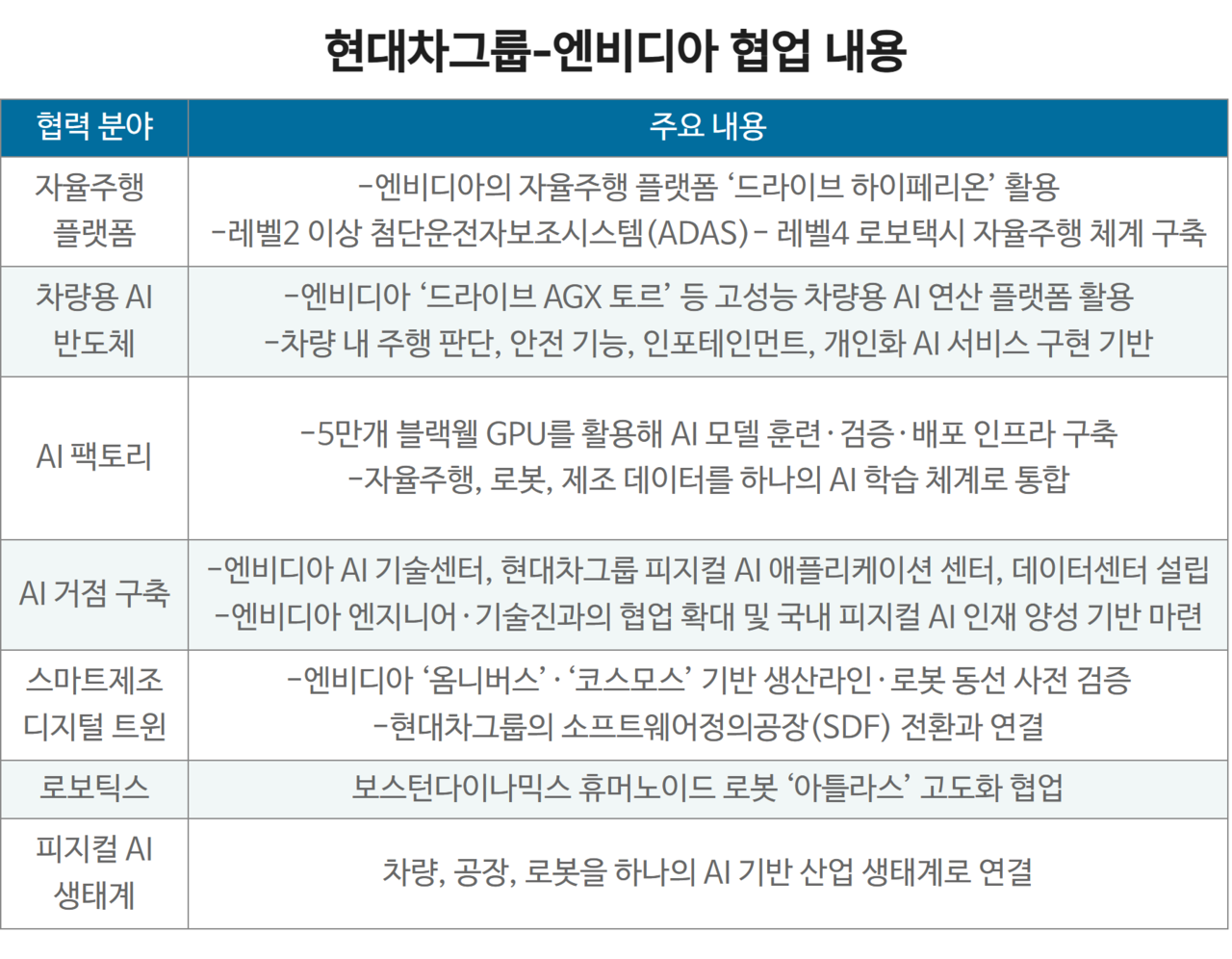
AI factory cooperation is another major agenda item. Hyundai Motor Group and Nvidia have agreed to build infrastructure using 50,000 Blackwell GPUs capable of training, validating and deploying integrated AI models.
On the manufacturing side, software-defined factory and digital twin collaboration are closely intertwined. Hyundai Motor Group is pursuing a software-defined factory transition that reorganizes production lines around software to make facility operations more flexible and shorten vehicle development and mass production timelines. Nvidia's Omniverse and Cosmos platforms can replicate actual factories in virtual environments, allowing production processes, robot movement paths and equipment layouts to be verified in advance.
Atlas upgrade also a key agenda item
Robotics is another central area of cooperation. Hyundai Motor Group is working through Boston Dynamics to upgrade its Atlas humanoid robot. Deploying humanoid robots in automotive factories and logistics facilities will require physical AI capabilities that allow robots to perceive their surroundings, make independent judgments and move accordingly.
![Nvidia CEO Jensen Huang and Hyundai Motor Group Chairman Euisun Chung leave Woo Lae Oak restaurant in Jongno-gu, Seoul, after their meal on Sunday. [Provided by reader. Redistribution and DB use prohibited] [Yonhap]](https://wimg.heraldcorp.com/news/cms/2026/06/08/rcv.YNA.20260607.PYH2026060705340000301_P1.jpg)
An internal reorganization at Hyundai Motor Group is also drawing attention in the context of the expanding partnership with Nvidia. The group is consolidating its autonomous driving, software-defined vehicle and robotics capabilities under its Advanced Vehicle Platform division. Park Min-woo, head of the AVP division and CEO of 42dot, is a former Nvidia executive who had direct lines of communication with Huang. The recent integration of the Robotics Lab under the AVP division is accelerating the push to unify autonomous driving and robotics technology under a single physical AI strategy.
At the "2026 CEO Investor Day" in April, Park said the standard sensor combination for autonomous driving — cameras, radar and lidar — proposed by Nvidia "is sufficient to validate a wide range of driving scenarios." He added that "applying the same sensor architecture across Motional, 42dot and Hyundai Motor and Kia production vehicles would allow data collected from each vehicle to be shared, significantly increasing the value of group-wide data learning."
kwater@heraldcorp.com