![Dealers work at the trading room of Hana Bank's headquarters in Seoul on Monday, after a circuit breaker was triggered on the Kospi amid a sharp market selloff. [Yonhap]](https://wimg.heraldcorp.com/news/cms/2026/06/08/rcv.YNA.20260608.PYH2026060803430001300_P1.jpg)
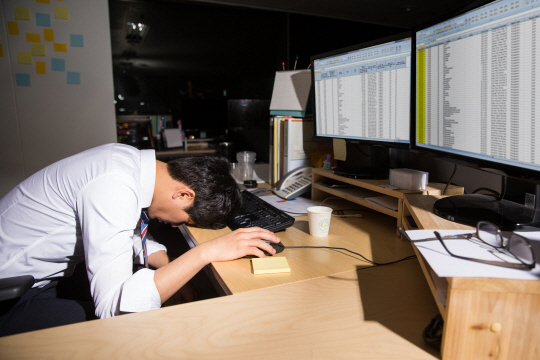
South Korea's stock market is facing a "triple high" crisis. With the won-dollar exchange rate surging to its highest level since the global financial crisis, mounting pressure from elevated interest rates and rising oil prices has sent the Kospi — which had only recently broken into the 8,000-point era — tumbling to the low-to-mid 7,000s.
Adding to the pressure, the record-scale initial public offering of Elon Musk's SpaceX is emerging as a global liquidity "black hole," raising fears that the capital underpinning South Korea's market could drain away rapidly. Some analysts warn that Monday's rout may not be a short-term correction but the start of a broader trend reversal.
The won opened at 1,555.2 won per dollar at 9 a.m. Monday in Seoul's foreign exchange market, up 16.1 won from the previous session's daytime closing price of 1,539.1 won. It was the highest opening rate since March 6, 2009 — during the global financial crisis — when the rate stood at 1,590 won.
The won had closed the daytime session on Thursday at 1,539.1 won but finished overnight trading 19.9 won higher at 1,559.0 won. At one point during overnight trading, it touched 1,561.5 won — the highest level since March 6, 2009, when it reached 1,597.0 won.
Market participants point to heavy foreign selling as the primary driver of the recent exchange rate surge. Foreign investors have net sold approximately 118 trillion won ($76.5 billion) worth of domestic shares on the main bourse so far this year. They offloaded roughly 44 trillion won in May alone and recorded net sales of about 18 trillion won in just four trading sessions into June.
On Monday, foreign investors continued their exit, dumping more than 300 billion won in net sales in early trading. Individual investors net bought approximately 200 billion won, while institutional investors net purchased around 140 billion won.
The Kospi plunged more than 8 percent, triggering a circuit breaker that halted trading. Korea Exchange suspended trading on the main board for 20 minutes starting at 9:03:42 a.m. At the time of the halt, the Kospi stood at 7,474.74, down 685.85 points, or 8.40 percent, from the previous session.
A key concern is the self-reinforcing dynamic between the exchange rate and foreign capital flows. Analysts warn that a vicious cycle could take hold: foreign outflows push the won lower, while a weaker won amplifies currency-loss fears and triggers further selling.
A rising exchange rate also complicates monetary policy. Authorities typically defend the currency by raising interest rates, but higher rates tighten liquidity and increase corporate borrowing costs — a direct headwind for equities.
Rising global oil prices are compounding the problem. Higher oil prices fuel inflation, which in turn raises the case for further rate increases. The combination of a weak won and elevated oil prices could ultimately create a feedback loop of rate pressure that weighs on the market.
The concentration of global investment flows into large-cap US growth stocks and mega-IPOs is adding another layer of strain on the domestic market.
SpaceX, Elon Musk's space company, is the most prominent example. The company is pursuing what would be the largest IPO in history, drawing intense interest from investors worldwide. Market estimates suggest investor demand has reached roughly $150 billion — about twice the targeted offering size.
Securities industry analysts say the SpaceX IPO could act as more than just a single listing — it could function as a black hole absorbing global liquidity. Large institutional investors raising cash to participate in the offering may reduce their exposure to emerging-market equities in the process, analysts said, adding further supply-demand pressure on a Korean market already contending with sustained foreign selling.
Authorities are closely monitoring the situation. Korea Exchange convened an emergency market review meeting Monday to discuss measures to address rising volatility in domestic and overseas markets. The exchange plans to intensify scrutiny of unfair trading practices that exploit market uncertainty and strengthen surveillance of illegal short selling.
Korea Exchange Chairman Jeong Eun-bo urged officials at the meeting not to let their guard down. "We must focus all our efforts on stable market operations so that we can respond swiftly to sudden market swings," he said.
Experts expect the trajectory of the exchange rate, interest rates and oil prices to remain the key variables shaping the domestic market's direction for now. Most forecast that volatility will persist until there are clear signs of improvement in foreign investor flows and exchange rate stabilization.
Lee Sang-jun, a researcher at NH Investment, said rising oil prices driven by fears of a Strait of Hormuz blockade are a key factor behind the current inflationary pressure. "The market is now in a position where it could react even more sensitively to future inflation data and shifts in monetary policy," he said.
Lee Young-won, a researcher at Heungkuk Securities, said inflation and the resulting rise in interest rate burdens represent the biggest obstacle to AI growth, which requires massive sustained investment, and are the key variables determining the scale and pace of benefits flowing to the semiconductor industry. "For the AI industry, where investment on an almost unimaginable scale has been announced, rising interest rates are likely to grow into a core issue that goes beyond the cost of financing — one that determines whether the entire endeavor is sustainable," he said.
th5@heraldcorp.com
hajun825@heraldcorp.com