School violence survival game, Part 5: A student's view
A zero-tolerance approach to school violence has turned classrooms into a ruthless survival game. As even minor disputes are funneled into school violence committees, the number of hearings has surged — yet the most common outcome is a finding of "not school violence," paralyzing schools' ability to resolve conflicts on their own. Caught in a proxy legal war waged by parents desperate to protect their children's university prospects, students have abandoned apology and reconciliation in favor of collecting evidence against each other. This series examines the structural contradictions of a school violence regime that has lost sight of its core purpose — protecting victims — and become mired in legalism, told through four conflicting perspectives: parents, lawyers, teachers and students.
![A student is excluded from a group chat. [Image generated via ChatGPT]](https://wimg.heraldcorp.com/news/cms/2026/06/14/news-p.v1.20260610.f37a1375c51d4fae9991b0494edb68f3_P1.png)
By Kim Yong-jae, The Herald Business
"When there's a fight, everyone files a report first. If you apologize too soon, you get labeled the aggressor. There's a pervasive feeling in the classroom that if you just take it, you lose."
A, a 20-year-old repeat college entrance exam candidate, offered that bleak assessment when asked about the school violence system. What started as petty teasing and name-calling in a group chat ended with a school violence committee hearing after the other student's parents filed a complaint — and a written-apology sanction entered into A's school record.
"I was the one who got hurt too, but in the end the record only went into my file," A said. "All through my senior year I was searching online, terrified that one entry would cost me my university admission. It was hell."
The biggest change the school violence regime has left on students is not a heightened awareness of harm — it is a defensive instinct. A culture of reaching for a report before an apology, and securing evidence before seeking reconciliation, has taken root in classrooms across the country.
'When I fight with friends, the first thing I do is screenshot the Instagram DMs'
The erosion of friendship begins with the routine collection of digital evidence. In 2025, verbal abuse accounted for 32.5 percent of all school violence committee hearings at high schools nationwide, and cyberbullying for 13.4 percent — together nearly half the total caseload.
B, a second-year middle school student who faced a school violence committee over a falling-out with friends, said everyone screenshots first when a fight breaks out. "KakaoTalk conversations and Instagram DMs can become evidence at any time, so nobody deletes them carelessly," she said. She added that she had expected a simple reconciliation to end the matter, but the situation escalated when the parents got involved. "From that point on, it felt like we weren't friends anymore — we were opposing parties."
Students are learning how to document before they learn how to resolve conflict. Those records ultimately became weapons for mutual counter-reports, and words that were once jokes on one day increasingly became school violence on another.
Going through a school violence committee leaves its own lessons. C, a second-year high school student in Gyeonggi Province who experienced the process, said she felt humiliated when committee members read her KakaoTalk messages aloud. "Instead of thinking about what I did wrong, I found myself calculating what to say to make things look less bad for me," she said.
'If you want to improve your ranking, just report a top student for school violence'
As students move into higher grades, accounts emerged of them internalizing the admissions logic of the adults around them. D, a student at a specialized high school, said his peers were initially willing to let things go, but his parents looked into hiring a lawyer after warning him that a school violence record would bar him from medical school.
"Honestly, feeling sorry for my friend became less important than worrying about which sanction level I'd receive," D said. "There's even talk going around that if you want to move up in the rankings, you can just report a higher-ranked student for school violence as a joke."
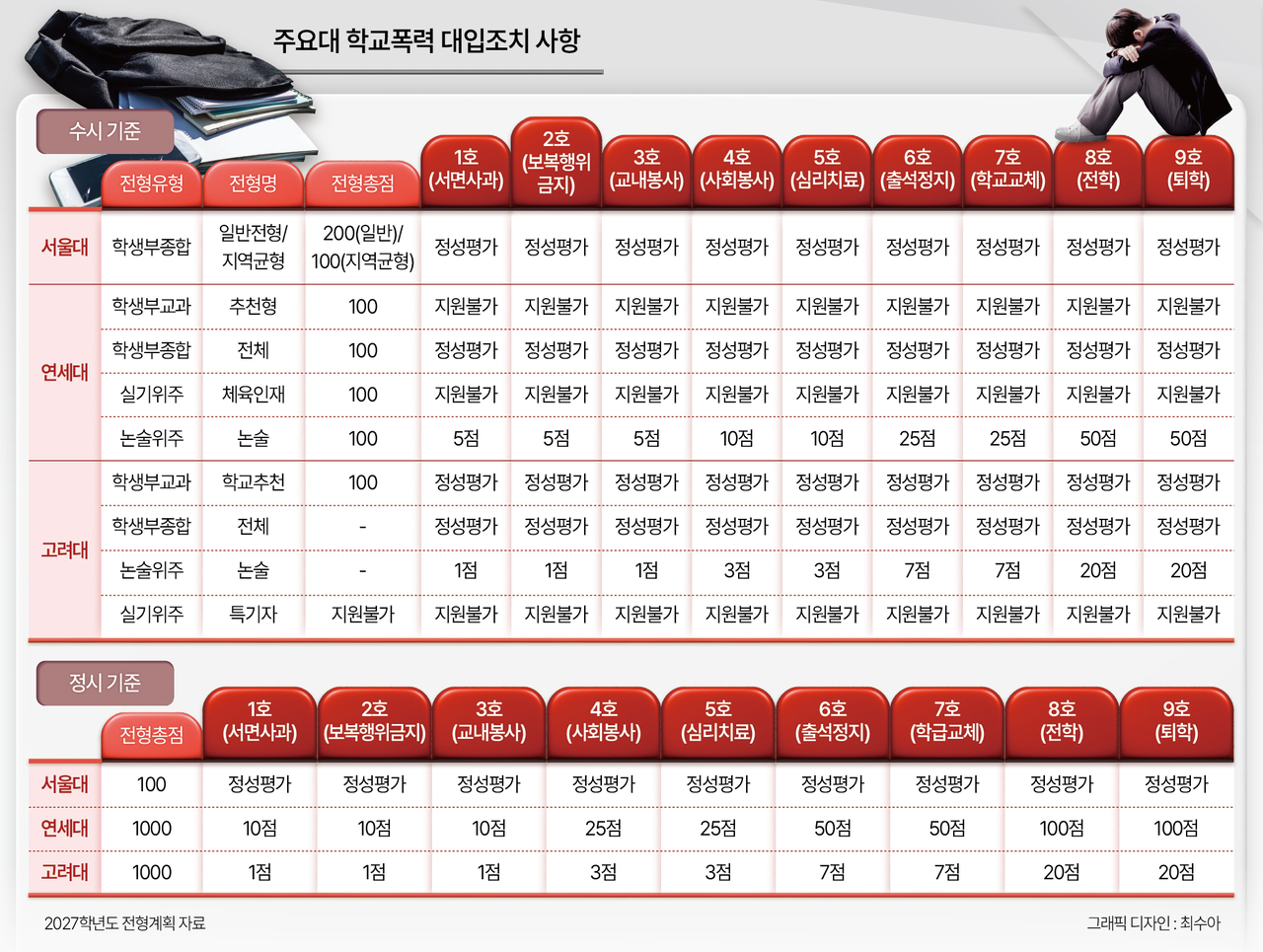
The reason students and parents fight so hard over sanction levels is straightforward: major universities have adopted a zero-tolerance policy toward school violence sanctions. Under admissions plans for the 2027 academic year, Seoul National University, Yonsei University, Korea University and other so-called SKY schools apply point deductions in both early and regular admissions for even the lightest Level 1 sanction — a written apology.
In a top-tier admissions race where fractions of a point decide outcomes, a single written-apology record from a minor prank amounts in effect to a rejection notice.
Students in classrooms today no longer learn to apologize when conflict arises. Instead, they learn to screenshot KakaoTalk conversations, preserve evidence and avoid being the first one reported.
In classrooms where the belief that "apologizing first means losing" has spread, friends have quietly ceased to be people to reconcile with and become risks to guard against. In the school violence survival game that adults built, the first casualty was children's ability to make up.
brunch@heraldcorp.com