Meister high school employment rate at 71.8%, down 1.3 percentage points from last year
Roughly half of vocational high school graduates go to college; 25.7% find jobs
Overall employment rate rebounds to 55.8% after three consecutive years of decline
Share employed at firms with 300-plus workers rises for 5th consecutive year to 38.4%
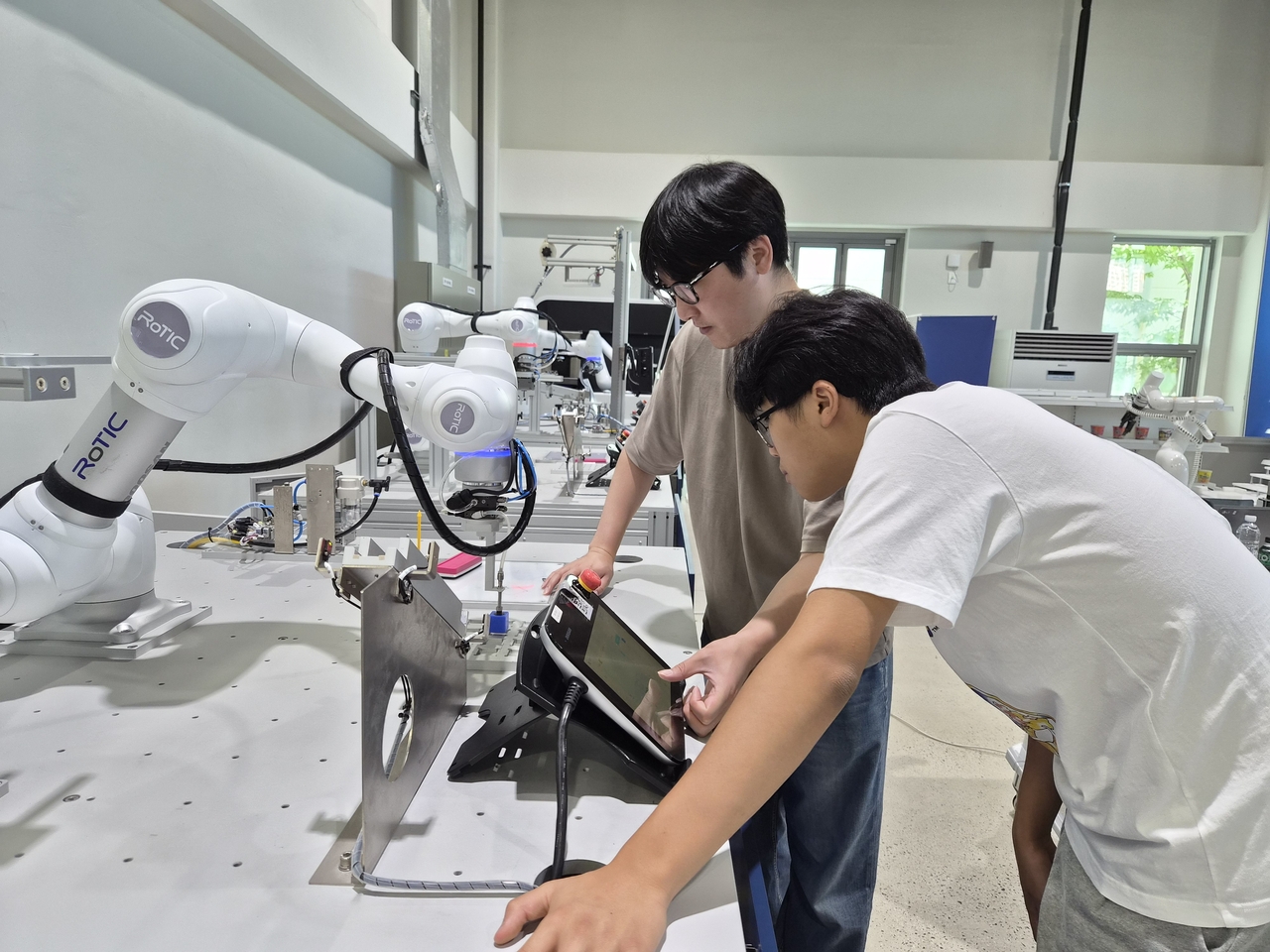
The employment rate at Meister high schools — institutions designed to train skilled workers for industry — has fallen to its lowest level in five years, according to data released Thursday.
The Ministry of Education and the Korean Educational Development Institute released their "2026 Vocational High School Graduate Employment Statistics Survey" Thursday, showing the employment rate at Meister high schools stood at 71.8% this year, down 1.3 percentage points from last year. The survey tracked the employment and enrollment status of 63,038 graduates from 573 vocational high schools nationwide who completed their studies in January and February, as of April 1.
The Meister high school employment rate fell from 77.5% in 2022 to 73.7% in 2023 and 72.6% in 2024. It briefly rebounded to 73.1% last year before dropping again this year to its lowest point in five years — 5.7 percentage points below the 2022 figure. Of 5,284 Meister high school graduates this year, 3,184 found employment.
Across all vocational high schools, college enrollment outpaced employment. A total of 31,017 graduates — 49.2% of the total — went on to higher education, while 16,209, or 25.7%, entered the workforce. Roughly half of graduates headed to college, and about one in four found a job.
The college enrollment rate was unchanged from last year. By school type, the rate was highest among general high school vocational tracks at 60.8%, followed by specialized vocational high schools at 52.6% and Meister high schools at 7.3%. Among all college-bound graduates, 53.6% enrolled in two-year junior colleges and 46.4% in four-year universities.
The official employment rate — calculated by excluding college-bound graduates, military enlistees and those granted exemptions due to difficulty participating in economic activity — came to 55.8%, up 0.6 percentage points from last year. This figure differs from the 25.7% rate, which measures employed graduates as a share of all graduates.
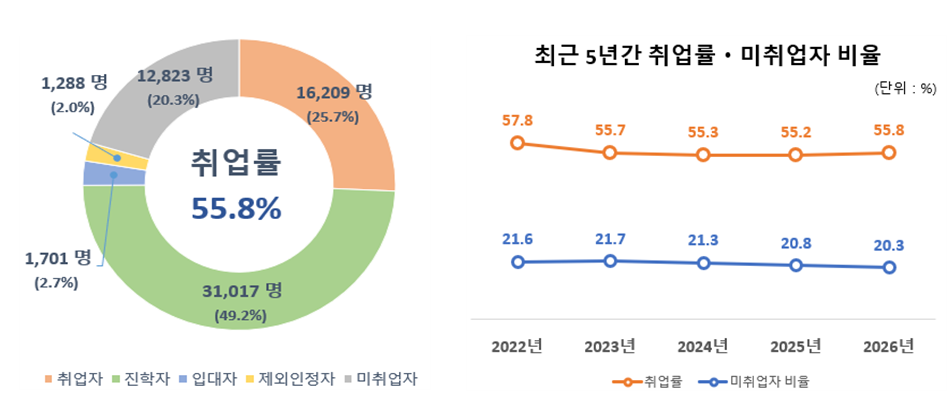
The overall employment rate at vocational high schools had declined for three consecutive years — from 57.8% in 2022 to 55.7% in 2023, 55.3% in 2024 and 55.2% in 2025 — before rebounding this year. The recovery was driven largely by specialized vocational high schools, which account for 87.0% of all vocational high school graduates and posted an employment rate of 53.6%, up 1.2 percentage points from the previous year. The rate for general high school vocational tracks fell 0.4 percentage points to 37.8%.
The number of graduates not in employment, education or military service stood at 12,823 — up 403 from last year. As the total number of graduates increased, however, their share fell 0.5 percentage points to 20.3%. The figure also includes graduates whose employment status could not be confirmed through public databases.
The size of firms where graduates found work also grew. Among employed graduates confirmed as national health insurance workplace subscribers or employment insurance enrollees, 38.4% worked at companies with 300 or more employees — a share that has risen for five consecutive years. The Ministry of Education cited this as evidence of qualitative improvement in employment conditions for vocational high school graduates.
The survey also tracked how long graduates remained employed. Of 15,121 graduates from last year who were confirmed as insurance subscribers in April of that year, 82.2% were still employed six months later and 68.9% after one year. Compared with the previous cohort, the six-month retention rate fell 0.9 percentage points while the one-year retention rate rose 0.7 percentage points.
Deputy Education Minister Choi Eun-ok said the rebound in employment rates for vocational high school graduates — who are key to balanced regional development — was "a meaningful achievement in an environment where youth employment remains difficult." Choi added that the ministry would expand Meister high schools and contract-type specialized vocational high schools, and work with related ministries and provincial education offices to support the growth of technically skilled graduates.
brunch@heraldcorp.com