Authorities eye NDF trades as main driver of won's surge; smoothing operations, national pension swaps to continue; banks brace for capital ratio deterioration
Tension is mounting across South Korea's financial sector as the won-dollar exchange rate broke through the psychologically critical 1,550-won level. With foreign investors offloading shares in large volumes and putting further pressure on the won, and with the Middle East war dragging on and US interest rate hikes looming, pessimists are gaining ground in arguing the rate could climb as high as 1,600 won to the dollar.
Authorities have issued a warning targeting what they describe as speculative trading. The won opened Monday at 1,555.2 per dollar on the Seoul foreign exchange market — its highest level in 17 years and three months.
Regulators consider speculative foreign exchange transactions centered on the non-deliverable forward market to be the primary driver of the won's recent sharp depreciation. The Bank of Korea said Monday that "in the foreign exchange market recently, it is judged that some speculative foreign exchange transactions, including NDF trades, have amplified volatility beyond supply-and-demand factors," adding that it "will never tolerate excessive volatility and one-directional herding beyond what fundamentals justify, and will respond forcefully."
Authorities say exchange rates pushed up in the NDF market are feeding broader market expectations of further won weakness, accelerating the currency's decline. An NDF is a derivative instrument settled offshore based solely on the difference in exchange rates at maturity, without any direct exchange of foreign currency. Because only a margin deposit is required, investors can take positions worth dozens of times the actual amount — a structure that allows a relatively small sum to exert an outsized influence on the foreign exchange market.
The authorities' push to extend foreign exchange trading to 24 hours as part of a broader "won internationalization" drive is partly aimed at reducing the NDF market's influence, by drawing opaque offshore transactions onshore and minimizing speculative currency activity. At the same time, authorities are expected to continue short-term measures to prevent excessive one-way moves, including smoothing operations — in which the Bank of Korea sells dollars from its reserves and buys won — and foreign exchange swap arrangements with the National Pension Service, under which the pension fund sources dollars directly from the central bank.
Because both measures draw on foreign exchange reserves to stabilize the rate, reserves could shrink further in the months ahead. According to the Bank of Korea, reserves fell $880 million from the previous month to $426.99 billion in May as a result of market stabilization measures.
Banks and major financial holding companies are closely monitoring the impact on capital adequacy and liquidity as upward pressure on the exchange rate intensifies. Their most immediate challenge is defending capital adequacy ratios: when the exchange rate rises, the won-denominated value of foreign currency assets increases, inflating risk-weighted assets and pushing capital ratios lower.
As a rule of thumb, a 10-won rise in the won-dollar rate is estimated to shave roughly 0.02 percentage points off a bank's common equity tier 1 ratio. Given that the rate has climbed nearly 70 won over the past month, CET1 ratios are estimated to have fallen by around 0.14 percentage points.
A rising exchange rate also tightens foreign currency liquidity, increasing banks' funding costs and weighing on their liquidity coverage ratio calculations.
By far the financial sector's biggest concern, however, is the spillover into the real economy. Small and mid-sized import and export companies with limited capacity to hedge currency risk are particularly vulnerable to a rapid deterioration in loan quality.
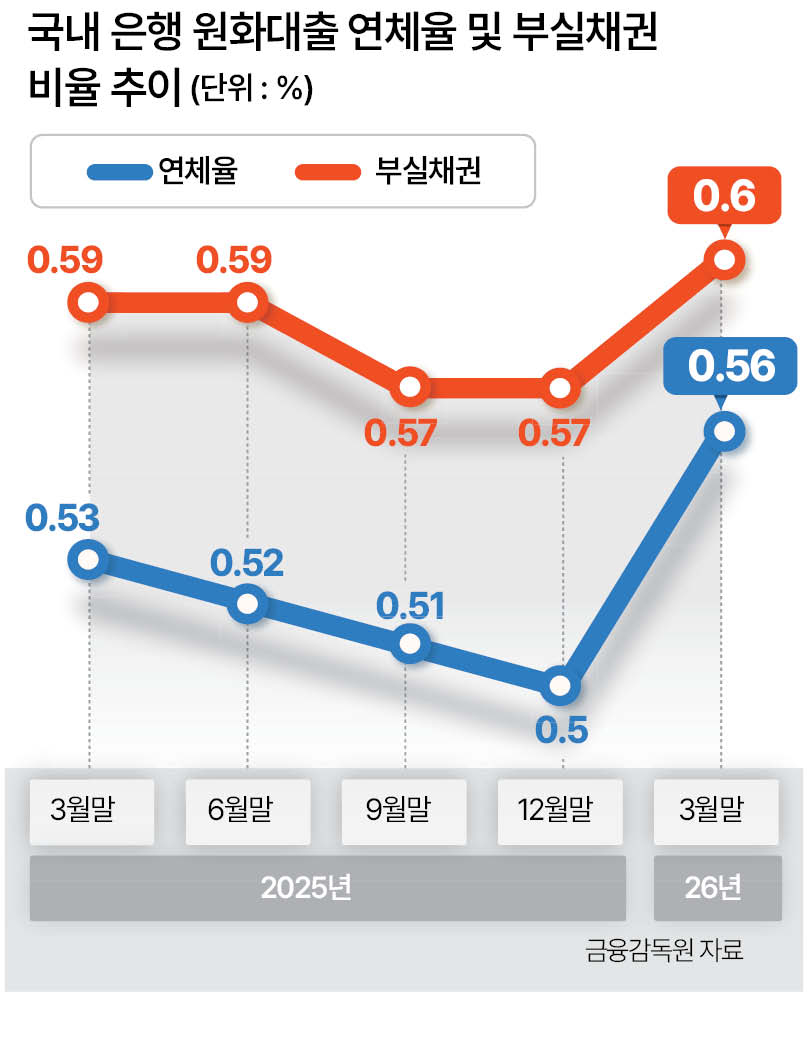
In fact, loan quality has already deteriorated sharply after a prolonged economic slowdown. According to the Financial Supervisory Service, the non-performing loan ratio at domestic banks stood at 0.6 percent as of the end of March — entering that range for the first time since March 2021 (0.62 percent) — after the NPL balance grew by more than 1 trillion won (about $648 million) in three months. The delinquency rate also hit 0.56 percent in the same period, the highest for that month since 2016 (0.63 percent).
Experts warn that structural domestic factors are also adding to upward pressure on the exchange rate, and that a collapse of the US AI bubble that derails the semiconductor cycle could cause the domestic economy to deteriorate sharply. Kim Jeong-sik, an emeritus professor of economics at Yonsei University, said the rate "could well reach 1,600 won, as upward pressure persists — domestic factors are considerable, US interest rates are rising, and oil prices could remain elevated for an extended period."
ehkim@heraldcorp.com
kimstar@heraldcorp.com
hyuk@heraldcorp.com
won@heraldcorp.com