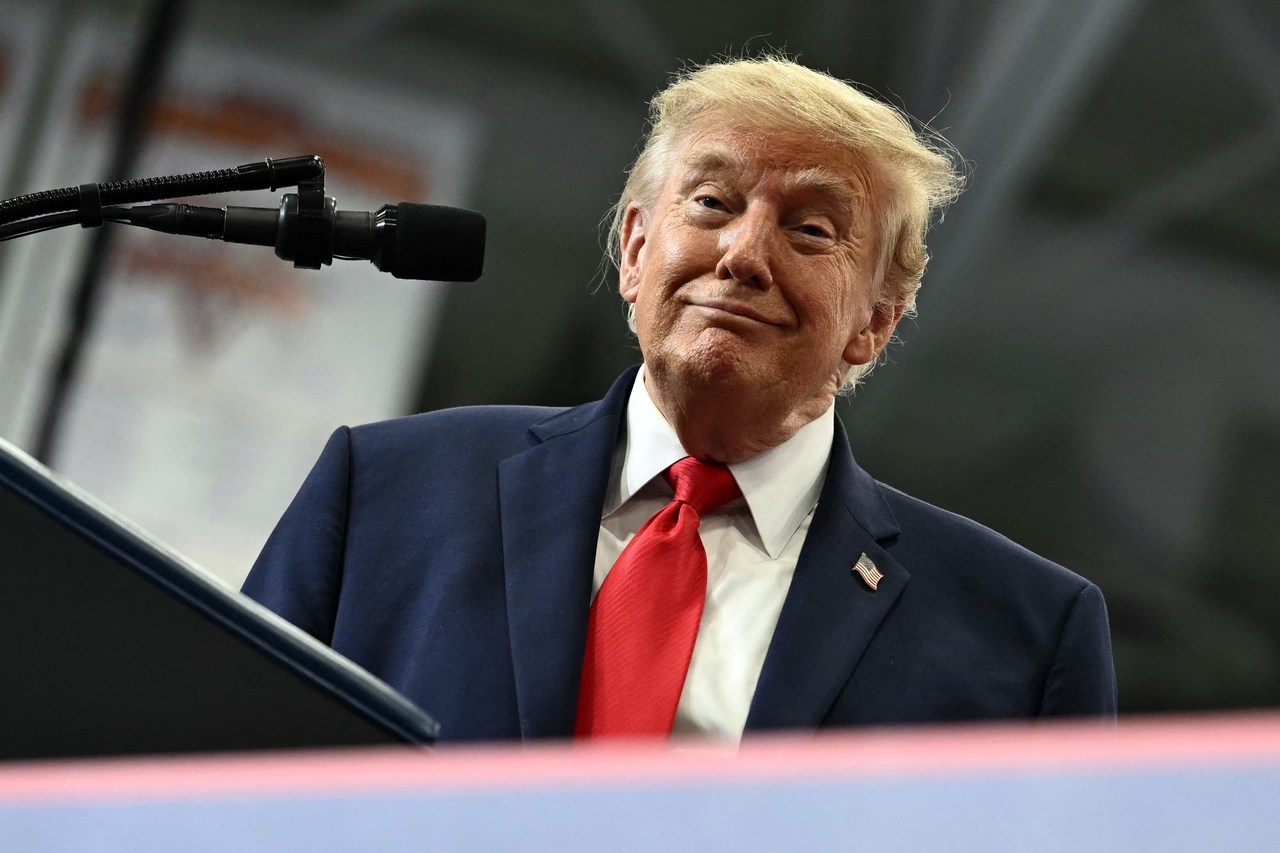
President Lee says Korea's property holding taxes 'generally low'
Fair market value ratio could be raised via executive order
Tax brackets may be refined for properties worth 1.2–5 billion won
![Apartments in Yongsan and Gangnam as seen from Namsan in Seoul. [Herald Business DB]](https://wimg.heraldcorp.com/news/cms/2026/06/09/news-p.v1.20250908.d780c2a474ff455e9d8e76efae7e3476_P1.jpg)
With President Lee Jae Myung again calling for stronger real estate taxation and signaling a tax reform package for July, attention is turning to the tools the government could use to increase the tax burden on property owners. Among the most frequently cited options are raising the fair market value ratio — adjustable without National Assembly approval — along with refining the tax brackets for the comprehensive real estate tax, known as jongbusae, and scaling back the long-term holding special deduction. Although the ruling party's performance in the June 3 local elections was described as only a partial victory after it lost Seoul, the president's direct push to raise the cost of holding non-primary-residence properties signals that a tax drive targeting multi-home owners and high-value property holders is set to accelerate.
Political and real estate industry sources said President Lee doubled down on his stance on expanding property holding taxes at his first-anniversary press conference Monday. "Korea's holding taxes are generally low," he said. "Even if you accumulate many homes, the burden is not that great." He added that property owners should bear holding costs comparable to those in advanced Western countries, saying: "It's fine to own multiple homes, but you should bear the cost."
As home prices continue to rise in key Greater Seoul areas and the president's tax-increase remarks grow more frequent, tighter real estate taxation is increasingly seen as a foregone conclusion. Analysts expect the government, freed from the political constraints of the June 3 local elections, to push ahead with a sweeping tax drive in July — targeting multi-home owners, holders of high-value properties, and single-home owners who do not live in their properties for speculative purposes.
"In the current market environment, tax is the only card the government has left," said Song Seung-hyun, head of Urban and Economy, a real estate consultancy. "Real estate policy is not just about suppressing demand — easing earlier regulations could also be an option — but given that the government's direction is toward tighter controls, expanding taxation will inevitably be the core of any future measures."
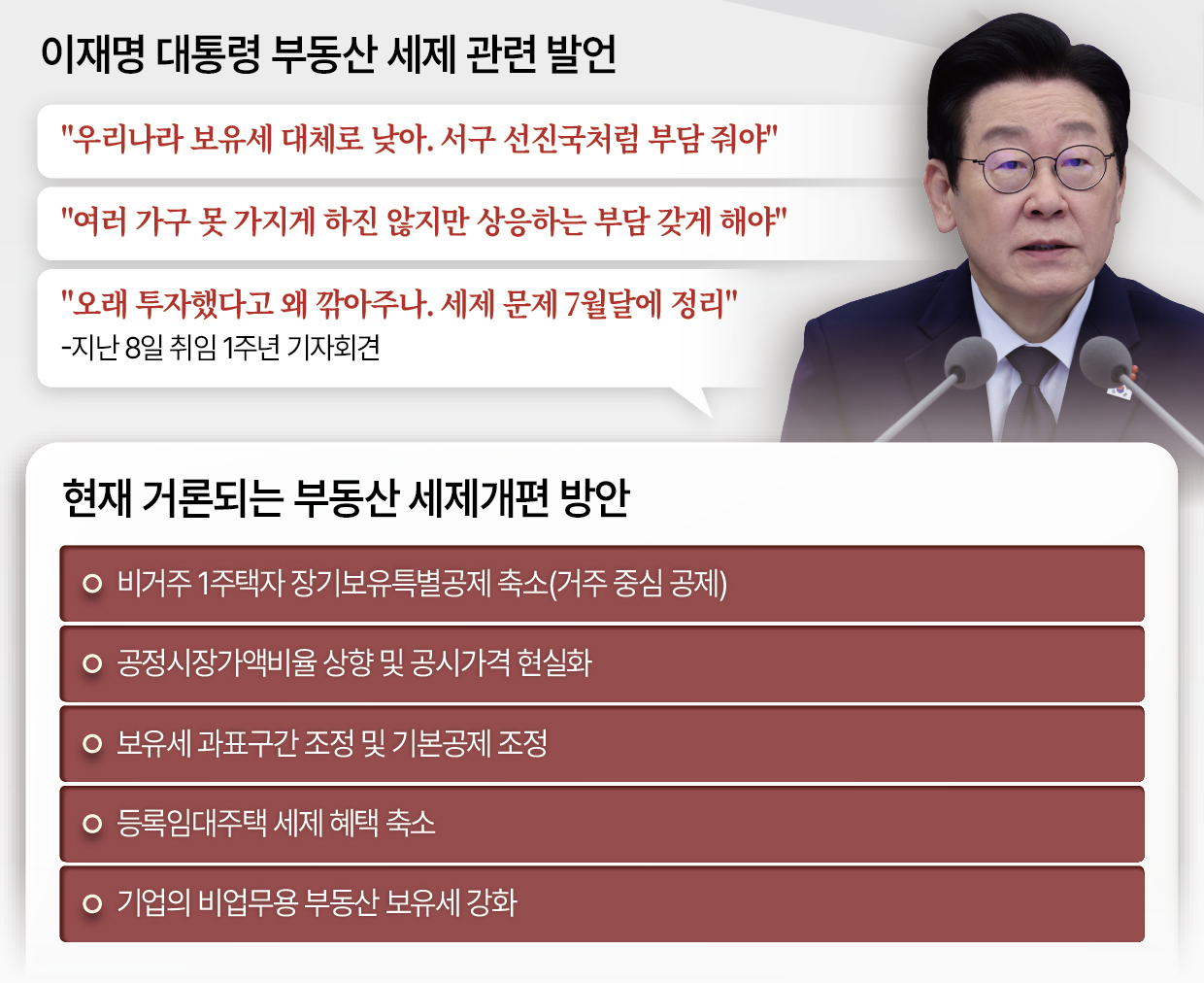
The easiest lever for the government to pull is the fair market value ratio — the multiplier applied to the officially assessed price to calculate the tax base for the comprehensive real estate tax and property tax. The ratio has been held at 60 percent since 2022, down from 80 percent under the Lee Myung-bak administration and a peak of 95 percent under the Moon Jae-in government, which raised it in stages. Because the ratio can be adjusted by amending an enforcement decree without going through the National Assembly, it is seen as the most straightforward way to raise taxes while bypassing the legislative process.
"The June 1 assessment date has passed, but the process of issuing tax bills begins in earnest from September, when applications for comprehensive real estate tax exclusions are filed," said Park Hap-su, an adjunct professor at Konkuk University's Graduate School of Real Estate. "Since adjusting the fair market value ratio requires only a Cabinet resolution, processing it by the end of August would allow an immediate tax increase."
Analysts also consider it more likely that the government will refine the tax brackets rather than directly raise the holding tax rate. The current brackets are divided into seven tiers: up to 300 million won (about $217,000), up to 600 million won, up to 1.2 billion won, up to 2.5 billion won, up to 5 billion won, up to 9.4 billion won, and above 9.4 billion won. The focus is on narrowing the relatively wide gaps in the middle tiers — specifically the 1.2 billion-to-2.5 billion won range, the 2.5 billion-to-5 billion won range, and the 5 billion-to-9.4 billion won range — by introducing more granular sub-brackets.
Kim Yong-beom, the presidential chief of staff for policy at Cheong Wa Dae, also signaled the possibility of refining the brackets in an interview earlier this year. "There is a proposal to apply holding taxes more precisely by subdividing the brackets for a single home — for example, into tiers of 2 billion, 3 billion and 4 billion won," he said.
For multi-home owners, the government may also consider reducing the basic deduction amount or raising the comprehensive real estate tax rate back to Moon-era levels. "Under the Moon administration, the top rate for owners of three or more homes was 6 percent; it is currently 5 percent, so there is a possibility of raising it by 1 percentage point," Park said. "Reducing the basic deduction threshold for multi-home owners is another option."
The overhaul of the long-term holding special deduction, which President Lee has raised since the start of the year, is also expected to be included in the July tax reform package. At Monday's press conference, he questioned the rationale for the benefit, saying: "Why should someone get a discount just because they held an investment for a long time?" The proposal under discussion would lower the deduction rate for the holding component — currently up to 40 percent — while raising it for the residency component, also currently capped at 40 percent.
Other measures the president has raised on his X account and at Cabinet meetings — including reducing tax benefits for registered rental housing and strengthening holding taxes on non-business-use real estate held by corporations — are also considered realistic candidates. The government plans to review the various tax measures in stages and pursue legislative and enforcement-decree amendments in sequence.
"We will fundamentally lower the expected rate of return on real estate," President Lee said. "We will organize taxation, finance, regulation and supply in line with the national economy and common sense, and announce them all together soon."
A separate report found that the average deposit on new jeonse contracts signed in Seoul from Jan. 1 through Monday stood at 655.33 million won, according to the Ministry of Land, Infrastructure and Transport's actual transaction price disclosure system — an increase of about 100 million won over two years.
![서울 아파트 전세 새로 구하려 봤더니 2년 새 1억 올랐다 [부동산360]](https://wimg.heraldcorp.com/news/cms/2026/06/09/news-p.v1.20260522.c1e0f9bea53043c7962fefcf67e1ec6d_T1.jpg)
hwshin@heraldcorp.com