
Services sector drives job growth; auto parts factory fire weighs on manufacturing
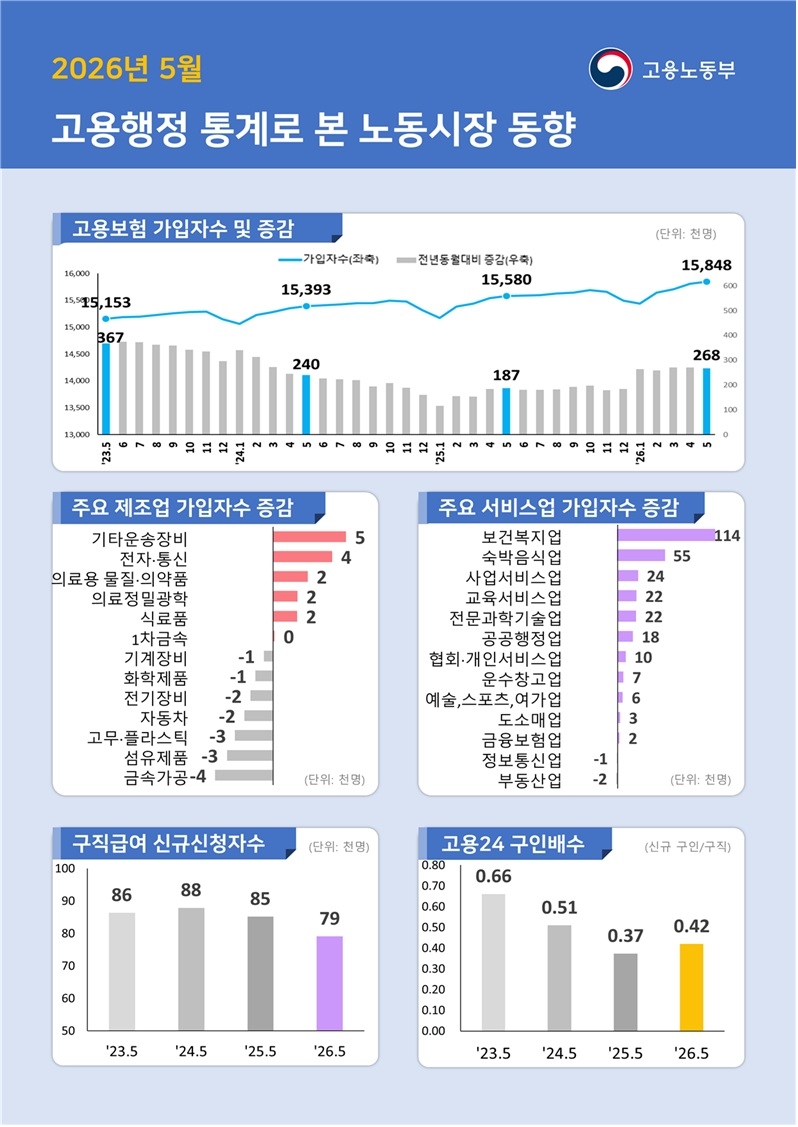
The number of employment insurance subscribers grew by more than 270,000 for the fifth consecutive month in May, but the divergence between industries and age groups deepened as manufacturing and construction continued to shed workers and youth enrollment kept falling.
According to the "Labor Market Trends Based on May 2026 Employment Administration Statistics" released by the Ministry of Employment and Labor on Tuesday, active employment insurance subscribers stood at 15.848 million as of the end of last month — up 268,000, or 1.7 percent, from a year earlier. The figure has held in the upper 200,000s for five straight months, following gains of 263,000 in January, 259,000 in February, 270,000 in March and 271,000 in April.
The services sector was the primary driver of employment growth.
Services sector subscribers totaled 11.113 million, up 284,000 from a year ago. Health and welfare led all subsectors with an increase of 114,300, followed by accommodation and restaurants (up 55,200), business services (up 24,200), educational services (up 22,400) and professional, scientific and technology services (up 21,900).
Manufacturing, by contrast, fell for the 12th consecutive month, with subscribers dropping 9,900 to 3.84 million. Metal fabrication (down 4,000), textile products (down 3,200), rubber and plastics (down 2,600) and automobiles (down 2,000) led the decline.
The auto manufacturing subsector in particular has seen its losses widen since turning negative in March.
The ministry attributed part of the decline to production disruptions caused by the fire at Daejeon's Anjeong Industrial last year. "In the case of the auto industry, the impact of last year's Daejeon Anjeong Industrial fire has been reflected in the figures, widening the pace of decline," said Cheon Gyeong-gi, head of the ministry's Future Employment Analysis Division.
Electronics and telecommunications manufacturing — which includes semiconductors — bucked the trend, adding 4,100 subscribers for a ninth straight month of growth. Other transportation equipment manufacturing, which includes shipbuilding, rose by 5,100 for a 42nd consecutive monthly gain. The divergence within manufacturing itself was stark.
Construction subscribers fell 8,500 to 745,000, extending the sector's losing streak to 34 consecutive months. Although the pace of decline eased slightly, general construction alone shed 8,600 workers, underscoring the prolonged slump in the sector.
By age group, young workers continued to struggle.
Subscribers aged 29 and under fell 65,200 from a year earlier to 2.233 million, with the sharpest drops in manufacturing (down 28,000), information and communications (down 15,000), health and welfare (down 12,000) and wholesale and retail (down 9,000). Workers in their 30s rose by 84,300, those in their 50s by 46,100 and those aged 60 and older by 207,500, while the 40s age group declined by 4,700.
Unemployment benefit indicators improved. New applications for job-seeking benefits in May fell 6,000, or 7.2 percent, from a year earlier to 79,000, led by declines in construction (down 4,200) and manufacturing (down 1,300). The number of recipients dropped 40,000, or 6.0 percent, to 630,000, and total payouts fell 78 billion won, or 7.0 percent, to 1.0328 trillion won (about $668 million).
On the job-matching front, employer demand rose while the number of job seekers fell.
New job postings through the Employment24 platform increased 12,000, or 8.7 percent, from a year earlier to 153,000, while new job seekers declined 12,000, or 3.3 percent, to 364,000. As a result, the job-offer ratio — the number of openings per job seeker — rose to 0.42 from 0.37 in the same month last year.
fact0514@heraldcorp.com





