
National Assembly Budget Office re-estimates health insurance finances
10-year cumulative deficit to rise by 27.8 trillion won if reform costs included
Office urges clear division between state and insurance funding
![The headquarters of the National Health Insurance Service in Wonju, Gangwon Province [Herald Business DB]](https://wimg.heraldcorp.com/news/cms/2026/06/10/news-p.v1.20250121.9880378256f04984a665f3084173b170_P1.jpg)
South Korea's national health insurance reserves could run dry two years earlier than previously projected if the government's first and second rounds of medical reform are factored in, a new analysis shows. The additional spending tied to the reform is expected to push the cumulative deficit over the next decade up by 27.8 trillion won (about $18.3 billion), raising fresh concerns about the long-term fiscal stability of the national health insurance system.
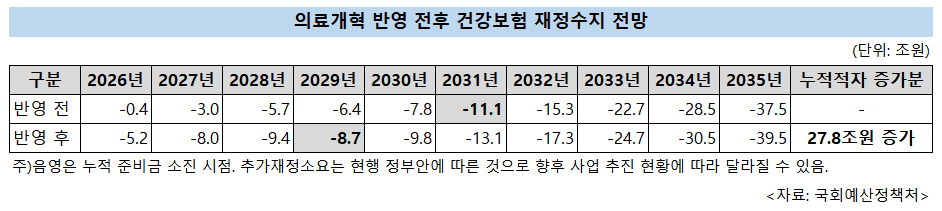
The National Assembly Budget Office released a report Wednesday re-estimating health insurance finances to incorporate the first and second medical reform implementation plans. It projects the national health insurance reserve fund will be exhausted in 2029 if reform-related spending is included — two years ahead of the 2031 depletion date forecast under a scenario that excludes the reform's financial impact.
The budget office based its revised projections on measures in the first reform plan, including fee schedule increases and restructuring and a support program for the structural transformation of tertiary hospitals, as well as second-plan programs supporting comprehensive secondary general hospitals and the strengthening of essential specialized medical functions. Costs associated with future policy agenda items — such as covering nursing care expenses under insurance or institutionalizing a sick-leave benefit — were excluded from the analysis.
Even without the reform, the health insurance balance is projected to swing to a 400 billion won ($290 million) deficit in 2026 and widen to a 37.5 trillion won ($27 billion) deficit by 2035. With the reform factored in, the 2026 shortfall grows to 5.2 trillion won ($3.8 billion) and the 2035 deficit reaches 39.5 trillion won ($28.5 billion). The cumulative deficit for 2026 through 2035 is expected to grow by 27.8 trillion won compared with the baseline forecast.
The scale of health insurance spending tied to the medical reform is substantial. The government plans to commit roughly 2 trillion won ($1.4 billion) per year to support essential medical services and revamp fee schedules, 10 trillion won ($7.2 billion) in total for the tertiary hospital structural transformation program, 680 billion won ($490 million) annually for the comprehensive secondary general hospital support program, and 44 billion won ($32 million) per year to strengthen essential specialized medical functions. In total, the reform is expected to cost more than 20 trillion won ($14.4 billion) over the five years from 2024 to 2028.
The budget office said the overall direction of the medical reform is necessary, but warned that placing the entire financial burden on the national health insurance system has its limits. "Medical reform aimed at strengthening essential and regional healthcare and normalizing the public health system is a necessary policy direction," the report said. "However, programs that provide performance-based rewards to individual institutions or support structural transformation are responsibilities of the state, and it is necessary to draw a clear line between the roles of national health insurance finances and general government finances."
The office also said spending increases from fee schedule additions are expected to continue beyond 2028, when the reform investment period ends, and called for a review of medium- to long-term fiscal sustainability. It also recommended that efforts to improve spending efficiency — including tighter management of non-covered services and reform of the supplemental private insurance structure — be carried out without delay, and that the government explore funding stabilization measures drawing on overseas examples.
fact0514@heraldcorp.com





