Investing in US stocks has gone from optional to essential. But knowing what to watch and how to invest remains a challenge. Accurate information and timely analysis are both the starting point and the destination for US equity investors. We will navigate that journey together — and answer your questions and concerns in "Korean Retail Investor Inc."
![The SpaceX logo. [Reuters]](https://wimg.heraldcorp.com/news/cms/2026/06/11/news-p.v1.20260609.afef0abc9d7b4c8b9aa1eeaa75939db2_P1.jpg)
The SpaceX listing — the most anticipated initial public offering in the world — is now just one day away. Investors are about to get a chance to buy into humanity's largest space company, but they will also be paying what may be the most expensive ticket in stock market history.
The sheer scale of the company and the offering has prompted some to say that "space itself is going public." Before boarding the SpaceX rocket, here are the key points every investor should examine.
$1.75 trillion: A valuation 100 times higher than a decade ago
The first thing to examine is SpaceX's valuation — the central point of contention surrounding this listing.
SpaceX is targeting a valuation of $1.75 trillion. That would make it only the second company to go public at a valuation above $1 trillion since Saudi Aramco in 2019. If the target market capitalization is realized, SpaceX would instantly leapfrog Meta ($1.48 trillion) and Tesla ($1.24 trillion) as of Tuesday to enter the global top 10, drawing level with Saudi Aramco, currently ranked eighth at $1.75 trillion.
SpaceX's valuation has risen 100-fold in just a decade, climbing from $12 billion in 2016 to $1.25 trillion this year.
"The IPO target price rose to $1.75 trillion in just over three months after SpaceX was valued at $1.25 trillion at the time of its merger with xAI in February," said Jeong Eui-hun, a researcher at Eugene Investment & Securities.
The rapid ascent has sparked fierce debate over valuation. SpaceX posted sales of $18.67 billion last year, implying a price-to-sales ratio of 96.4 — an extreme multiple compared with Nvidia at 13.3 times, Apple at 9.6 times and Tesla at 15.5 times.
"This means the market is pricing in the future after SpaceX builds out its monopolistic space infrastructure, not its current fundamentals," said Park Jun-gyu, a researcher at Samsung Securities. "Sustaining this multiple will require not only improving fundamentals but also a continuous supply of new narrative." In other words, justifying the current valuation demands compelling growth stories alongside actual earnings improvement.
![A Falcon 9 rocket on display at SpaceX's facility in Hawthorne, California, on June 2. SpaceX has confidentially filed paperwork for an initial public offering that could rank among the largest in history. [Getty Images]](https://wimg.heraldcorp.com/news/cms/2026/06/11/news-p.v1.20260403.134d1edc07cd4810a61819fea8b0282e_P1.png)
SpaceX plans to issue 555,555,555 Class A common shares in the offering, with the IPO price fixed at $135 per share.
Most companies going public set a price range and then determine a final price through a book-building process. SpaceX instead set a firm fixed price from the outset. At $135 per share, the implied market capitalization stands at approximately $1.77 trillion.
Morningstar criticized the $135 offering price as excessive, estimating fair value at $63 per share. The research firm said the price relies too heavily on the success of large-scale projects such as an orbital AI data center and a reusable Starship.
Not everyone agrees. Some argue that SpaceX should not be viewed simply as a rocket manufacturer — its role as a space infrastructure company, they contend, justifies a premium valuation.
"Even as challengers such as Rocket Lab and Chinese state-owned enterprises gain ground, SpaceX's reusable launch vehicle technology and launch infrastructure — built on tens of trillions of won in sunk costs — represent an impassable, proprietary barrier to entry," said Jeong Ji-su, a researcher at Meritz Securities.
$75 billion: Why is a space company investing in AI?
How SpaceX intends to use the proceeds is something every investor must scrutinize. The company is targeting $75 billion in gross proceeds — comfortably surpassing the previous all-time record of $29.4 billion set by Saudi Aramco.
Strong demand was already signaled. Reuters reported Tuesday that investor demand for the offering had reached 3.5 to 4 times the target amount.
Markets are betting on SpaceX's future. But where exactly will the company put that money? The answer, perhaps surprisingly, is not rockets — it is AI infrastructure.
According to the S-1 SpaceX filed with the Securities and Exchange Commission, the planned uses of proceeds are listed in this order: expanding AI computing infrastructure, developing launch infrastructure and Starship, and expanding the Starlink satellite network.
What stands out is that AI comes first. Reports from the roadshow indicate that Elon Musk's AI ambitions were on full display for prospective investors.
![A screen displaying the logo of Grok, the generative AI chatbot developed by xAI. [AFP]](https://wimg.heraldcorp.com/news/cms/2026/06/11/news-p.v1.20260112.5320b59d4cf7428c9cf39af1569399d6_P1.png)
Goldman Sachs, the lead underwriter, projected at the roadshow that SpaceX's AI segment revenue would grow roughly 100-fold, from $3.2 billion last year to $322 billion by 2030 — accounting for 68 percent of total revenue that year.
"Goldman Sachs's projections reconfirm that SpaceX, despite its name, intends to make AI infrastructure — not its satellite network or launch vehicles — its core business," said Kim Il-hyuk, a researcher at KB Securities.
SpaceX's AI focus is also evident in its capital expenditure. In the first quarter of this year, 77 percent of total capex of $10.1 billion went to the AI segment, reflecting the massive investment in data centers and GPU clusters following the xAI merger.
Starlink is the cash cow powering the 'space empire'
The second area to examine is SpaceX's fundamentals — its actual earnings. As a private company, SpaceX disclosed its financial statements publicly for the first time through the S-1 filing. The market's reaction to the long-awaited numbers was mixed.
Some on Wall Street said SpaceX's valuation is "difficult to justify by any valuation formula," pointing to last year's revenue of just $18.7 billion against an operating loss of $4.9 billion.
Looking more closely at the numbers, SpaceX operates across three business segments: Space, Connectivity and AI.
The company's earnings are driven by Starlink, its connectivity business. Starlink provides high-speed internet to individuals, businesses and government agencies through a low-Earth orbit satellite network. As of late March, the service had 10.3 million subscribers and approximately 9,600 satellites in operation, giving it an effective stranglehold on the global satellite communications market.
The financial performance is strong. Last year, connectivity segment revenue — including Starlink — reached $11.39 billion, representing 61 percent of total revenue. Operating profit came in at $4.42 billion, with an operating profit margin of 38.8 percent. That is why Starlink is widely regarded as SpaceX's cash cow.
All roads lead to Starship — commercialization is the key
The Space segment — the rocket launch business — contributes less to revenue than its symbolic importance might suggest. Last year, Space segment revenue reached $4.09 billion, up just 8 percent from the prior year, a modest gain compared with the nearly 50 percent growth posted by the Connectivity segment over the same period.
However, the number of launches in the first quarter of this year rose to 40, up 11 percent year on year, and the payload mass delivered to orbit reached 556 metric tons, a 24 percent increase — signs that launch vehicle capabilities are strengthening.
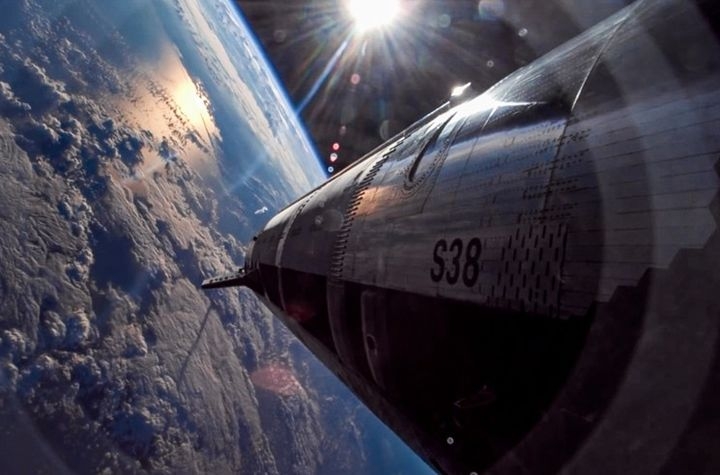
Experts broadly agree that Starship is the linchpin of all three business segments. "Completing Starship development is a prerequisite for growth across SpaceX's Space, Connectivity and AI segments," said Lee Ju-eun, a researcher at Shinhan Investment.
Starship is SpaceX's next-generation fully reusable launch vehicle currently under development. The system aims to recover and reuse both the first-stage booster and the second-stage spacecraft, with the goal of cutting launch costs by more than 99 percent and bringing the per-kilogram launch price below $1,000.
The next-generation Starlink V3 satellite network, an orbital data center and even plans for Mars colonization all hinge on Starship's success. Without it, the sweeping vision SpaceX has laid out would be difficult to realize. SpaceX itself listed Starship development delays and failure to achieve full reusability as risk factors in its S-1.
The commercialization timeline has already slipped once. The start of commercial operations, originally expected last year, has been pushed back to the second half of this year. SpaceX specified in its S-1 that payload deployment is scheduled for the second half of this year.
For SpaceX investors, the pace of Starship's commercialization will likely be the most important metric to watch.
$6.3 billion in losses — yet the AI narrative keeps the valuation afloat
How much is SpaceX's heavily funded AI business actually earning? The short answer: it is the primary source of the company's losses.
The AI segment was created in February when SpaceX merged with xAI. Its key assets include the generative AI chatbot Grok, the social media platform X (formerly Twitter) and the massive data center known as Colossus.
The results are underwhelming. Last year, AI segment revenue came in at just $3.2 billion, while the operating loss reached $6.36 billion — a deficit nearly double the segment's revenue.
A path to monetization has recently emerged. Last month, SpaceX signed a contract with Anthropic to lease idle computing resources, under which it expects to recognize $1.25 billion in monthly revenue through May 2029.
Even so, experts remain concerned about deteriorating financial health as AI losses mount and investment accelerates. "The Anthropic deal provides a stopgap that can narrow the operating loss, but a fundamental solution to the pace of cash burn is still needed," said Park Jun-gyu.
"The AI segment is the primary factor adding downward pressure to consolidated earnings in the near term, but at the same time it holds a dual status as the core narrative asset underpinning the company's $1.75 trillion asking price," said Park Ki-hyun, a researcher at Kiwoom Securities.
Experts advise that the key investment questions are whether the AI business can become genuinely competitive and whether SpaceX can generate sufficient cash flow to sustain the enormous investment.
What Korean retail investors need to know
SpaceX will list on the Nasdaq under the ticker SPCX on Friday local time. Korean retail investors, however, were shut out of the IPO allocation. Mirae Asset Securities conducted a private placement subscription for professional investors, but ordinary retail investors were not eligible to participate.
![A view of Wall Street with the American flag. [Reuters]](https://wimg.heraldcorp.com/news/cms/2026/06/11/news-p.v1.20250602.bb35dc16fbc946b9b9a5552c7f27debe_P1.jpg)
Korean investors are left with two options: buying shares directly on US markets or gaining exposure through space and aerospace exchange-traded funds listed in the United States or South Korea.
Analysts at home and abroad urge caution about buying on the first day of trading. Cathy Donnelly, co-author of the investment book "The Lifecycle Trade," has noted that many IPO stocks tend to surge on their debut only to fall below their first-day low within weeks. Even companies with compelling growth stories often see early-stage froth reverse.
Another concern is the unusually high retail investor allocation. SpaceX plans to allocate roughly 30 percent of the total offering — about $22.5 billion worth of shares — to retail investors. That is a striking departure from the typical 5 to 10 percent retail allocation in US IPOs.
A heavy retail weighting could weigh on the share price by amplifying volatility. Robinhood, which went public in 2021 and allocated 20 to 35 percent of its offering to retail investors, saw its share price fall more than 8 percent on its first day of trading.
On the supply-demand side, there is also a favorable factor. Although SpaceX's target valuation is $1.75 trillion, only $75 billion worth of shares — roughly 4.3 percent of the total — will enter the market through this offering.
When supply is limited and demand is high, the share price can rise quickly. If passive fund inflows tied to a potential Nasdaq 100 inclusion are added on top, early supply-demand dynamics could push the stock higher.
The real test comes after that. Once the lock-up period expires, the float will expand, and the current lofty valuation will need to be validated by earnings. Given how high SpaceX's price-to-sales ratio already is, once the initial supply-demand tailwind fades, growth prospects and profitability will inevitably return to the center of the investment calculus.
moon@heraldcorp.com