Speaker Choi Ho-jeong vows to fulfill promises to citizens through responsible governance until the end of the term; 86 agenda items to be handled over 15 days through June 24, including approval of the 2025 fiscal year settlement for the Seoul Metropolitan Government and Seoul Metropolitan Office of Education
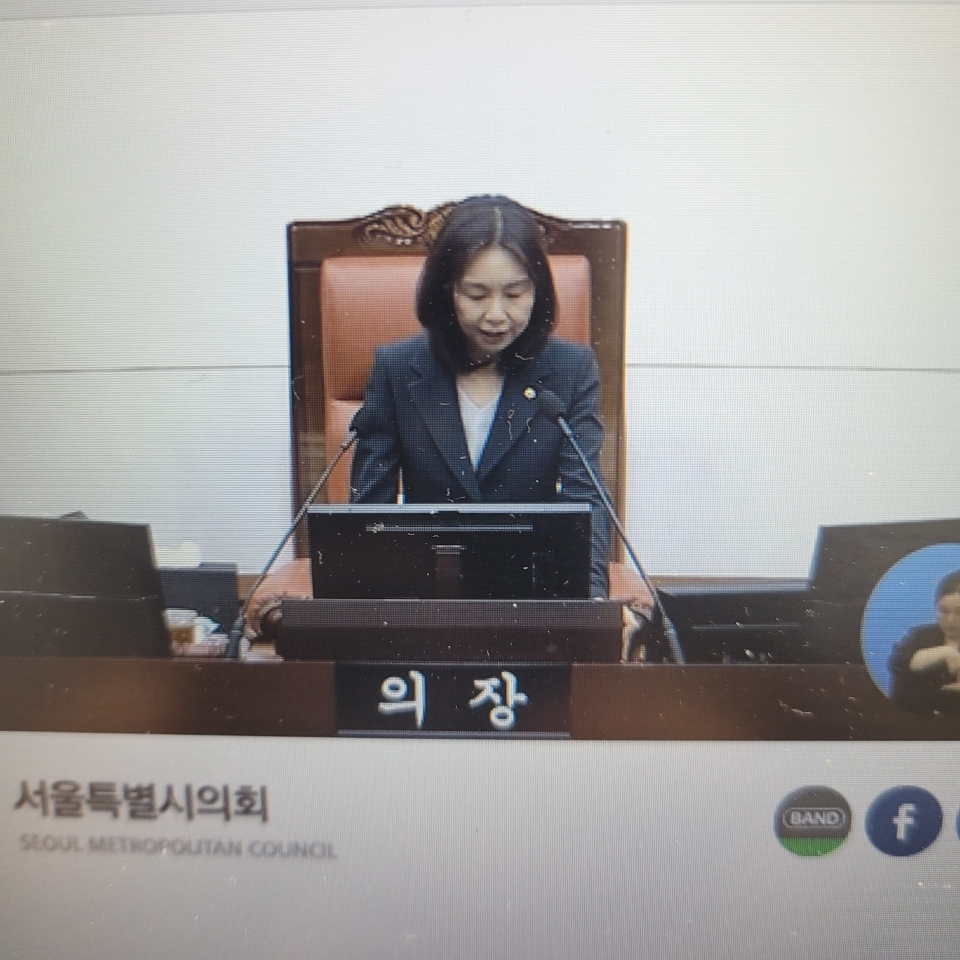
The Seoul Metropolitan Council (Speaker Choi Ho-jeong) opened its 336th regular session Thursday, running for 15 days through June 24.
The session will deliberate and vote on major agenda items including the 2025 Fiscal Year Settlement Approval and a motion to approve changes to the MOU governing the Han River Bus service.
A total of 86 agenda items have been submitted to the 336th regular session — 34 introduced by Assembly members, 44 by the mayor, six by the superintendent of education, and two citizen petitions.
By type, the items include 43 ordinance bills, four settlement approval bills for the 2025 fiscal year covering the Seoul Metropolitan Government and the Seoul Metropolitan Office of Education (including two fund settlement approvals), 32 consent motions, one recommendation, one regulation bill, three opinion-hearing bills, and two petitions.
As the final session of the 11th Seoul Metropolitan Council, the assembly intends to fulfill its oversight and monitoring role — as entrusted by citizens — through thorough deliberation of all agenda items until the last day of its term.
In particular, the council will scrutinize the settlement approval bills to verify whether the Seoul Metropolitan Government and the Seoul Metropolitan Office of Education executed their prior-year budgets appropriately and efficiently in accordance with relevant laws and the purposes for which the assembly granted approval.
The council will also revisit the Han River Bus service MOU amendment — which the Environment and Water Resources Committee rejected at the 335th extraordinary session — after a revised version was resubmitted. Deliberations will focus on issues including the rationalization of labor cost standards used to calculate operating deficits.
In her opening address, Speaker Choi urged the Seoul Metropolitan Office of Education to take an active role in reforming the local education finance grant system, warning against mismanagement of a fund projected to exceed 80 trillion won (approximately $52.5 billion) this year. "For the past four years, the 11th Seoul Metropolitan Council has repeated the mantra 'Into the field, beside the citizens' countless times, always wanting to be closest to the citizens we love," she said. "Until the very end, we will keep the promises we made to citizens through responsible governance and close this chapter beautifully."
Looking ahead to the 12th Seoul Metropolitan Council and the ninth term of elected city government, both set to launch July 1, Choi said "countless challenges and changes await us." She expressed confidence that the incoming administration would "wisely lead Seoul's future — putting the interests of all citizens above those of any particular group, and choosing tomorrow's values over today's praise."
Choi closed by expressing deep gratitude to citizens for their support and trust in the Seoul Metropolitan Council over the past four years.
The session proceeds in three stages: the opening ceremony and interpellation of city administration take place Thursday; committee reviews of the 2025 fiscal year settlement and other referred items proceed in standing committees and the Special Committee on Budget and Accounts from Friday through June 23; and a plenary session to vote on all submitted agenda items is scheduled for June 24, the final day of the session.
The following is the full text of Speaker Choi Ho-jeong's opening address at the 336th session of the Seoul Metropolitan Council.
Dear citizens of Seoul,
Mayor Oh Se-hoon, Superintendent of Education Jeong Geun-sik, and fellow civil servants,
And my sunbae and fellow Assembly members,
Today, Thursday, I call to order the final regular session of the 11th Seoul Metropolitan Council.
Looking back on the past four years, so much has happened.
As we emerged from the long tunnel of COVID-19 and worked to restore everyday life, we wrestled hard with how to be a pillar of strength for citizens burdened by hardship — a shoulder to lean on in difficult times.
Above all, in our effort to make Seoul a safer city, we repeated the mantra "Into the field, beside the citizens" and went wherever we were needed, running tirelessly to strengthen the city's competitiveness.
In that spirit, we listened closely to the will of the people and worked to reflect their voices in city administration and education policy.
Sometimes checking, sometimes cooperating, we walked steadily toward our shared goal of Seoul's development and citizens' happiness.
Thanks to those efforts, Seoul has been able to leap forward as a warmer city, a more livable city, and a global city that people from around the world seek out and love.
Above all, under the value of "walking alongside the vulnerable," Mayor Oh Se-hoon and the civil servants who worked to look after the lives of each and every citizen and advance policies to prepare Seoul for the future — I extend my deepest gratitude for your dedication.
Because of you, citizens were happy, and Seoul shone brightly.
On July 1, the 12th Seoul Metropolitan Council and the ninth term of elected city government will begin anew.
In the four years ahead, countless challenges and changes await us.
Seoul is an aging city carrying the burden of urban deterioration, and its demographic structure is shifting rapidly amid a low birth rate and an aging population.
At the same time, Seoul is growing into a city that the world watches — a dynamic city where new industries, talent, and opportunities continuously converge.
Managing and regenerating an aging Seoul safely, while creating new engines of growth for a new Seoul — this is no easy task, but it is the defining responsibility of our time, one that must be accomplished for Seoul's future.
Advances in AI and cutting-edge technology will dramatically reshape the landscape of industry and employment. Some jobs will disappear while new ones emerge, and that change will bring both anxiety and new opportunity to the lives of individual citizens.
I trust that Mayor Oh Se-hoon and the 12th Seoul Metropolitan Council will wisely lead Seoul's future at the center of these changes — putting the interests of all citizens above those of any particular group, choosing tomorrow's values over today's praise, reducing the risks Seoul faces and expanding the opportunities before it.
At the heart of that path must always be ordinary citizens who quietly build their lives in their own places.
I also have a word for Seoul's education community.
In the recent election, citizens saw the campaign pledges of many superintendent of education candidates across the country — promises to hand out money to students and parents under various pretexts — and were reminded once again, unmistakably, that education offices have ample budgets.
The local education finance grant system, which is the source of education office revenue, cannot continue to operate as it has.
The number of students in Seoul fell below 800,000 this year — down 200,000 from eight years ago and 100,000 from four years ago.
The education grant flowing into local education finance will exceed 80 trillion won this year. Per student, that is double what it was a decade ago.
And yet the burden of private education costs on parents remains severe.
Those in the education sector may be looking the other way, but the education office's coffers are overflowing.
Local governments, meanwhile, are facing increasingly difficult circumstances due to rising welfare expenditures and urban deterioration.
A portion of local education finance must be transferred to general local government finance.
I urge the Seoul Metropolitan Office of Education to take the lead with an open mind in reforming the local education finance grant system.
When the education office shows that it is willing to yield and work together for the good of the entire country, parents will applaud and students will learn from the example.
Education budgets should not be spent on showy projects or on distributing cash and digital devices. They must first be used to transform the school environments where children spend most of their days — improving aging classrooms and deteriorating facilities, and creating safe learning and living environments for students.
In addition, I ask that more active efforts be made to protect teachers' rights, so that teachers struggling with disruptions to their educational activities can focus on teaching with peace of mind.
I thank Superintendent Jeong Geun-sik and all educators for their dedication, and I ask for your continued efforts for the advancement of Seoul education.
Dear citizens, whom I respect and love,
Thank you deeply for the support and trust you have shown the Seoul Metropolitan Council over the past four years.
"Into the field, beside the citizens!" — this is the pledge we have repeated countless times.
The 11th Seoul Metropolitan Council, which always wanted to be closest to the citizens it loves, will keep the promises it made to citizens through responsible governance until the very end, and close this chapter beautifully.
Thank you.
Every moment shared with you has been happiness and honor.
I wish you all health and happiness in the days ahead.
Thank you.
seouldream01@heraldcorp.com