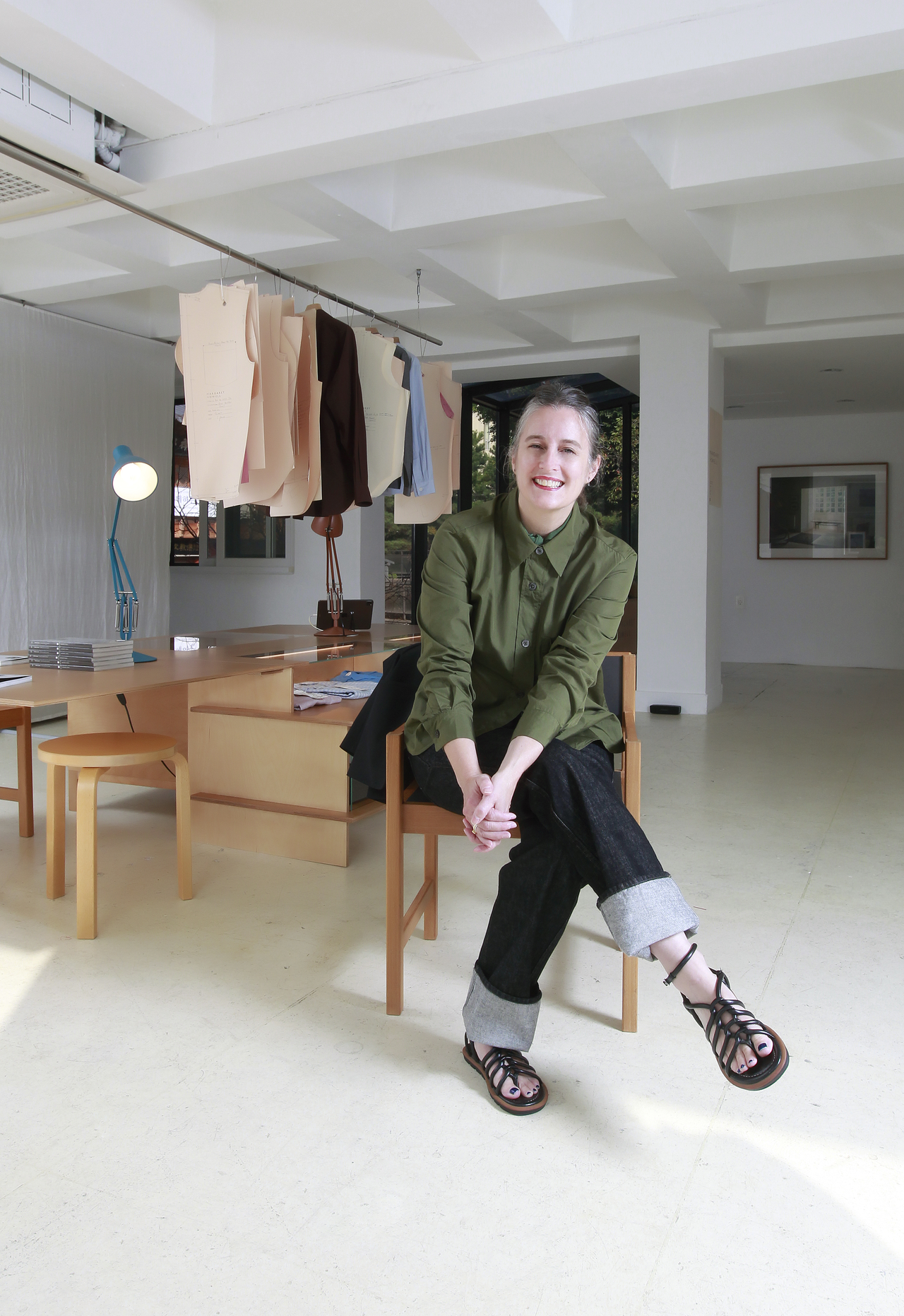
Oh Ji-eun, organizer of the Yeonghui Festival, opens the event Friday
A female musician who stood on Hongdae's uneven playing field
Her answer to an imbalance that never changed
![Singer-songwriter and author Oh Ji-eun, organizer of the Yeonghui Festival [Mapo Art Center]](https://wimg.heraldcorp.com/news/cms/2026/06/12/news-p.v1.20260612.3fc6836f95d64f3b9623d53de865c031_P1.jpg)
"Go back to who you were before you knew me / and keep living like you're so smart." ("Hwa," 2007)
"You don't love me — you love the feeling inside you that loves me." ("It's Not That You Love Me," 2009)
"I'm sorry for being only this much / sorry for being a person who can only amount to this." ("Only This Much," 2013)
She led with contempt and curses where others offered tears. Where compliance was expected, she wrote with an intimacy stripped of romance. She did not dress love up, nor did she consume heartbreak as sorrow. She cursed and blamed herself, and she dissected the hypocrisy of relationships. Lyrics tossed out like offhand remarks dismantled every defense. Singer-songwriter Oh Ji-eun earned the nickname "Witch of Hongdae" in an era that sorted indie female musicians into two camps: goddesses and witches. In those days, a male colleague once asked her:
"You didn't actually write the lyrics to 'It's Not That You Love Me' yourself, did you?"
Oh Ji-eun, now 45, replied more bluntly than any lyric she had written. "Are those lyrics really that remarkable? Is there something profound about them? Or do I just look very pretty to you?"
In certain circles, gender was treated as a ceiling on ability. No matter what explanation she was given, something always felt wrong, she said. Eventually, she turned the arrow on herself.
"I kept manufacturing reasons to convince myself I had somehow invited being undervalued. I wanted to make sense of that question on my own terms," she said.
She debuted in 2007 and spent roughly a decade working at full tilt before leaving Hongdae behind. Some distance gave her room to look back — to examine the particular music world that "Hongdae" had meant for her as a creator. The woman who had answered persistent questions with self-deprecation and self-blame found a new kind of answer.
That answer is a festival for people who were endlessly consumed yet consistently misread. It is called the Yeonghui Festival, running Friday through Sunday at Mapo Art Center. The name — so common it had long been invisible — has returned. It means both "an ordinary name" and "glory and joy."
![Singer-songwriter and author Oh Ji-eun, organizer of the Yeonghui Festival [Mapo Art Center]](https://wimg.heraldcorp.com/news/cms/2026/06/12/news-p.v1.20260612.03c2d2c0b1e04a7fab483faa8b4b816c_P1.jpg)
Worse than the '90s: the goddess-or-witch divide
The seed of the Yeonghui Festival was planted 30 years ago. "It started as a delusion," Oh said with a laugh. She was reading a magazine article about Lilith Fair, the women-led singer-songwriter festival that launched in the United States in 1997. The festival was born out of a severe imbalance in the American mainstream music industry.
"Radio, one of the most important outlets in the American music industry, had a rule: if two female musicians appeared as guests in consecutive weeks, stations would stop playing their songs, saying the programming had become too one-sided. This was happening even as Sarah McLachlan reached No. 3 on the Billboard charts and Alanis Morissette's album sold 30 million copies," she said.
A rule that never applied to male musicians drove female artists of 1990s America to band together. For Oh as a high school student, Lilith Fair was "the stage I wanted to stand on if I was going to make music."
Oh entered the indie scene in 2006 when she won a bronze prize at the Yoo Jae-ha Music Contest. The following year she debuted with her first album, "Jieun," and made an immediate impression on Hongdae. She released the self-produced record through Hyang Music, and it sold 10,000 copies without a single line of promotion — finishing second on the charts behind only a long-awaited new Toy album by Yoo Hee-yeol. The Hongdae indie scene she entered, however, was a more tilted playing field than the American music industry where Lilith Fair had been held two decades earlier.
"For a long time I watched, like a dog sitting outside a village school, how music festivals were planned and by whom," she said. "Some people get called because they're popular, some because they have a devoted following, some because of their artistic credibility. Behind those judgments, the unconscious biases and personal tastes of the decision-makers weigh heavily."
"It's like a job interview where the company already has a specific ideal candidate in mind. If the decision-makers are of a particular gender and a particular age group, I started to wonder whether that might be influencing things," she said.
![Performers at the Yeonghui Festival [Mapo Art Center]](https://wimg.heraldcorp.com/news/cms/2026/06/12/news-p.v1.20260612.bd8a966b03c2466d9761db7855e6c942_P1.jpg)
The selection criteria were fairly simple. Gender played a significant role in shaping festival lineups. "There was a pattern — sometimes I'd get the call, sometimes I wouldn't — and every time it happened I felt a sense of unease," Oh said. When she did appear on a festival stage, no other female musicians were on the bill. "The analogy isn't perfect, but it felt like a quota system — like a special admissions track for rural students at a university," she said.
She saw the industry's attitude as performative generosity — inviting one female musician to tick a gender box and presenting it as a remarkable act of consideration. "There were so many outstanding female creators in the scene, yet promoters kept using the excuse that women's music wasn't popular and didn't draw crowds," she said.
She argued that the industry had long misread female fandom. "At every label meeting I'd hear, 'We have no idea where Oh Ji-eun's fans are hiding,'" she said. "Female listeners who love female singer-songwriters express that love in a very private, exploratory way — and the industry interpreted that as having no fans at all."
Now also active as an author, she hears similar confessions at book talks. "People come up and say they finally worked up the courage to come after 10 years," she said. "'I had a prejudice, so I never listened to your music.' They told me they had kept their distance from female creators' work because they were afraid society would look down on them for liking it."
The indie scene turned 31 this year, yet female creators have always been treated as exceptions — classified as "women" rather than recognized as musicians. Producers divided them in a medieval fashion, like the women of Wagner's operas: the binary of goddess and witch. This is why, in the mid-to-late 2000s, the taunt that "Hongdae is a shrine" began to circulate. Oh's sensibility did not fit the "Hongdae goddess" mold, so she was labeled the "Hongdae Witch." The first to hold that title was Kim Yoon-ah.
"Whether goddess or witch, those were not titles any of us chose. None of us wanted to be called that. Even the so-called goddesses would wave their hands in protest whenever the subject came up," she said.
![Singer-songwriter Oh Ji-eun [Mapo Art Center]](https://wimg.heraldcorp.com/news/cms/2026/06/12/news-p.v1.20260612.4c1d5307f80f48cbbb024b3a573f96ba_P1.jpg)
Fashion magazines of the era ran photo spreads framing the Hongdae goddesses and witches as a good-versus-evil tableau, while music programs lumped them together under the banner of "Hongdae female musicians." Oh fought hard against that framing and avoided those programs whenever she could.
"It felt less like independent musicians doing their own thing and more like corralling female musicians together and treating them as interchangeable," she said. "I felt that the moment you got grouped that way, another layer of prejudice would be plastered on top." She saw the "Hongdae goddess" label as a naked marketing strategy — industry insiders using those musicians as a kind of signboard. "It was a lure: 'There are goddesses in Hongdae, come take a look.' But underneath it was a way of saying, 'Our real music is something else entirely,'" she said.
Because witches were outnumbered by goddesses, the "Hongdae Witch" label gave Oh an unusual position. "The nickname became a kind of exemption — it let me slip past that enclosure on my own," she said quietly. "Maybe that's why I've always felt a sense of debt toward my peers and the musicians who came after me."
She was never a headliner on a festival's main stage, but the "witch" label did earn her top billing on smaller stages, and she was booked for prime slots on main stages as well. Perhaps for that reason, whenever she raised the gender imbalance in festival lineups, the response was that she was making too much of it. "You still got to stand on a festival stage," people told her. "Why are you so greedy? What more do you want?"
"If Billie Eilish had debuted in Korea, she would have started out on the waterside stage at Grand Mint Festival — the one smaller than the main 88 Lawn stage. (Laughs.)" And she might well have been handed a nickname like "Hongdae Witch" of her own.
'Shy' fans come out: every seat, every showing sold out in one minute
The years of anger, endurance and self-blame are behind her. While living in Jeonju after turning her back on Hongdae, Oh's perspective widened. Working as an author, she tracked developments in publishing and literature, and observing music scenes abroad helped her recognize, with some objectivity, just how distorted the gender bias in Korean indie music had become.
The shift in her thinking came when she saw the reality facing younger musicians. Kim Sa-wol, Ahn Da-young and Jeong Woo — artists who had built distinctive musical worlds and were among the most respected figures in the indie scene — sought her out and unburdened themselves.
"At some point I realized these younger musicians had all become veterans in their own right, building their own musical worlds, and yet they were making the trip to find me out in the countryside to open up. These were worries they couldn't share anywhere else — worries I had held onto for so long and desperately wanted to be rid of," she said.
![Performers at the Yeonghui Festival [Mapo Art Center]](https://wimg.heraldcorp.com/news/cms/2026/06/12/news-p.v1.20260612.265287a68ec049a0abaca71e95378438_P1.jpg)
The emotional years Oh had lived through were not history — they were still happening. The structural imbalances, the contradictions, the layers of prejudice remained. The younger musicians were repeating, like a loop, the same self-directed blame she had once inflicted on herself. "The time I thought I had survived alone looked different to me," she said. "The biased environment is still there — if anything, it may be worse."
"Back then there was still a program like 'Yoo Hee-yeol's Sketchbook,' and if you played the 4 p.m. slot on the lawn stage at Grand Mint Festival, people who hadn't come to see you specifically would still notice you as they wandered around," she said. "But now, in the age of algorithms, the gap between 'known to those who know' and everyone else has grown wide."
As more and more younger musicians she had never met began showing up at her door, a conviction took shape inside her. These younger female creators were no longer promising rookies — they were already masters who had each built their own era.
"I realized that gathering just these people alone would already make a full day's festival." Her mind raced. "I kept thinking someone else should do this, but something felt off — surely not… is it me? (Laughs.)"
She ultimately put her own life on pause. She canceled "Gosari's Night," her signature concert she had staged every four years, and postponed a forthcoming essay collection about her life in Jeonju. Instead, she spent four months preparing the Yeonghui Festival in what amounted to unpaid work.
"Everyone agreed to participate for fees that were almost nothing. Kim Yoon-ah sunbae heard the concept and said 'I'm in' within 30 seconds. Sunwoo Jung-a joined without us ever having met. Everyone was hungry for something like this," she said.
Blind tickets — released before the lineup was even announced — sold out in one minute, a strong result for a three-day festival running across three venues including Mapo Art Center's 1,004-seat main hall. The day she heard the news, Oh sat alone in her Jeonju home and wept — joy and sorrow, anger and indignation all mixed together.
"It was the kind of tears you read about in 'Romance of the Three Kingdoms' — rough, furious tears, wringing a teacup in your hands. I kept thinking: 'See? I told you. The audience wanted this all along,'" she said.
Countless days had passed. Twenty years of prejudice absorbed in the Hongdae scene, all those days of standing on a tilted field and still finding ways to blame herself — it all came back in a panorama. "In that one minute, the audience gave proof that the prejudice and misreading heaped on female musicians was wrong," she said.
The Yeonghui Festival has brought together female musicians who for years existed like islands scattered across the sea. "If you connect islands standing alone on the ocean, they form one complete constellation," she said. "This festival is itself the lineage of Hongdae's female musicians."
![Performers at the Yeonghui Festival [Mapo Art Center]](https://wimg.heraldcorp.com/news/cms/2026/06/12/news-p.v1.20260612.8620f65fee124bfcb1b6cc0c4d533fb1_P1.jpg)
Like Han Kang in literature: toward a new default in music
Oh Ji-eun seemed like someone who had walked out of the victimhood and shadow-boxing that had once confined her. Watching the evolution of publishing and the literary world through her work as an author gave her hope that the music scene could change too.
"Even reading descriptions in Haruki Murakami's novels — a slip left behind by a woman — I desperately tried to project myself into the perspective of the middle-aged male protagonist making pasta, even though I was the subject being described. Reading Cho Jung-rae's 'Taebaek Mountains' or Kim Hoon's 'Sword Song,' I would inhabit the rough masculine consciousness. We were educated to see that as the 'cool, grand, mainstream literature.' The intimate writing of female authors was dismissed as 'speculative, shallow women's literature' — that was the sensibility of the 1990s," she said.
Around the time Han Kang received the Nobel Prize in Literature, the literary world shifted. "Now, if all 10 winners of the Young Writer Award are women, the public and critics accept it naturally," she said. "The music scene felt stuck in a very old grammar." The Yeonghui Festival, she said, is "the most sophisticated question and answer" she can throw at a stagnant scene.
The festival, made for every "Yeonghui" in the world, has assembled female creators in a way that has never been done before. Kim Yoon-ah, Lee Sang-eun and Sunwoo Jung-a headline alongside contemporaries including Kim Sa-wol, Yozoh, Ahn Shin-ae, Ahn Da-young and Lee Rang. Beyond music, the program spans book talks, film Q&As, exhibitions and comedy. "For anyone starting out in music, I hope the hard times are as short as possible, and that they can fully enjoy the glory and joy they deserve — and spend as little time as possible doubting themselves," she said.
This year's performers will each perform a song by a female singer-songwriter they would like to invite to the next Yeonghui Festival. The artists they chose are Taylor Swift and Billie Eilish.
"I think the best singer-songwriter in Korean pop right now is Rosé," Oh said. "People talk about Psy of 'Gangnam Style' as a great songwriter and producer, but no one talks about Rosé that way. I'd love to have Rosé, CL and IU — outstanding female musicians like them," she said with a smile.
The most ideal future Oh envisions is, paradoxically, a world where the Yeonghui Festival is no longer needed — an era when female creators no longer have to be grouped and explained separately, when a female singer-songwriter headlining the main stage of a major festival is no longer remarkable. Until that day, the Yeonghui Festival will keep going.
"This is not a stage only for female creators. It is a festival for everyone who has experienced self-denial and being undervalued — for everyone who carries a 'Yeonghui' inside them," she said. "Ultimately, I dream of this festival becoming obsolete."
shee@heraldcorp.com