Late bloomer who entered film after a decade in public service
Debut film earned him rookie director honors at Blue Dragon, Baeksang
Led Bucheon Fantastic Film Festival for six years
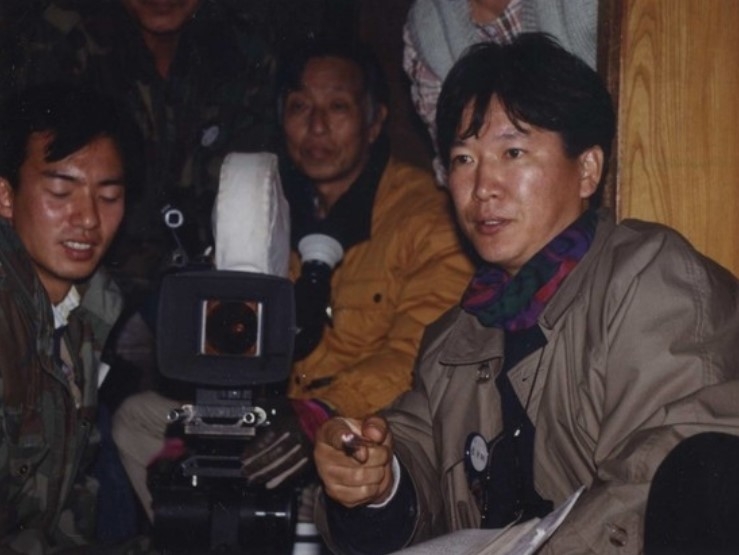
Director Kim Young-bin, who left a bold mark on Korean cinema in the 1990s with muscular, male-driven narratives in "Kim's War" (1992) and "Terrorist" (1995), has died. He was 71.
Kim died Sunday after a sudden illness, according to the film industry.
His path into filmmaking came later than most. Born in 1955, Kim spent a decade in public service before enrolling in the theater and film program at Hanyang University, graduating in his early 30s. He had publicly vowed to join the crew of director Im Kwon-taek, and he kept that promise — spending more than six years as an assistant director on Im's films, including "Surrogate Mother" (1986), "Adada" (1987) and "Come, Come, Come Upward" (1989).
His directorial debut brought a real-life story to the screen. "Kim's War" was based on the 1968 incident in Shizuoka, Japan, in which ethnic Korean resident Kim Hee-ro shot and killed two gang members who had subjected him to ethnic discrimination and threats, then took hostages at an inn. The lead role was played by actor Yoo In-chon, who would later serve as Minister of Culture, Sports and Tourism. The debut film alone earned Kim the rookie director prize at the 13th Blue Dragon Film Awards, the rookie director and screenplay awards in the film category at the 28th Baeksang Arts Awards, and the rookie director prize at the 12th Korean Film Critics Association Awards.
After "No Exit" (1993), Kim released "Terrorist," the film that cemented his name with the public. Written by Kim himself, it told the tragedy of two orphaned brothers who grew up dreaming of becoming police officers, only to end up on opposite sides of the law. Choi Min-su played the younger brother Su-hyeon and Lee Kyeong-yeong the elder Sa-hyeon, with Yeom Jeong-a rounding out the cast. Choi won best actor and the popularity award at the 16th Blue Dragon Film Awards for his performance.
Kim's subsequent filmography — "Come to Me" (1996), again with Choi Min-su, and "Phoenix" (1997), starring Lee Jung-jae, Oh Yeon-su and Son Chang-min — kept male characters torn between violence and desire at its center. In the 2000s he directed "Run" (2007) and "Urban Romance" (2011).
Kim remained connected to cinema beyond the set. After serving as chairman of the South Jeolla Province Film Commission's steering committee, he joined the faculty of Inha University's theater and film department in 2008. In February 2010 he was appointed the fifth executive director of the Bucheon International Fantastic Film Festival, a post he held through 2015, overseeing the 14th through 19th editions. At the time, he was the only working director among the heads of South Korea's major international film festivals. During his tenure he worked to bring the festival's core facilities together at Bucheon City Hall and its lawn plaza into a unified "Festival Center," with a focus on making the event a celebration for ordinary citizens. "Since taking on the role of executive director, I have aimed to make this a film festival that belongs to the citizens," he said in an interview that year.
The funeral is being held at Wooju Funeral Home in Goheung-eup, Goheung-gun, South Jeolla Province. The funeral procession departs Tuesday at 9 a.m., and the burial will take place at Seoul Memorial Park.
shee@heraldcorp.com