Statement draws nearly 1,900 signatures in a single day
Signatories call for scrutiny of hierarchies in admissions, hiring and casting
"We hope our juniors can respect their teachers without fearing them."
In the world of Korean traditional music, students learn from their teachers, take the stage on their teachers' recommendations, and lose their footing the moment they fall out of favor. That tight bond between teacher and student, a confession from within the field now makes clear, has long served as a curtain concealing sexual violence.
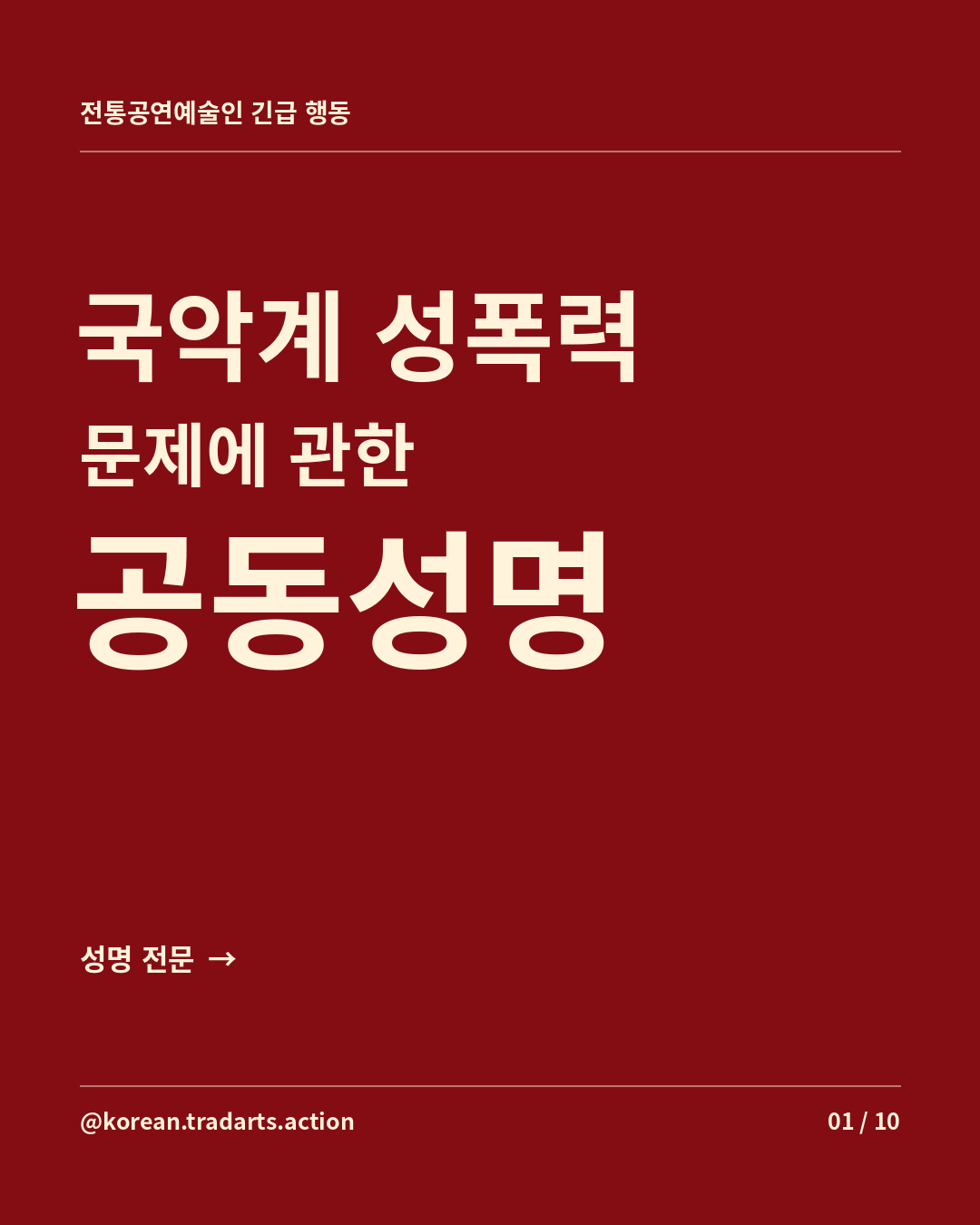
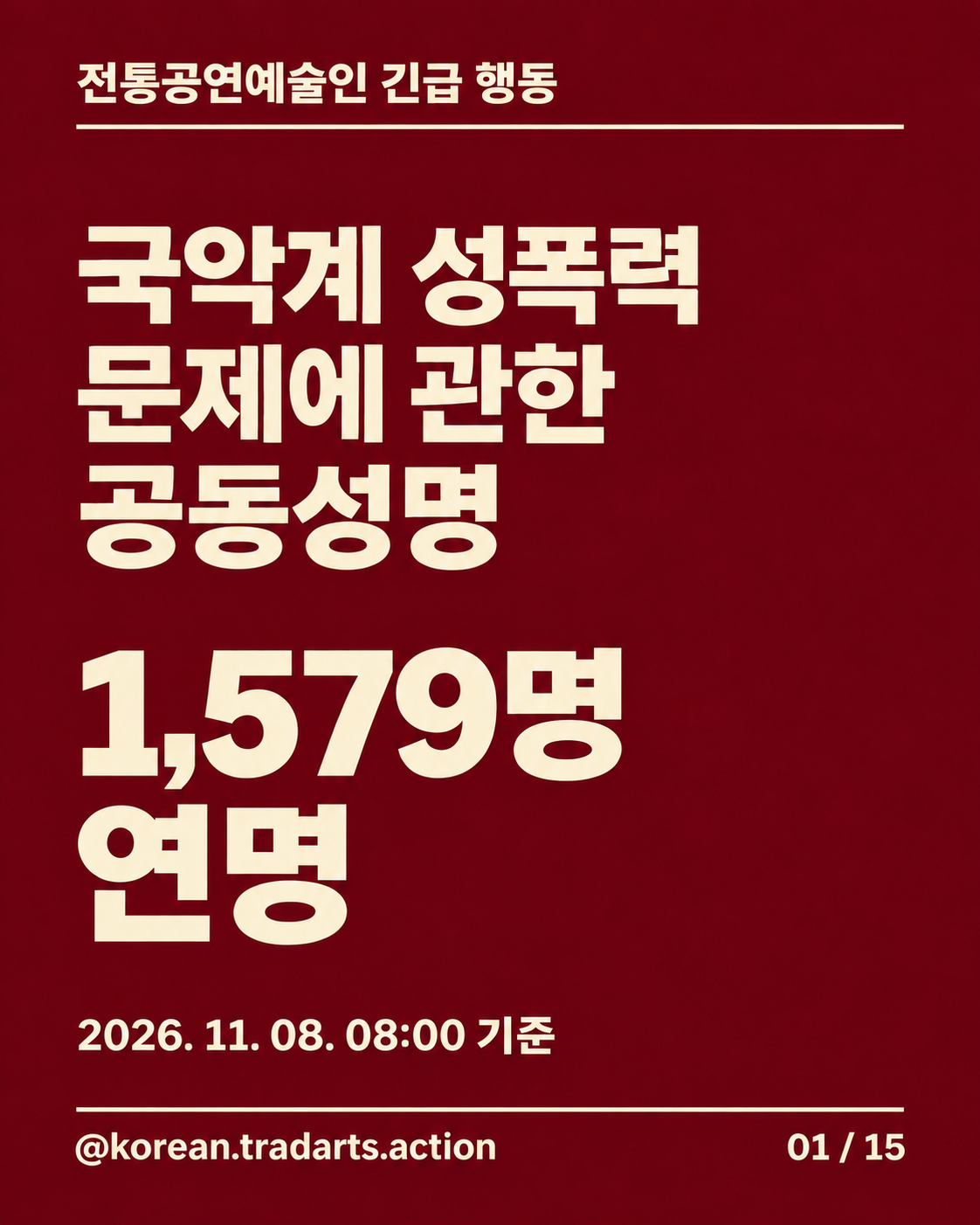
A joint statement on sexual violence in the gugak community, published Saturday at 10:30 a.m. by Traditional Performing Arts Emergency Action, had drawn more than 1,900 signatures by 11 a.m. Sunday — roughly one day after its release, according to the group. More than 500 of the signatories were students. The statement drew names from across the performing arts, academia and arts education, and spread rapidly through Facebook and Instagram.
The list of initiators lends the statement considerable weight. Thirty current professors, performers, critics, directors, broadcast producers and organizers put their names to it — among them Seoul National University professors Lee Ji-young, Heo Yun-jeong and Kim Jeong-seung, Dankook University professor Kang Eun-il, and Korea National University of Arts professors Ryu Kyeong-hwa and Jeon Ji-young. Those who hold the keys to admissions decisions, hiring and adjudication have themselves raised the question of structural failure.
A month of accusations — 'We stayed silent even during #MeToo'
Sexual violence cases in the gugak world have surfaced one after another since last month. A member of the National Gugak Orchestra, identified only as A, was indicted on charges of groping a student the member had taught since middle school at a year-end gathering. Prosecutors sought a summary order of 3 million won ($2,240) in fines, but the victim requested a full trial. At the National Traditional Arts High School, two male third-year students were referred to prosecutors without detention in January on charges including aggravated rape after allegedly assaulting a classmate and filming it illegally at a music practice room in Anyang, Gyeonggi Province, in May last year. The two students graduated and enrolled in university without any disciplinary action while school violence committee proceedings dragged on. It took 291 days from the initial report to the conclusion of the school violence case.
The matter spilled into the National Assembly's national audit. Choe Hwi-yeong, minister of culture, sports and tourism, whose ministry oversees the National Traditional Arts High School, bowed at the Oct. 23 audit, saying, "As minister of culture, sports and tourism, I feel deeply sorry and bear a heavy sense of responsibility."
Accusations continued to emerge. Police received a complaint alleging that a prominent gugak performer who had won a presidential award sexually exploited a minor student over more than four years. The performer's side has denied the charges. It also came to light that an elementary school vice principal who taught gugak at a graduate school of education had been fined for groping a graduate student. Of 11 court rulings on sex crimes by gugak practitioners involving teacher-student relationships from 2010 through this year, seven involved minor victims — and in four of those cases, the victims were under 13.
The statement also contained a candid admission: when the #MeToo movement swept through the arts and culture world in 2018, the gugak community stayed silent and looked the other way. In a narrow industry, becoming both a victim and an accuser meant being stigmatized — and that stigma, the statement concluded, pushed victims out of gugak entirely.
Lesson rooms, auditions, transmission halls — the silence hierarchy creates
Most of the offenses documented in court rulings took place in lesson rooms and classrooms. For a student preparing for college entrance auditions, a teacher is at once an instructor, a reference writer and, at times, a judge. In the case involving the prominent performer, the performer's spouse was reportedly the victim's high school major instructor — linking the lesson room, the school and the auditions in a single chain. The same dynamic appeared in the transmission of intangible cultural heritage. One student who raised objections to a teacher's misconduct endured accusations of trying to sabotage a living national treasure's reputation, and ultimately had to leave the transmission hall.
The statement sets out three demands. First, it urges schools, affiliated institutions and arts organizations to conduct swift, independent investigations whenever a complaint is filed, and to impose penalties commensurate with confirmed acts of sexual violence. It also calls on them not to shield perpetrators on the basis of a colleague's reputation, achievements or teacher-student ties. The second demand is for self-reflection within the gugak community itself. Treating sexual violence as individual misconduct alone, the statement argues, leaves intact the entrenched practices and hierarchies of admissions, hiring, recommendations and casting that make it so difficult for victims to speak out.
The third demand is directed at the government and public institutions. The statement calls on the Ministry of Culture, Sports and Tourism, education authorities and national and public institutions to conduct a comprehensive survey covering schools, universities, private lessons, public ensembles and performance venues. Specific measures proposed include independent reporting and counseling channels that bypass those who evaluate or cast victims, the exclusion of interested parties from investigations, protective measures for minor victims, operating standards for private one-on-one lessons between teachers and students, prevention education, and conflict-of-interest management standards for admissions, hiring and auditions. The statement also demands that those confirmed as perpetrators be barred from performances, teaching, adjudication and hiring, and that the responsible agencies and implementation timelines be made public.
Why did the measures from eight years ago fall short?
These demands are not new. During the 2018 #MeToo movement, the Ministry of Culture, Sports and Tourism and the National Human Rights Commission of Korea ran a 100-day special investigation team on sexual harassment and violence in the arts, and put forward policy tasks including the establishment of a dedicated body and the exclusion of perpetrators from public support. Sector-specific reporting and counseling channels were subsequently set up. Yet eight years on, victims in the gugak world have continued to delay reporting out of concern for their careers. That is why the statement repeatedly emphasizes "ongoing protection" over "reactive response." How to detect harm before it is disclosed — in spaces like lesson rooms and transmission halls that institutional oversight struggles to reach — remains an unresolved challenge.
One signatory wrote, "A permanent protection system that operates immediately, without requiring victims to go public, must be established." Another, who noted they were not a gugak practitioner, said they had witnessed similar things happening to seniors and juniors while receiving arts education.
Traditional Performing Arts Emergency Action plans to collect signatures for two weeks while gathering field opinions through public forums and panel discussions to develop policy recommendations. "This joint statement is not a one-time expression of anger over a specific incident," the group said. "It is the shared resolve of those in the field that silence and inaction must no longer be repeated. We need a permanent protection system capable of identifying danger and protecting victims before they are forced to come forward publicly."
shee@heraldcorp.com