Seoul National University Hospital analyzes default mode network in drug-naive adolescents with depression; stronger links between depressive-thought regions and sensory-cognitive areas tied to greater symptom reduction

Many parents of teenagers have told themselves: "It's just puberty — they'll grow out of it." But while adolescence is naturally turbulent, stress from academic pressure and high expectations can tip into clinical depression, which may persist into adulthood. Researchers have now published findings showing that brain functional connectivity, measured before treatment begins, can help predict how well a depressed teenager will respond to antidepressants.
A new study confirms that checking the brain's functional connectivity before treatment can predict antidepressant response in adolescent depression patients. Specifically, the stronger the pre-treatment connections between the brain region governing depressive thinking and areas involved in sensory processing and cognition, the greater the reduction in depressive symptoms after medication.
A research team led by professor Kim Jae-won of the Department of Child and Adolescent Psychiatry at Seoul National University Hospital — together with professor Jang Moon-young of the Department of Psychiatry at Korea University Guro Hospital and professor Lee Kyung-hwa of the Biomedical Research Institute at Seoul National University Hospital — analyzed the relationship between pre-treatment brain functional connectivity and antidepressant response in 70 adolescent depression patients aged 12 to 17 who had no prior drug treatment. The team announced the findings Friday.
Adolescent depression, which develops during a critical period of brain growth, can lead to impaired academic and social functioning if not treated promptly and may affect mental health in adulthood. Because adolescents differ from adults in their neurobiological mechanisms and tend to express depression through physical complaints, their responses to drug treatment also differ. Although selective serotonin reuptake inhibitors (SSRIs) are the first-line treatment, some patients show drug resistance or side effects — and with no reliable biomarker to anticipate these outcomes, the need for new predictive tools has been pressing.
The research team turned to the brain's default mode network (DMN), which has drawn attention as a predictive marker for treatment response in adult depression. The DMN activates when a person is at rest; it comprises the ventromedial prefrontal cortex, dorsomedial prefrontal cortex and posterior cingulate cortex, and is closely linked to inward-directed cognitive processes such as self-reflection and rumination — as well as to depression itself.
The team conducted the study with 70 drug-naive adolescent depression patients seen at the Mood and Anxiety in Youth (MAY) Clinic in the Department of Child and Adolescent Psychiatry at Seoul National University Hospital. To isolate the pure therapeutic effect of antidepressants, no other psychological interventions such as cognitive behavioral therapy were administered alongside. Before treatment began, each patient underwent approximately 10 minutes of resting-state functional MRI (rs-fMRI) to measure "functional connectivity" — how closely different brain regions exchange signals with one another. Patients then received the SSRI escitalopram for eight weeks.
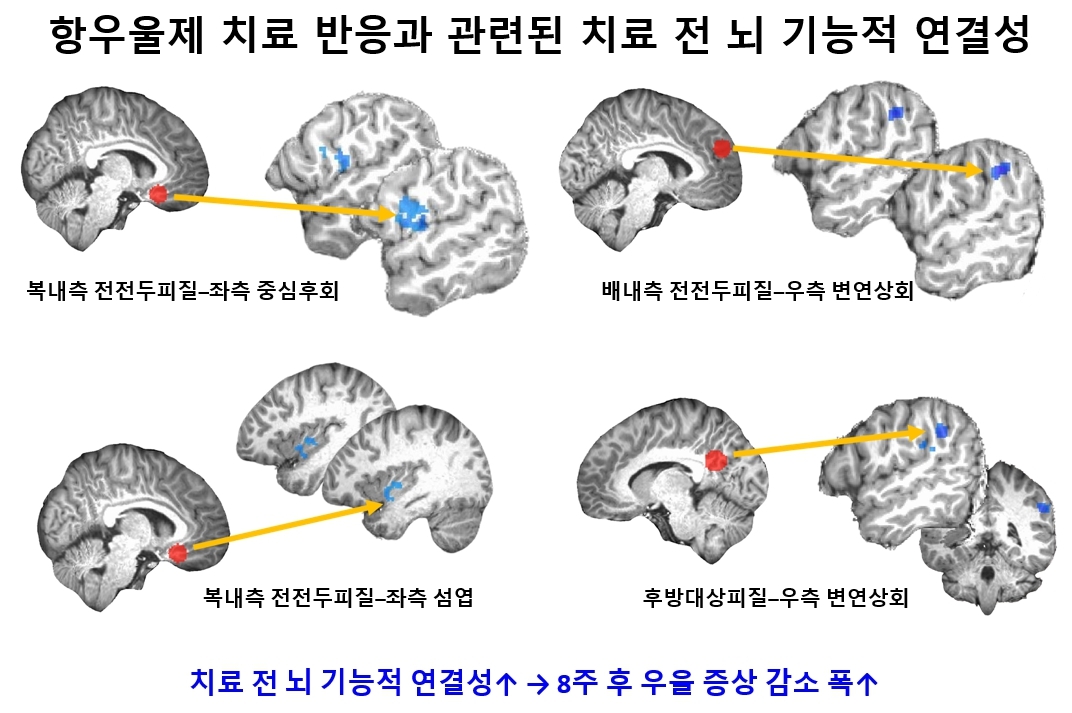
The average depression score on the Children's Depression Rating Scale-Revised (CDRS-R) fell from 58.59 before treatment to 43.11 after eight weeks, a mean decrease of 15.47 points. Patients whose three core DMN regions showed stronger pre-treatment connectivity with areas handling physical sensory processing — the insula and postcentral gyrus — and with the supramarginal gyrus, which is involved in cognitive control, showed significantly greater symptom reductions.
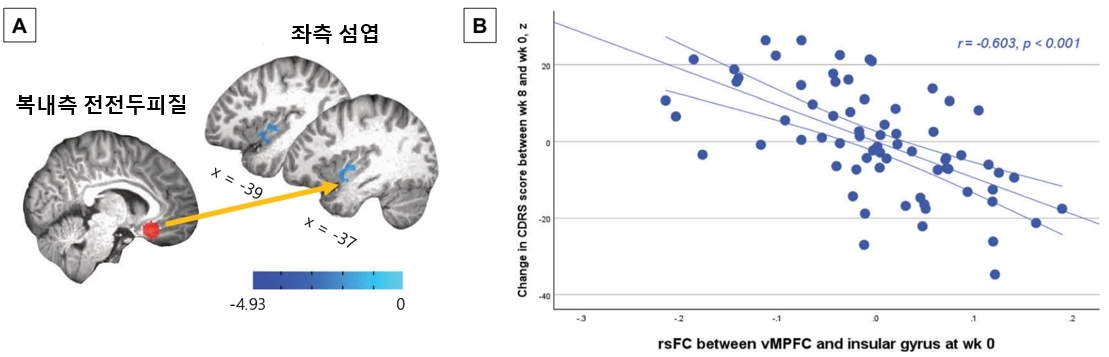
More specifically, stronger connectivity between the ventromedial prefrontal cortex and the left postcentral gyrus, between the ventromedial prefrontal cortex and the left insula, between the dorsomedial prefrontal cortex and the right supramarginal gyrus, and between the posterior cingulate cortex and the right supramarginal gyrus were each significantly associated with greater reductions in depressive symptoms — all four connections reaching statistical significance (p < 0.001). By contrast, connectivity among the internal regions of the DMN itself showed no relationship with treatment response.
The findings suggest that the brain's ability to prevent excessive negative thinking and to communicate smoothly with areas that process external stimuli may be a key mechanism underlying successful treatment. Given adolescents' tendency to express depression through physical symptoms, the research team said the capacity to connect with sensory neural networks may be a major factor determining treatment response.

"Adolescent depression may involve neurobiological mechanisms distinct from those of adult depression, given the characteristics of the developmental stage," said professor Jang Moon-young of Korea University Guro Hospital. "These results provide an important clue for understanding and predicting antidepressant treatment response in adolescent depression."
Professor Kim Jae-won of Seoul National University Hospital said the study "demonstrates that antidepressant treatment response in adolescent depression may be related to individual differences in pre-treatment brain functional connectivity." He added that larger-scale research and the development of predictive models could yield "a biomarker that helps select more appropriate treatment strategies for patients from the very start of treatment." The findings were published in the latest online edition of the international journal Neuropsychopharmacology (impact factor 7.1).
kty@heraldcorp.com