
Kospi falls 8.29%, Kosdaq drops 9.08%
Circuit breakers, sell sidecars triggered in both markets
Foreign investors post net selling for 21st consecutive session
US rate hike fears, Middle East tensions freeze investor sentiment
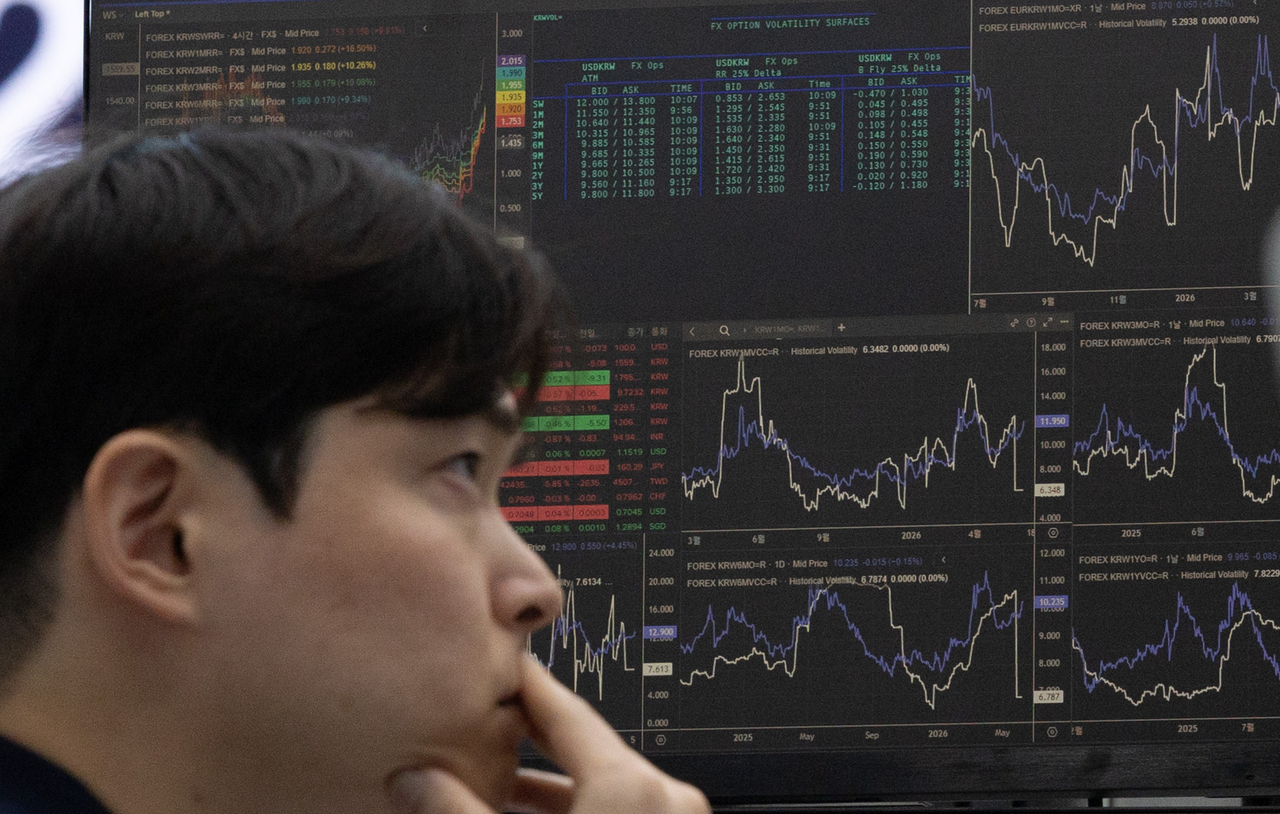
South Korea's stock market suffered a "Black Monday." Fears of a US interest rate hike and escalating geopolitical risks in the Middle East combined to send the Kospi and Kosdaq tumbling 8 to 9 percent, triggering both circuit breakers and sell sidecars — temporary halts on program sell orders — in both markets.
The Kospi, which broke above the 8,000 mark for the first time in history last month, was pushed back to the mid-7,000 range in just 14 trading sessions, as relentless foreign selling and a sharp drop in large-cap technology stocks froze investor sentiment across the board.
According to Korea Exchange, the Kospi closed down 676.18 points, or 8.29 percent, at 7,484.41 on Monday. The point decline was the second largest on record, trailing only the 698.37-point drop logged on March 4. Circuit breakers and sell sidecars were triggered in quick succession shortly after the opening bell.
A circuit breaker halts all trading on the securities market for 20 minutes to prevent panic selling when share prices fall sharply.
The Kospi opened down 112.50 points, or 1.38 percent, at 8,048.09, then extended its losses to break below 8,000, at one point touching an intraday low of 7,442.73. The index had first crossed 8,000 intraday on May 15 — its first time ever — making Monday's breach just 24 calendar days, or 14 trading sessions, later.
Foreign investors and institutional investors sold a net 354 billion won and 1.627 trillion won, respectively, on the Kospi, weighing on the index. Retail investors were the sole buyers, posting net purchases of 1.763 trillion won. Foreign investors' selling pressure eased somewhat from prior sessions, but Monday marked their 21st consecutive session of net selling.
The Kospi tumbled in the wake of a technology-led selloff on Wall Street and renewed tensions in the Middle East. Strong US employment data fueled expectations that the Federal Reserve could raise interest rates, prompting investors to offload technology stocks including Nvidia and Micron Technology in New York.
The fallout hit South Korea's blue-chip technology names hard, with Samsung Electronics falling 10.18 percent and SK Hynix dropping 7.68 percent, pushing their share prices below 300,000 won and 2 million won, respectively. Hyundai Motor, Samsung Electro-Mechanics and LG Energy Solution also declined.
Among the top 50 stocks by market capitalization, only Naver and SK Telecom — both buoyed by positive news tied to Nvidia CEO Jensen Huang — finished in positive territory, with SK Telecom edging up 0.28 percent.
The Kosdaq closed down 91.05 points, or 9.08 percent, at 911.39. It opened down 42.83 points, or 4.27 percent, at 959.61, then deepened its losses throughout the session, failing to reclaim the 1,000 level.
Sell sidecars and circuit breakers were also triggered on the Kosdaq. Foreign investors were net buyers of 298 billion won on the Kosdaq, while retail and institutional investors sold a net 125 billion won and 146 billion won, respectively. Most individual stocks declined, including Ecopro BM, Alteogen, Ecopro and Rainbow Robotics.
The won weakened against the dollar amid foreign selling, geopolitical uncertainty and US rate hike concerns. As of 3:30 p.m., the won traded at 1,535.0 won per dollar in the Seoul foreign exchange market, down 4.1 won from the previous session. The won-dollar rate had climbed to the mid-1,550 range in the morning before easing after verbal intervention by currency authorities.
th5@heraldcorp.com





