Demand deposits at the five major banks shed more than 15 trillion won in just two weeks, as retail investors rushed to buy the dip during a volatile market. The outflow is intensifying pressure on banks and savings institutions to raise deposit rates and launch customer-retention campaigns, even as the Bank of Korea signals a rate hike ahead.
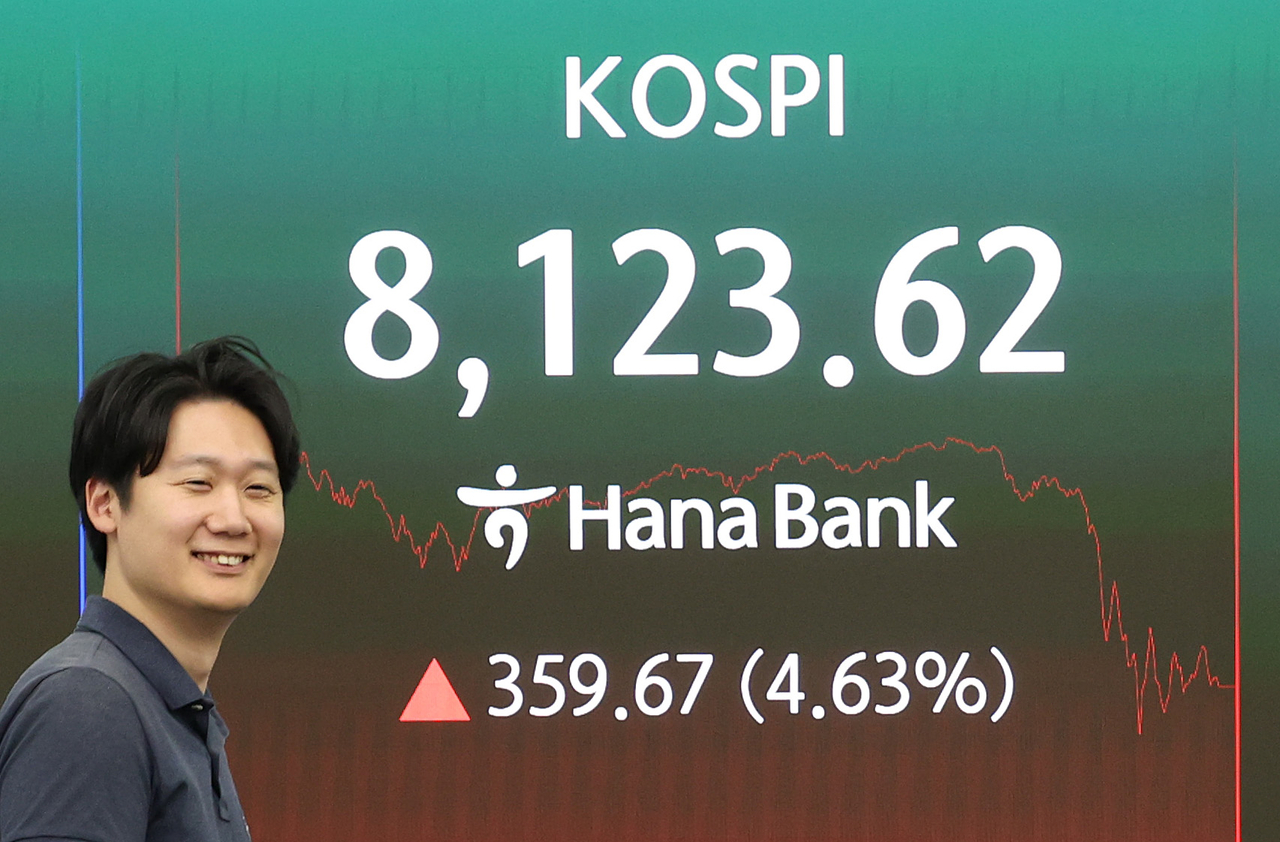
As the Kospi swings sharply in both directions, money is flowing rapidly out of demand deposits and money market deposit accounts — the banking sector's primary pool of standby funds — and into the stock market. Commercial banks and secondary financial institutions alike have responded by raising fixed-deposit rates and launching customer-acquisition campaigns in what has become an all-out battle to defend their deposit bases.
Demand deposit balances, including MMDA accounts, at the five major banks — KB Kookmin Bank, Shinhan Bank, Hana Bank, Woori Bank and NH NongHyup Bank — stood at 699.372 trillion won as of Thursday, according to financial industry data released Saturday. That marks a drop of 15.2858 trillion won, or 2.14 percent, in just two weeks from the end of last month, when balances had crossed 700 trillion won for the first time in nearly four years, reaching 714.658 trillion won.
The decline was particularly sharp in MMDA balances, which fell to 147.697 trillion won as of Thursday — down 9.9703 trillion won, or 6.32 percent, from 157.667 trillion won the previous month.
The simultaneous reversal in both demand deposits and MMDAs — which had been rising consistently throughout this year — marks a notable shift. It suggests that standby funds sitting on the sidelines during a period of peak Kospi volatility this month have moved en masse into equities. Demand deposits tend to be highly sensitive to market conditions, as they typically hold funds that have yet to find a destination in assets such as shares or real estate.
"As major domestic share prices pulled back and swings widened in June, retail investors appear to have read the timing as a buying opportunity and moved large sums into the stock market," a banking industry official said.
Competition for deposit customers is expected to intensify further. Persistent market volatility, compounded by the Bank of Korea's signaled rate hike, has made it increasingly difficult for banks to attract and retain retail funds.
Banks have moved preemptively to raise fixed-deposit rates. Rates that hovered mostly in the 2 percent range at the start of this year have climbed into the 3 percent range, with some products approaching the high 3 percent range. Among the five major banks, Woori Bank's "Woori First Transaction Preferential Fixed Deposit" currently offers the highest rate at 3.30 percent per annum.
Banks are also focusing their rate increases on short-term products with maturities of less than one year, recognizing that customers prefer to keep funds liquid and flexible in a rapidly shifting market.
Shinhan Bank raised fixed-deposit rates by up to 0.15 percentage points across various tenors in late May, following an earlier increase in March. For its "Sol Convenient Fixed Deposit," the three-month product was lifted from 2.70 percent to 2.80 percent per annum, while the six- and nine-month products rose from 2.70 percent to 2.85 percent — increases of 1.00 and 1.15 percentage points, respectively, designed to attract short-term funds. By contrast, the 12-month product was raised by only 0.05 percentage points, to 2.90 percent, underscoring the bank's deliberate tilt toward shorter maturities.
Online banks and commercial banks have joined the rate-hike relay. Kakao Bank recently raised its 12-month fixed-deposit rate by 0.20 percentage points to 3.40 percent per annum, and lifted its six-month rate by 0.10 percentage points to 3.20 percent. Woori Bank (Woori One Plus Deposit, up to 2.90 percent), KB Kookmin Bank (KB Star Fixed Deposit, up to 2.90 percent) and Hana Bank (Hana Fixed Deposit, up to 2.90 percent) have all raised rates in tandem.
NH NongHyup Bank is taking a different approach, targeting demand deposit customers with a mobile gift voucher promotion: customers who maintain a monthly average balance of at least 1 million won receive a 5,000-won voucher, while those maintaining 3 million won or more receive a 10,000-won voucher. Winners will be announced in July for customers who maintain their balances through the end of this month.
Secondary financial institutions are moving even more aggressively. OK Savings Bank has added a new three-to-six-month tier to its "OK e-Fixed Deposit" product, offering a rate of up to 4.0 percent per annum to capture customers who move funds quickly in response to market shifts. It also raised the rate on its existing six-to-seven-month tier from 2.81 percent to 4.0 percent — a jump of 1.19 percentage points — subdividing deposit terms to absorb short-term demand. Welcome Savings Bank raised the maximum rate on fixed deposits with maturities of 12 to 24 months from 3.3 percent to 3.6 percent, and expanded the high-rate deposit ceiling from 100 million won to 300 million won.
The accelerating pace of outflows is raising anxiety within the banking sector. "The shift of deposits into the stock market was a central topic at a recent issues-review meeting with our regional business heads," a senior executive at one commercial bank said. "We will closely monitor the money-move trend and develop additional deposit-defense strategies as needed."
![“구천피 눈앞 두고 너도나도 마통” 빚투 열풍에 5월 가계대출 9.3조↑[머니뭐니]](https://wimg.heraldcorp.com/news/cms/2026/06/11/news-p.v1.20260611.6cb1852f248c4d04903f85b48eab99d7_T1.png)
won@heraldcorp.com