SpaceX makes its historic market debut Friday with an IPO priced at $135 per share and a valuation of $1.75 trillion, drawing billions from institutional investors including BlackRock. The listing is set to be followed by OpenAI and Anthropic, raising fears that a wave of mega-IPOs could drain market liquidity and amplify volatility across US indexes if the companies underperform.
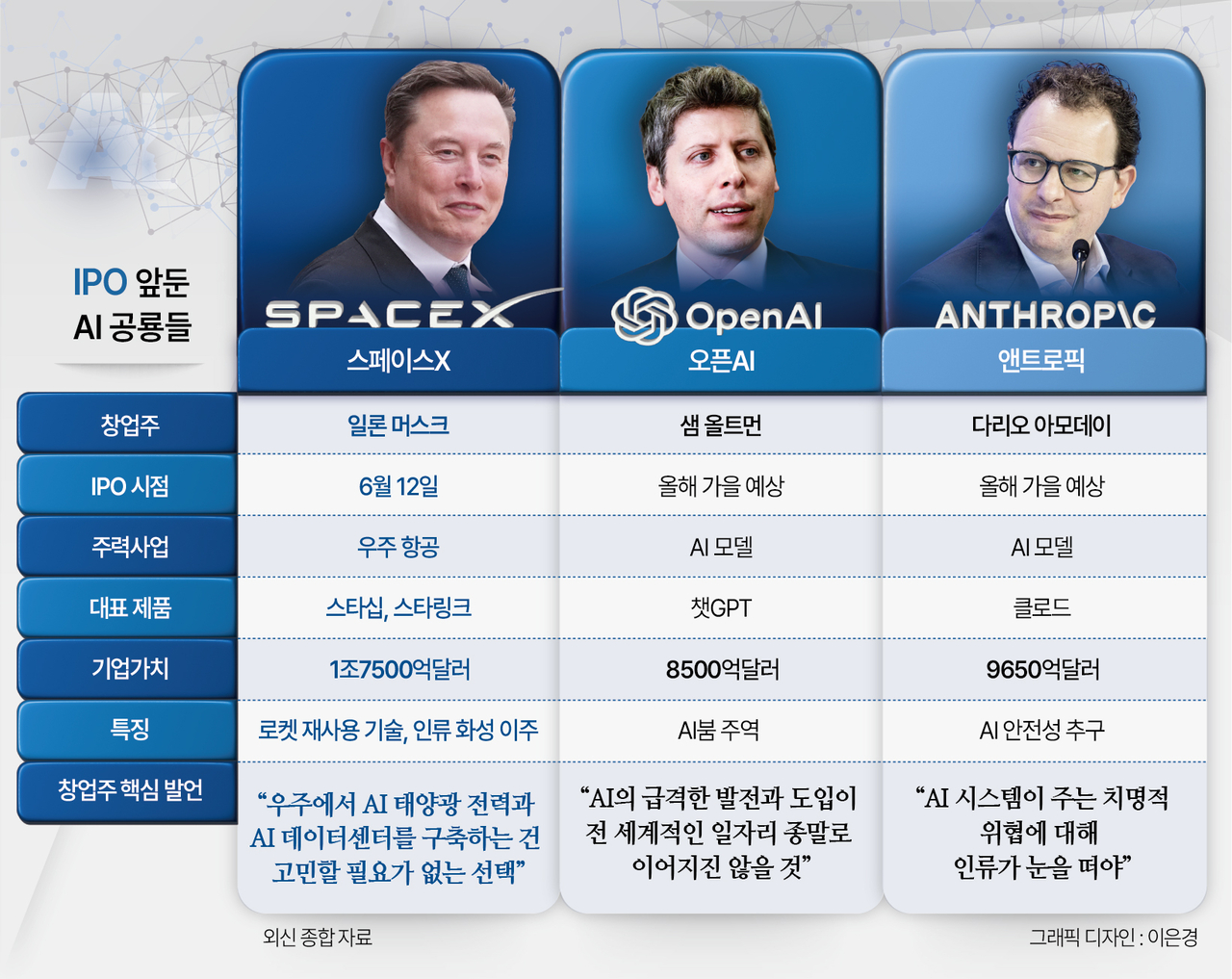
Elon Musk's space company SpaceX is set to make its market debut Friday in what is shaping up to be the largest initial public offering in history. The offering price was set at $135 per share, drawing massive demand from global institutional investors including BlackRock. SpaceX's listing is expected to be the first in a wave of mega-IPOs from AI giants including OpenAI and Anthropic. However, concerns are mounting that these colossal offerings — each absorbing enormous sums of capital — could drain global market liquidity and, if the newly listed companies fail to meet earnings expectations, amplify volatility across US equity markets.
According to Bloomberg and other outlets, the combined fundraising from SpaceX, OpenAI and Anthropic alone is expected to far exceed the record $156 billion raised in IPOs in 2021. The three listings together would inject roughly $4 trillion in new market capitalization into US exchanges. Some observers are so confident in the offerings' success that they project SpaceX's valuation could eventually soar to $30 trillion.
SpaceX posted a loss last year — so why are investors piling in?
![SpaceX CEO Elon Musk visits the Viva Technology startup and innovation fair at the Porte de Versailles exhibition center in Paris, France, in June 2023. [AFP]](https://wimg.heraldcorp.com/news/cms/2026/06/15/news-p.v1.20260610.1e5ac546dd4f4d38a36872a66a0c5beb_P1.jpg)
Just a year ago, SpaceX posted sales of $18.67 billion (about 25 trillion won), with an operating loss of $2.59 billion (about 4 trillion won) and a net loss of $4.94 billion (about 7.6 trillion won).
Yet the listing has captured the world's attention, driven by investor expectations. Even without blockbuster revenue figures yet, the market widely believes SpaceX's business ventures are poised to hit a jackpot.
Last year, SpaceX launched its workhorse Falcon 9 rocket 165 times, cementing its dominance in the launch market with a string of industry firsts. Its Starlink satellite internet service has become a piece of global infrastructure, with roughly 9,600 satellites currently in operation — accounting for 75 percent of all maneuverable satellites worldwide — serving customers in 164 countries. Subscriber numbers jumped from 4.4 million in 2024 to 10.3 million by the end of the first quarter of this year.
![SpaceX's next-generation Starship spacecraft, mounted atop a Super Heavy booster, lifts off from the Boca Chica launch pad near Brownsville, Texas, on an uncrewed test flight in November 2023. [Reuters]](https://wimg.heraldcorp.com/news/cms/2026/06/15/news-p.v1.20260610.ff7240bd516e4bc49328b1eb502018d1_P1.jpg)
Musk has also unveiled an ambitious plan to place up to 1 million satellites carrying AI computing chips into orbit, building a network of data centers in space. Those orbital AI data centers would run continuously on solar power, adding 100 gigawatts of AI computing capacity per year — a concept that breaks from the conventional assumption that AI data centers must be powered from the ground.
Ahead of its IPO, SpaceX has positioned itself as a "vertically integrated platform" that unites rocket launches, satellite communications and AI under one roof. In this structure, launch operations underpin Starlink, Starlink sustains the entire company, and AI is the engine of future growth.
The IPO price was confirmed at $135 per share. SpaceX plans to issue about 555.6 million shares, raising up to $75 billion in the process, with a target valuation of $1.75 trillion (about 2,662 trillion won).
On the eve of the listing, retail investor orders for SpaceX shares exceeded $100 billion (about 153 trillion won). BlackRock, the world's largest asset manager, purchased at least $5 billion (about 7.6 trillion won) worth of shares in the offering.
Analyst coverage of SpaceX's target price has also been unusually active. Investment bank Oppenheimer initiated coverage Friday with an "outperform" rating and a price target of $190 — implying roughly 41 percent upside from the $135 IPO price. Market research firm New Street Research also initiated coverage Friday with a 12-month price target of $165.
SpaceX's listing is expected to serve as the first benchmark for valuing generative AI companies in the public market, with significant implications for OpenAI and Anthropic as they prepare their own offerings.
What SpaceX's IPO means: the dawn of the 'Musk empire'
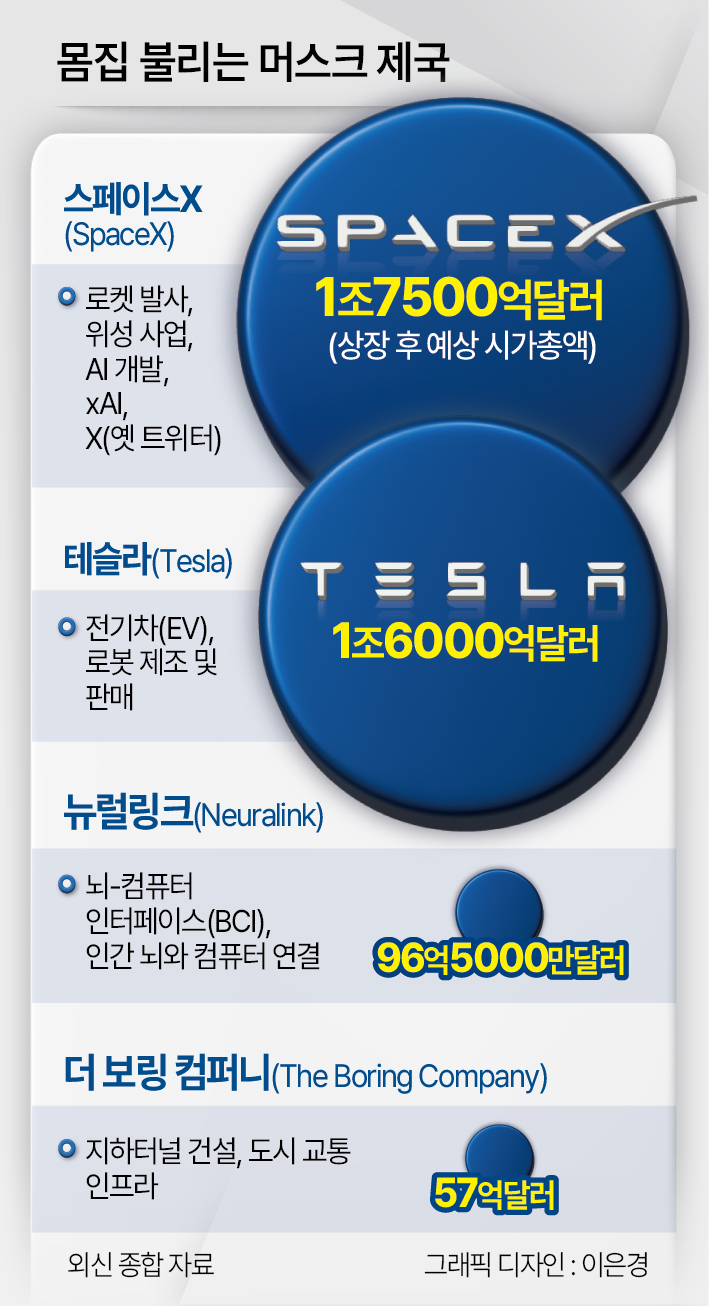
Many observers see SpaceX's IPO as the opening act of a broader "Musk empire." Markets are watching closely to see whether Musk — who also serves as CEO of AI startup xAI and electric vehicle maker Tesla — can use a successful SpaceX listing as a springboard to weave his various companies into a single business ecosystem.
Musk currently leads six companies: SpaceX, Tesla, xAI, X (formerly Twitter), Neuralink and the Boring Company. Their combined market cap exceeds $3 trillion, approaching that of Microsoft.
In a concrete step toward consolidation, Musk officially announced Feb. 2 that SpaceX had acquired xAI — creating a combined entity with a valuation of roughly $1.25 trillion (about 1,820 trillion won).
Attention has now turned to the possibility of a SpaceX-Tesla merger. Yahoo Finance reported that Musk has recently discussed merger scenarios involving the two companies, and that Tesla insiders believe a combination is likely over the long term.
![A Starship rocket stands at SpaceX's factory at Starbase in Texas ahead of the company's IPO on May 18, local time. A Tesla Cybertruck electric pickup truck is parked in front of the rocket. [Reuters]](https://wimg.heraldcorp.com/news/cms/2026/06/15/news-p.v1.20260610.3146eaab51344030ae72c2d0e342b957_P1.jpg)
The drive to consolidate his companies reflects Musk's desire to structure mergers on terms favorable to himself. CNBC reported that the SpaceX-xAI deal was partly motivated by a need to resolve xAI's funding shortfall — a strategy to pool the two companies, with a combined valuation of roughly 1,800 trillion won, to secure the large-scale capital required for AI development.
A potential SpaceX-Tesla merger is also seen as driven more by Musk's desire to expand his control than by operational synergies between the two companies. According to SpaceX's IPO prospectus, Musk currently controls 85.1 percent of SpaceX's total voting rights, while his stake in Tesla stands at only about 20 percent.
Wolf Research analyst Emmanuel Rosner cited three reasons why a SpaceX-Tesla merger is a credible scenario: securing highly liquid shares through the SpaceX IPO, giving Musk more than 50 percent of the voting rights in a combined entity, and the synergies from combining Tesla's driving data with SpaceX's computing infrastructure.
OpenAI files confidential IPO application, accelerating push to go public
![The logos of OpenAI and its generative AI model ChatGPT. [EPA]](https://wimg.heraldcorp.com/news/cms/2026/06/15/news-p.v1.20260610.b93444f4bab544bab82113bf913ae08e_P1.jpg)
The two AI giants preparing to follow SpaceX to market are OpenAI and Anthropic. OpenAI in particular is expected to deliver a growth catalyst for US markets on par with SpaceX, given that its launch of ChatGPT in 2022 introduced a new paradigm of conversational AI that answers questions in natural language.
ChatGPT's user base is approaching 1 billion — meaning roughly one in eight people on the planet, given a global population of more than 8 billion, uses the service.
That scale helped OpenAI raise $122 billion (about 167 trillion won) from investors in March at a valuation of $852 billion (about 1,170 trillion won). The company has said it plans to invest about $600 billion (about 824 trillion won) in AI infrastructure by 2030.
OpenAI is also preparing a sweeping platform overhaul, including plans to transform ChatGPT into a comprehensive super-app to compete with rivals including Anthropic. The Financial Times reported that the changes are part of a broader effort to capture high-margin enterprise customers and intensify competition with Anthropic.
Given ChatGPT's role in igniting the global AI boom, expectations for what OpenAI's listing could do for US markets are high. OpenAI filed a confidential IPO application with the Securities and Exchange Commission on June 8. Bloomberg reported that the company is in discussions with Goldman Sachs and Morgan Stanley about a listing as early as this fall.
However, CEO Sam Altman left the timing somewhat open-ended, saying the IPO would come "within the next year."
"Within that window, various factors could push it earlier or later, but by filing now we give ourselves the option to move faster if we want to," Altman said. He added that the closer the company gets to achieving "recursive self-improvement" — a stage at which AI can improve itself without human intervention — the more advantageous it may be to delay the IPO.
Still, enthusiasm for an OpenAI listing is tempered by real concerns. The company has seen key executive departures and has fallen short of both revenue and user growth targets.
Bill Peebles, who led the team behind the AI video generation model Sora, left OpenAI in April. Kevin Weil, a former chief product officer serving as vice president of science programs, also announced his departure. Srinivas Narayanan, chief technology officer for B2B applications, similarly announced his exit, saying he had decided "it was the right time to step back given product launch timelines and other considerations." In addition, Fidji Simo, the CEO of applications, took medical leave for health reasons, and Chief Marketing Officer Kate Rouch also stepped away to focus on treatment. The string of executive vacancies is seen as a potential drag on the company's IPO prospects.
High valuation vs. super-app launch: OpenAI and Anthropic jostle for IPO pole position
![OpenAI CEO Sam Altman and Anthropic CEO Dario Amodei (right). [AFP]](https://wimg.heraldcorp.com/news/cms/2026/06/15/news-p.v1.20260610.e18427d7e51942deb63cd9545e687b36_P1.jpg)
Although OpenAI is widely credited with igniting the AI boom, some observers now see it on the defensive, as Anthropic has grown rapidly and its AI model Claude has gained significant popularity.
Anthropic raised $65 billion in new investment last month, earning a valuation of $965 billion (about 1,460 trillion won) — surpassing OpenAI's March valuation of $852 billion. The surge appears to reflect the strong reception for Claude, Anthropic's flagship AI model, which has drawn praise for outperforming ChatGPT on key benchmarks.
Anthropic pushed further Thursday, announcing the release of "Claude Fable5," a top-tier AI model at the "Mythos" level that the company had long delayed making public, along with a security-focused variant called "Claude Mythos5." The two are essentially the same model, with Fable5 distinguished by additional safeguards in areas deemed at high risk of misuse.
Both models posted benchmark scores surpassing even the "Mythos preview" released two months ago. On the ExploitBench cybersecurity evaluation, Mythos5 scored 78 percent — outperforming OpenAI's GPT-5.5 at 34 percent, Anthropic's own Opus 4.8 at around 40 percent, and the earlier Mythos preview at 69 percent.
![Claude, the AI model developed by Anthropic. [EPA]](https://wimg.heraldcorp.com/news/cms/2026/06/15/news-p.v1.20260610.1bf41d6371bb402092c75e1872366d07_P1.jpg)
Anthropic filed its own confidential IPO application with the SEC on June 1 — a week before OpenAI submitted its filing on June 8. Industry observers say both companies appear to be racing to disclose information to investors, each keenly aware of the other's moves. Both are competing to list before their capital runs dry, knowing that a delayed IPO could put them at a disadvantage in attracting investment.
OpenAI's recent push to overhaul its platform is also partly a response to Anthropic surpassing it in valuation and moving ahead of it in the US listing process.
"Another reason Anthropic wants to enter the public market before OpenAI is that it would get to set the financial reporting standards for cutting-edge AI models," said Gil Luria, an analyst at investment bank D.A. Davidson. "By doing so, it can frame those standards in its own favor."
Index inclusion could deepen AI concentration — and amplify any downturn
![Traders work on the floor of the New York Stock Exchange on June 8, local time. [Reuters]](https://wimg.heraldcorp.com/news/cms/2026/06/15/news-p.v1.20260610.6170d9096d5c4928b28fd57d318089c8_P1.jpg)
If these giants list in rapid succession this year, a large-scale reallocation of investor capital is expected to accelerate further. But there are fears that if these AI behemoths disappoint on revenue after going public, they could drag down the Nasdaq 100 and S&P 500 as a whole.
The Economist cited research by Jay Ritter, a professor at the University of Florida, finding that companies that went public at valuations above 40 times sales underperformed the market by 58 percentage points over three years. SpaceX's target valuation of $1.8 trillion represents more than 90 times its sales. Given that the top 10 AI-related stocks already account for two-fifths of the S&P 500's total market cap, a stumble by any of the three companies could pull the entire index lower.
"Things are going to get a lot more dramatic over the coming weeks and months," said Paul Kedrosky, a veteran investor and market analyst. "Money from all corners of the market will pour out and rush into any asset even remotely connected to the companies about to go public."
As AI companies come to represent an ever-larger share of major US indexes, the market's vulnerability to any reversal in AI sentiment will only grow.
"Once the three IPOs are complete, AI-related companies could account for roughly 50 percent of total US market capitalization," Business Insider said. "That would represent a dramatic increase in concentration risk around a single industry."
A rush of AI mega-listings: the starting gun for a liquidity reshuffling?
![A SpaceX IPO sign is displayed on the Morgan Stanley building in New York on Thursday, local time. [Reuters]](https://wimg.heraldcorp.com/news/cms/2026/06/15/news-p.v1.20260610.828e7d4ff8c44f68aa0bfc95fec8cbd5_P1.jpg)
SpaceX's IPO could bring structural changes across equity, bond and commodity markets. If investor capital concentrates heavily in the SpaceX offering, funds could flow out of existing holdings and into SpaceX shares, creating a "liquidity black hole" that absorbs capital from the broader market.
In the short term, that dynamic could weigh on share prices. Investors often sell existing holdings to fund IPO participation, and supply-demand imbalances can amplify volatility in specific sectors.
Markets currently expect SpaceX to raise between $40 billion and $80 billion. That has raised the possibility that major US indexes will add SpaceX to their constituents in stages — a process that would require index funds to sell some existing holdings to make room, creating additional selling pressure on other stocks.
"Because the IPO is so large, some portion of market capital flows will concentrate in SpaceX for a period of time," said Kyle Stanford, an analyst at market research firm PitchBook. "In the short term, less well-known companies are likely to face the greatest difficulty raising capital."
Josef Schuster, head of IPO-focused financial services firm IPOX, also weighed in. "A mega-IPO of this scale can amplify volatility in individual stocks and spread that effect across the broader market," he said. "However, US markets have rarely experienced a new listing of this magnitude, so it is difficult to gauge the full impact with precision."
yckim6452@heraldcorp.com