
'High oil prices weigh on earnings … will recover as much as possible in H2'
'Passenger operations alone unlikely to turn profit'
'Annual synergies of more than 300 billion won expected'
Aug. shareholder vote, Dec. merger, new shares to list in Jan.

Asiana Airlines acknowledged a disappointing first half amid external uncertainty but said the merger with Korean Air will set the stage for a meaningful improvement in corporate value. While high oil prices and a weak won have increased near-term earnings pressure, the airline said the combined carrier will have ample room for share price gains through synergies spanning routes, maintenance and procurement.
Asiana held a shareholder briefing Friday at Korea Investment & Securities headquarters in Yeouido, Seoul, updating investors on the merger's progress, timeline and shareholder rights. The session was organized ahead of an extraordinary general meeting scheduled for August to help retail shareholders better understand the transaction.
Seo Sang-hun, executive vice president and head of Asiana's strategy and planning division, said a sharp rise in jet fuel costs had significantly weighed on first-half earnings. "Looking only at the passenger business, excluding cargo operations, we have turned a profit just once or twice in the past decade," Seo said. "The structure makes it extremely difficult to generate a profit from passenger operations alone."
He added that the airline had set a goal at the start of this year to turn a profit from passenger services alone and had been working toward it, but was blindsided by oil prices. "Fuel costs have more than doubled, adding over 150 billion won to our monthly fuel bill," he said.
"The first-half deficit will be quite substantial," he said, adding that while the airline would try to recover as much ground as possible in the second half, returning to profitability would not be easy.
'Oil price stabilization will lift share price' — appraisal rights burden seen as limited
Seo struck an optimistic tone on the share price outlook, however. With the appraisal rights price set at 7,030 won per share, Asiana's closing price on Friday stood at 7,340 won, above that threshold. "As oil prices stabilize, I believe the share price will rise further," Seo said. "I think the volume of appraisal rights exercised will be smaller as a result."
On the post-merger share price trajectory, he said airline stocks tend to move in tandem. "Because the merger ratio has been set, if Korean Air rises, Asiana will ultimately converge and rise with it — that is the structure we are in," he said.
Seo also said the financial burden from appraisal rights would not be significant. "The number of shares in circulation is about 40 million. Even if we assume a generous 10 percent exercise rate, the total comes to roughly 28 billion won — that is not a heavy burden relative to our financial resources," he said.
He noted that when the company sold its cargo aircraft business last year, it had assumed a 10 percent exercise rate for appraisal rights, but actual exercises came in at less than 0.1 percent. "The total did not even reach 1 billion won," he said.
'A schedule is an airline's product' — joining joint venture to expand trans-Pacific demand
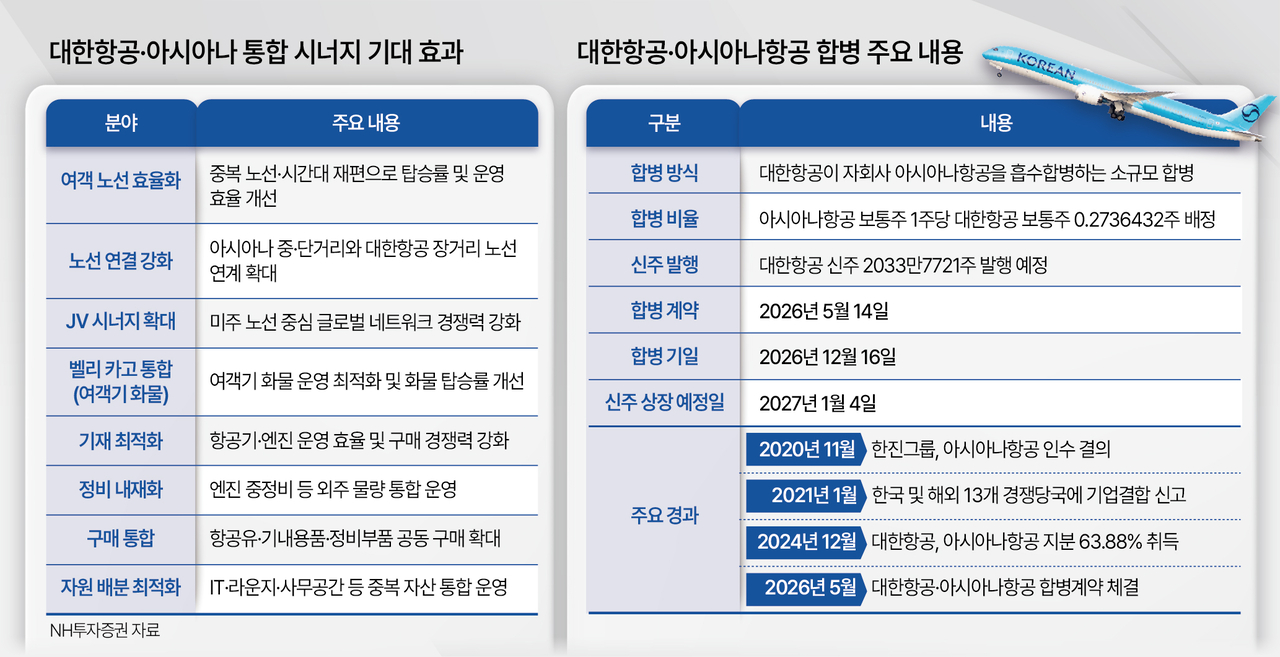
Asiana expects annual synergies of more than 300 billion won following the merger. "Merger synergies ultimately mean increased revenue and reduced costs through economies of scale," Seo said. "We expect them to be at least 300 billion won per year."
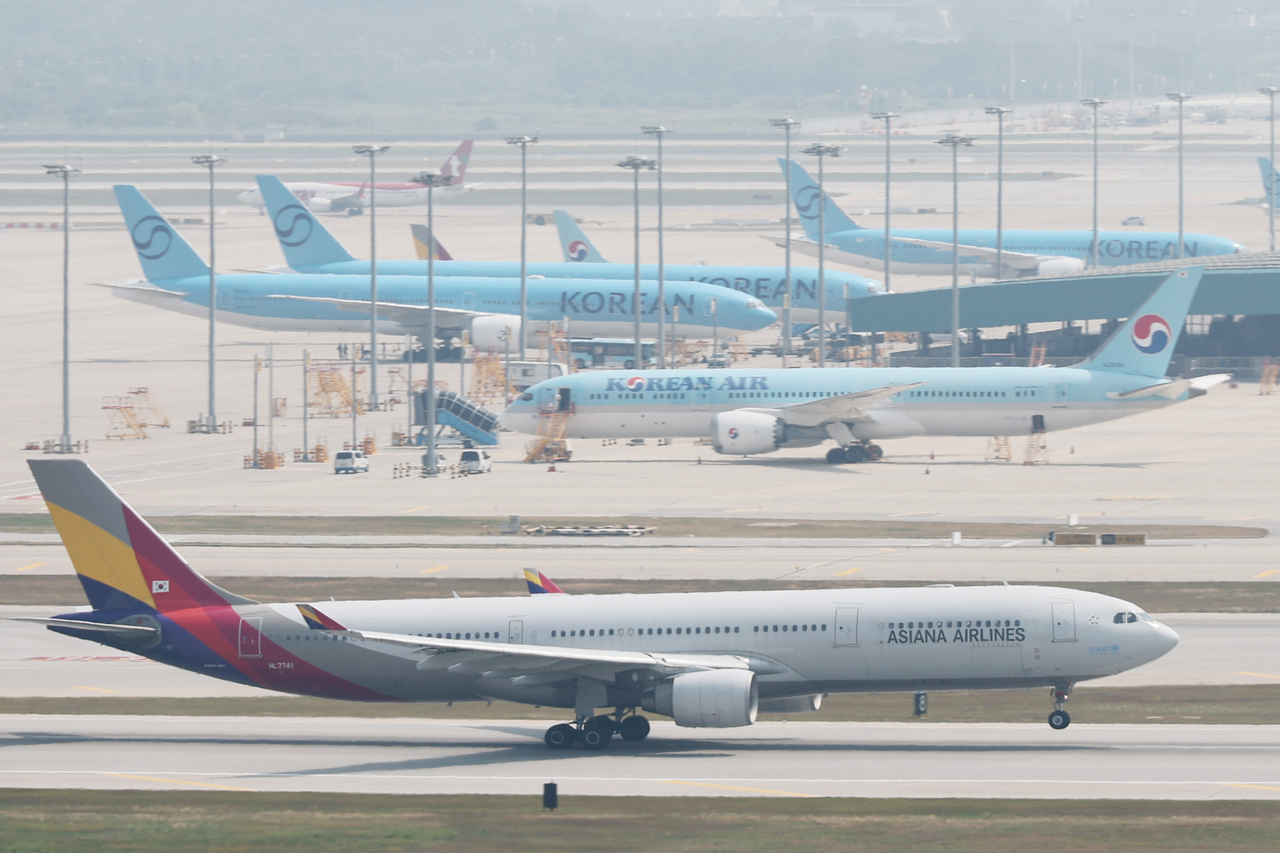
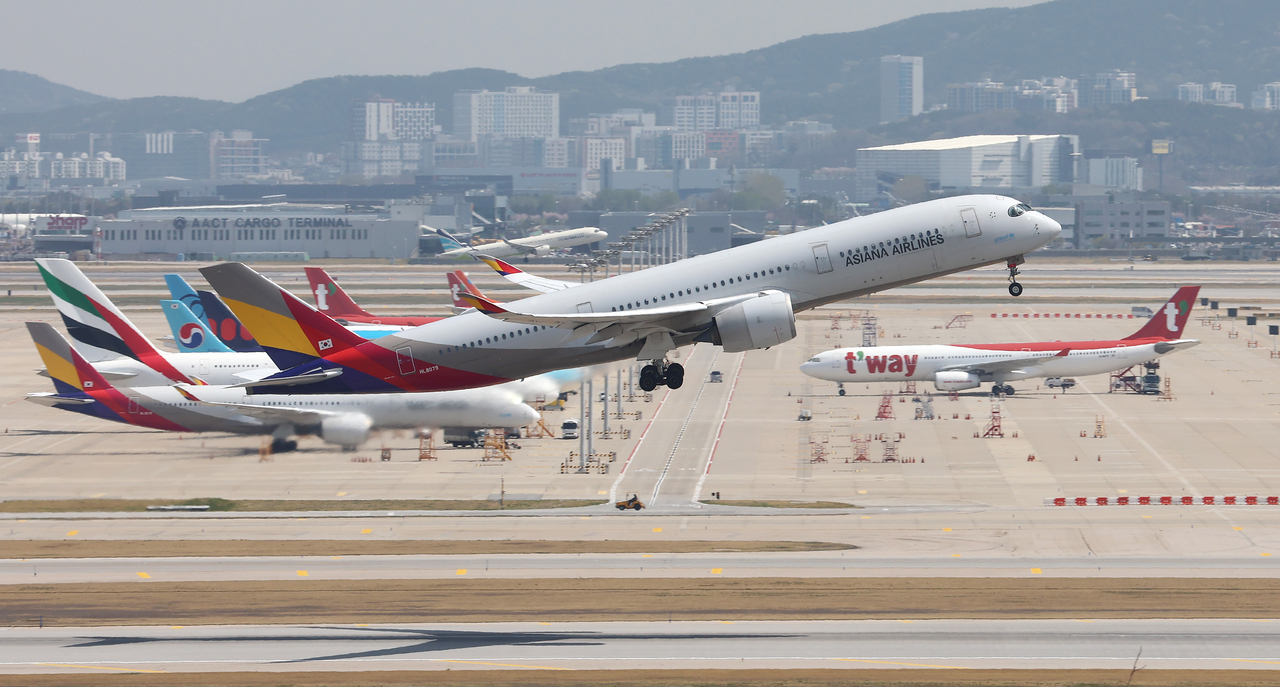
On the passenger side, schedule optimization and strengthened connecting flights are central to the plan. "A schedule is an airline's product," Seo said. "Right now, Asiana and Korean Air compete on the same routes and often operate at the same times. After integration, we can make that more efficient and diversified, delivering greater convenience to customers."
He added that Korean Air and Delta Air Lines currently operate a joint venture on trans-Pacific routes with strong results. "Once the merger is complete, Asiana's routes will be folded into that joint venture, and we expect a significant boost to revenue," he said.
Korean Air and Delta Air Lines have operated a trans-Pacific joint venture since May 2018. With approval from competition authorities in both South Korea and the United States, the two carriers jointly manage flight schedules and sales strategies on Asia-Americas routes and share revenues and costs. After the merger, Asiana's routes are to be incorporated into the joint venture's sales network to capture more connecting traffic originating in the Americas.
Belly cargo, in-house maintenance to deliver additional synergies
The airline also expects synergies in cargo. Asiana sold its freighter operations as a condition of merger approval but continues to operate belly cargo — freight carried in the lower holds of passenger aircraft.
"In cargo, you can use dedicated freighters or passenger aircraft belly space, but having only one of the two reduces efficiency," Seo said. "When the two are combined into a single network, the synergy effect will be substantial."
On the cost side, Seo highlighted in-house maintenance as a key savings driver. "Because Asiana's financial structure was weak, we relied heavily on operating leases for aircraft and had no choice but to outsource engine maintenance," he said. "If we can reach Korean Air's level in terms of aircraft and maintenance costs, we expect gradual annual savings of around 400 billion won."

'No forced restructuring' — mileage integration awaits Fair Trade Commission approval
Asiana reaffirmed that there are no plans for forced restructuring of overlapping staff. Kang Du-seok, executive vice president and head of the management administration division, said the company has no restructuring plans tied to the merger. "Even if some overlap in personnel arises, we expect no significant issues through business expansion and reassignment to new areas," he said.
On the mileage integration plan, the airline said it is awaiting final approval from the Korea Fair Trade Commission. CEO Song Bo-young said the Fair Trade Commission is conducting its final review of the mileage program. "It will be disclosed as soon as approval is granted," Song said.
Song added that the exchange ratio and other terms were not determined unilaterally by the company but were calculated based on assessments by independent consulting firms. "You can take it as meaning that the consumer value has been recognized," she said.
Asiana projected that the combined carrier will emerge as a mega-carrier with 49.4 trillion won in assets, annual sales of 22.7 trillion won and a fleet of 233 aircraft. The combined workforce is expected to reach approximately 28,000 employees.

Aug. shareholder vote, Dec. merger — new shares to list in Jan.
Going forward, Asiana will finalize its shareholder register on June 30. Notice of the general meeting and collection of dissenting votes will begin July 28, with the deadline for dissent set for Aug. 11. An extraordinary general meeting will be held Aug. 12 to vote on the merger.
Shareholders may exercise appraisal rights from immediately after the general meeting through Sept. 1, with payment due by Oct. 1. Trading in Asiana shares will be suspended from Dec. 14, and the shareholder register for the allocation of new merger shares will be finalized Dec. 15. The merger date is set for Dec. 16, with merger registration on Dec. 17. The new shares issued in connection with the merger are scheduled to list on Jan. 4 next year.
Asiana shareholders who vote in favor of the merger will receive 0.2736432 new Korean Air shares for each Asiana common share held. Dissenting shareholders may exercise appraisal rights at 7,030 won per share.
kwater@heraldcorp.com





