
Full model change in January pushed prices up by over 2 million won
Model-year update adds another 600,000 won increase
Some option packages up by 350,000 won
Tax benefit expiration compounds the burden
Hybrid buyers face up to 2.05 million won more next year
Seltos sales fell 7.8% in January–September
![The exterior of Kia's The All New Seltos [Kia]](https://wimg.heraldcorp.com/news/cms/2026/10/16/news-p.v1.20260507.3db8a71ae2ed45ad912c1e48f1e4188e_P1.jpg)
Kia has raised the price of its Seltos compact SUV again — just eight months after a full model change in January already pushed prices sharply higher. With a model-year update now adding another increase, and the expiration of a tax benefit compounding the effect, consumers could be paying more than 2 million won ($1,490) above the January price by early next year.
The back-to-back increases are drawing concern from parts of the auto industry, which warn that domestic compact and mid-size models are losing price competitiveness at precisely the moment Chinese automakers are aggressively expanding their foothold in the Korean market on the strength of low prices.
According to industry sources, Kia on Thursday converted the second-generation The All New Seltos — launched in late January — to the 2027 model year after roughly eight months, raising gasoline model prices by between 260,000 won and 600,000 won.
The steepest increase hit the Trendy, the entry trim of the 1.6 gasoline turbo lineup. Its price rose 600,000 won, or 2.4 percent, from 25.15 million won to 25.75 million won. The Prestige trim went up 540,000 won to 29.38 million won from 28.84 million won, while the Signature and X-Line each climbed 260,000 won.
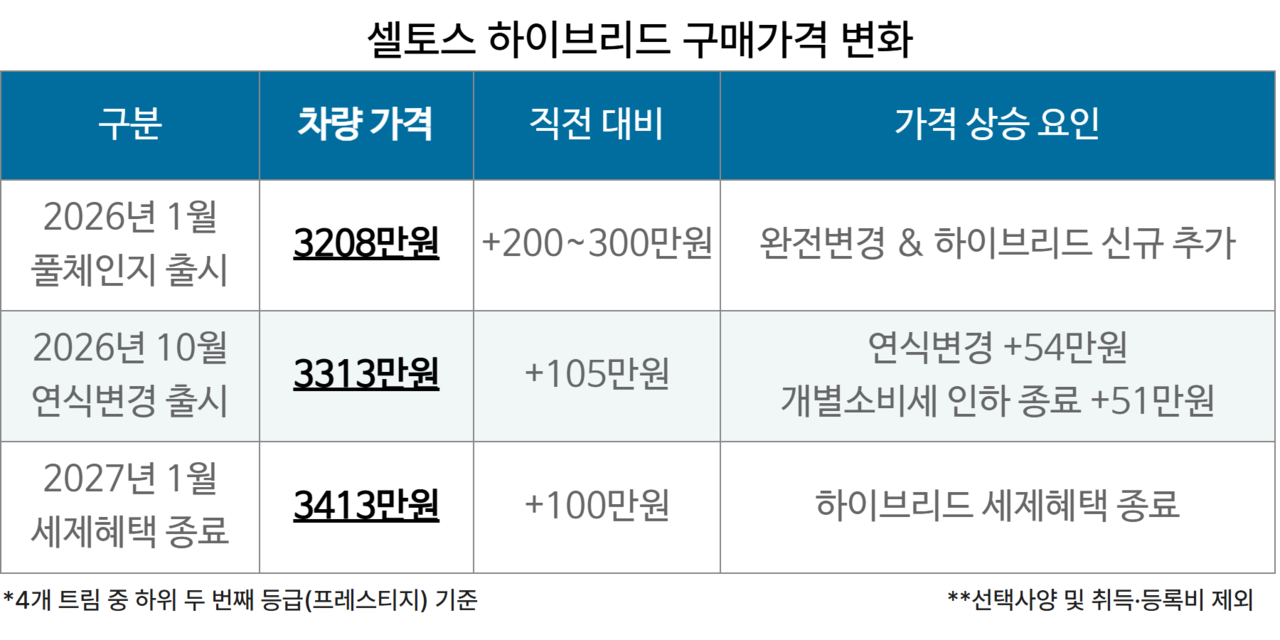
Hybrid trims also saw increases of between 250,000 won and 540,000 won. The Prestige rose 540,000 won to 33.13 million won from 32.59 million won, while the top-of-the-line X-Line edged up 250,000 won to 36.66 million won from 36.41 million won.
Some optional packages also became more expensive. The Convenience package — widely regarded by buyers as a must-have bundle that includes ventilated front seats and synthetic leather upholstery — rose 350,000 won to 990,000 won from 640,000 won.
Model-year updates follow no fixed schedule but typically come about a year apart. While automakers sometimes accelerate the timing for strategic reasons, raising prices through a model-year update in the very first year of a fully redesigned model is unusual. The 2027 Sportage, Sorento and Carnival — all updated in August — each arrived roughly a year after their previous model-year versions.
The Seltos had already seen a steep price increase at its full model change in January. The gasoline turbo Trendy jumped 2.11 million won from 22.66 million won to 24.77 million won, while the Prestige and Signature rose 2.31 million won and 2.44 million won, respectively.
The price increase consumers actually feel is even larger. In January, an individual consumption tax rate of 3.5 percent applied to the vehicle, but a temporary reduction expired in July and the rate reverted to 5 percent.
As a result, the consumer price of the Seltos gasoline Trendy has risen 980,000 won from 24.77 million won in January to the current 25.75 million won — 600,000 won from the model-year update and 380,000 won from the end of the tax reduction.
The burden on hybrid buyers is set to grow further next year. Tax benefits currently applied to hybrid vehicles — worth up to about 1 million won — are scheduled to expire at the end of this year. The Seltos hybrid Prestige will carry a price of 34.13 million won in January, 2.05 million won, or 6.4 percent, more than its January price of 32.08 million won once the model-year increase is factored in.
The changes could also put the Seltos at a disadvantage against low-priced Chinese electric vehicles. While hybrid tax benefits are set to end next year, electric vehicles will continue to receive incentives even as the individual consumption tax exemption ceiling is reduced from 3 million won to 2 million won. More affordable electric vehicles will retain their full existing benefits even after the ceiling is lowered.
That said, model-year price increases are not inherently negative. Automakers adjust prices to account for rising raw material and parts costs and higher labor expenses, while also making previously optional features standard to reflect consumer preferences.
The Seltos received several such upgrades in this update: the gasoline Trendy now comes standard with a panoramic wide display and full-auto air conditioning, while the Prestige gains auto-flush door handles as standard equipment.
![The All New Seltos, the second-generation model representing the first full redesign in six years since the first generation launched in 2019. [Kia]](https://wimg.heraldcorp.com/news/cms/2026/10/16/news-p.v1.20260123.66f5dd5fb6ff4691a060b1f75b4d2041_P1.jpg)
There are, however, precedents for model-year updates that improve a vehicle without raising its price. Kia froze prices on the updated EV3 and EV4 earlier this year while adding safety and convenience features. For the EV9, it introduced a new Light trim priced 2.15 million won below the previous entry trim, lowering the barrier to purchase.
Hyundai Motor similarly held the line on most trims when it unveiled the 2024 Kona, cutting the price of the base Modern trim by 400,000 won while adding convenience features to other trims at no extra cost. Model-year updates, in other words, do not inevitably mean price increases.
The Seltos hybrid's top X-Line trim currently starts at 36.66 million won. If the tax benefit expires as planned, that rises to 37.66 million won next year — and adding options such as a sunroof could push the total past 40 million won. That puts it in the same price range as Chinese electric vehicles, plug-in hybrids and domestic mid-size SUVs.
![The Kia logo is seen at the media day of the 2026 Paris Motor Show in Paris, France, on Monday (local time). [Reuters]](https://wimg.heraldcorp.com/news/cms/2026/10/16/rcv.YNA.20261012.PRU20261012286101009_P1.jpg)
As Chinese brands press into the Korean market with aggressive pricing, consumers are scrutinizing new-car prices from Hyundai Motor and Kia more closely than ever. The All New Avante that Hyundai Motor unveiled in August also drew criticism when the hybrid's top trim, fully loaded with options, crossed the 43 million won threshold.
Like the Avante, the Seltos is one of the most common first-car choices for young buyers entering the workforce. Because that segment tends to be especially price-sensitive, repeated increases risk making the car a harder sell.
"In the past, popular models were usually the last to rush into a model-year update — so it's puzzling that the Seltos, a top seller, has raised its price again in its very first year," an industry official said. "With Chinese companies waging a low-price offensive even at the cost of losses, domestic automakers need to think seriously about cutting prices to stay competitive."
kwater@heraldcorp.com





