$1 billion in sales reached 130 days after first shipment in February
Supplied to Nvidia and AMD AI accelerators, with big tech ASIC orders surging
Samsung's total HBM sales seen tripling year-on-year in 2026
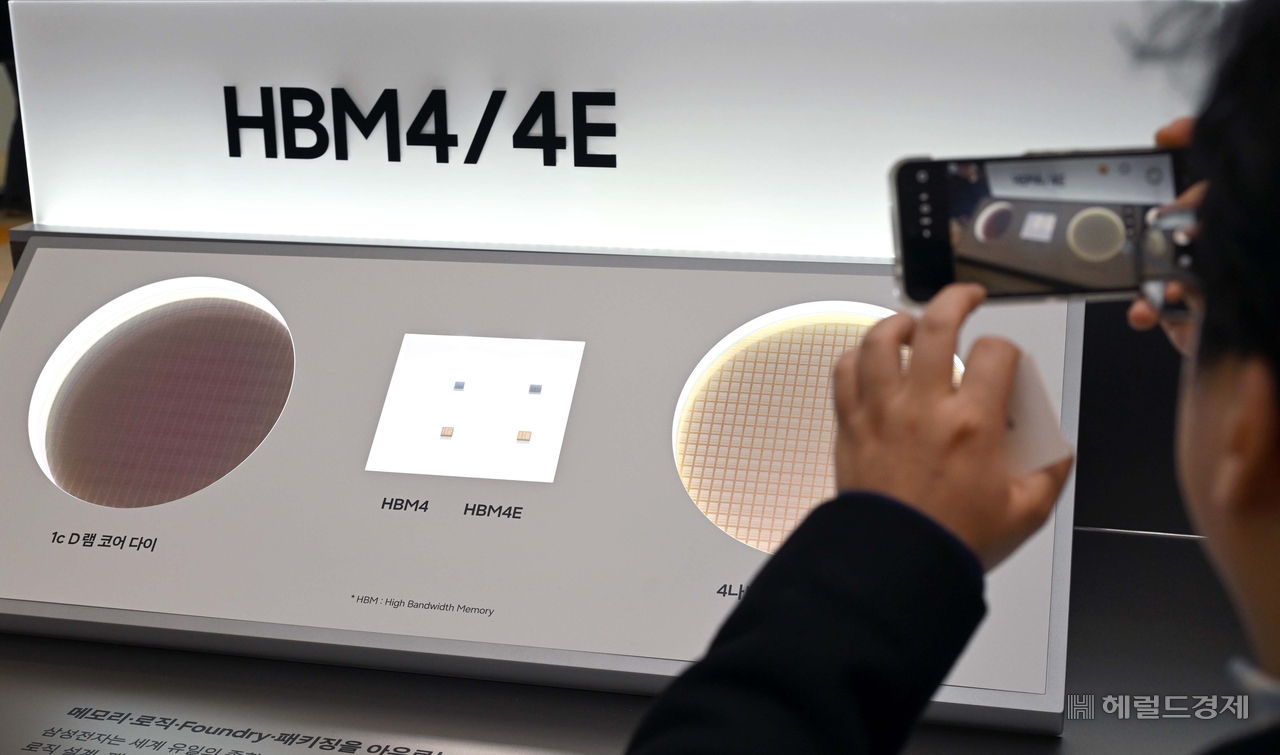
Samsung Electronics' sixth-generation high bandwidth memory chip, HBM4, has become the first product in the industry to surpass $1 billion in cumulative sales, industry sources said Tuesday. With orders pouring in from global big tech customers, the figure is expected to exceed $10 billion by year-end.
Samsung began mass-producing and shipping HBM4 on Feb. 12, becoming the world's first company to do so. The $1 billion milestone was reached roughly 130 days later, and cumulative sales are expected to top $1.2 billion by the end of June.
Samsung is currently supplying HBM4 as a priority component for Nvidia's next-generation AI accelerator, Rubin, and for AMD's AI accelerator MI455X, a direct competitor to Nvidia's lineup.
Demand from big tech companies building large-scale AI data centers has added further momentum. Sales have grown rapidly as those companies adopt Samsung's HBM4 for their in-house application-specific integrated circuits, or ASICs. The ASIC market currently includes Google, Amazon, Microsoft, Meta and Broadcom.
Samsung's HBM4 demonstrated a data transfer speed of 11.7 gigabits per second in final testing with Broadcom in December, the fastest in the industry, drawing the assessment that "Samsung is back." That figure is about 1.22 times faster than the maximum speed of 9.6 Gb/s achieved by its fifth-generation predecessor, HBM3E, and roughly 46 percent above the 8 Gb/s standard set by JEDEC, the global semiconductor standards body.
SK Hynix and Micron adopted 1b-node (fifth-generation 10-nanometer class) DRAM processes for their HBM4 products, while Samsung pursued higher performance by developing HBM4 on the more technically demanding 1c-node process. The base die — which has emerged as a key competitive battleground starting with HBM4 — also benefits from Samsung's own foundry 4-nanometer process, applied ahead of rivals.
As a result, HBM4's data transfer capacity is approximately 2.7 times higher than its predecessor's. Power efficiency has also improved by about 40 percent, reducing the power consumption and cooling burden on AI data centers, where heat and energy use are serious concerns.
The semiconductor industry expects Samsung to generate more than $10 billion in annual HBM4 sales if it continues to ramp up supply through year-end to meet growing customer orders. It would be highly unusual for a new memory chip product to surpass $10 billion in revenue in its first year of mass production.
Buoyed by strong HBM4 sales, Samsung's total HBM revenue this year is expected to more than triple compared with last year. The company's market share in HBM — where it has long trailed rivals — is also forecast to expand rapidly.
Samsung moved to extend its lead by shipping samples of its 12-layer HBM4E on May 29, again becoming the first to do so. As the technology evolves from HBM4E toward HBM5, base die design is becoming increasingly critical, and Samsung's integrated device manufacturer, or IDM, model — combining in-house foundry capabilities with HBM design expertise — is expected to serve as a key competitive advantage.
joze@heraldcorp.com