The Kospi swung from despair to relief in a single session. A day after suffering a near-10 percent collapse, the benchmark index swiftly reclaimed the 8,500 level. Despite a barrage of headwinds — a 12 percent-plus plunge in South Korea's two leading semiconductor stocks, interest rate hike fears and a decline on Wall Street — retail investors refused to panic-sell, instead snapping up a record 11 trillion won ($7.16 billion) to prop up the market. The episode is shaping up as fresh evidence of the long-held market axiom that a sharp crash is invariably followed by a rebound.
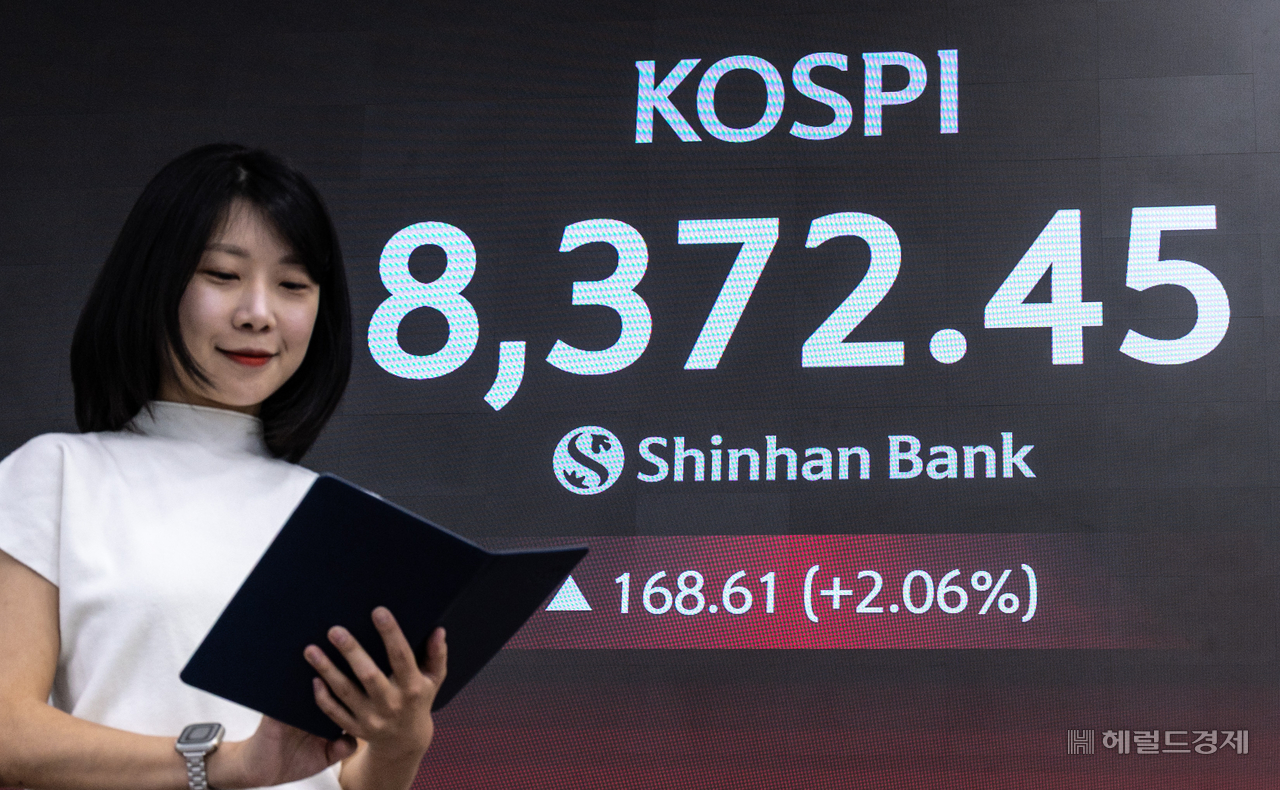
According to Korea Exchange, the Kospi opened Wednesday up 1.86 percent at 8,356.79 and recovered the 8,500 level in early trading. Samsung Electronics and SK Hynix, which had each tumbled more than 12 percent the previous session, were both staging steep recoveries.
The market shook off multiple headwinds in short order, including South Korea's failure to win inclusion in MSCI's developed-market index, a fall on Wall Street and concerns over rising interest rates.
Retail investors had collectively net-bought a record 11.5515 trillion won across Korea Exchange and Nextrade on Tuesday. They continued buying aggressively from the opening bell Wednesday, posting net purchases of 792.6 billion won as of 9:20 a.m. Foreign and institutional investors, who had net-sold 6.2469 trillion won and 5.5244 trillion won respectively the previous day, were again net sellers in early trading.
Individual investors appeared to read peak market fear as a buying opportunity, betting on the well-worn pattern that a steep selloff is followed by a rally.
The Kospi had closed Tuesday down 9.99 percent at 8,203.84, after breaching the 9,000 level intraday — triggering the market's 10th-ever circuit breaker as volatility hit extreme levels. A single-day drop of 9.99 percent ranks as the fifth-largest since 1996. The steepest on record was the US-Iran war earlier this year at minus 12.1 percent, followed by the Sept. 11 attacks in 2001 at minus 12.0 percent, the dot-com bubble collapse in 2000 at minus 11.6 percent and the 2008 financial crisis at minus 10.6 percent.
Securities industry analysts argue, however, that the cause of this crash is fundamentally different from those historical episodes. Rather than an external shock, they say the selloff was driven by investor anxiety over an extreme concentration of order flow in a handful of large-cap stocks — chiefly Samsung Electronics and SK Hynix — which weighed heavily on market sentiment.
On Monday, a battle for the top market capitalization spot between the two companies drew heavy buying in early trading, but a wave of profit-taking by foreign and institutional investors from midday onward triggered a cascade of index declines, further panic selling across all sectors and ultimately the circuit breaker. Single-stock leveraged products tied to the two names amplified the volatility further.
Adding to the pressure were Bank of America's forecast of three interest rate hikes this year, a delay in approval of SK Hynix's American depositary receipt listing in the United States, and concerns over pension fund rebalancing at the end of June.
The securities industry broadly expects the post-crash rebound pattern to repeat itself. In the five trading days following each of the major historical selloffs — the US-Iran war, the Sept. 11 attacks, the dot-com crash and the 2008 financial crisis — the Kospi posted gains of 10.1 percent, 2.3 percent, 5.6 percent and 18.6 percent, respectively.
The market impact of South Korea's failure to gain MSCI developed-market watch-list status is seen as limited. Yoon Jae-hong, a researcher at Mirae Asset Securities, said that in MSCI's "Global Market Accessibility Review" released June 19, the "investment products availability" criterion was upgraded from "improvement required (–)" to "adequate (+)," but key items including foreign exchange market liberalization, investor registration and account opening, and information flow all remained at "improvement required (–)," making deferral of watch-list inclusion widely anticipated. "Since the possibility of deferral had already been priced in, the announcement's impact on the market will be limited," he said.
Attention is now turning to Micron's upcoming earnings release, which is expected to serve as a key inflection point for the global semiconductor cycle. Overnight on Wall Street, the Philadelphia Semiconductor Index plunged 7.87 percent amid concerns over AI valuations and caution about peak levels, with Micron falling 13.18 percent, Nvidia dropping 4.13 percent and Tesla sliding 5.79 percent as technology stocks broadly faced profit-taking. The Dow Jones Industrial Average edged down 0.09 percent, while the S&P 500 and the Nasdaq Composite fell 1.44 percent and 2.22 percent, respectively.
Analysts nonetheless maintain that South Korean market fundamentals remain solid. Lee Gyeong-min, a researcher at Daishin Securities, said that with the second-quarter pre-earnings season approaching, "fundamental momentum is expected to strengthen as upward earnings forecast revisions resume," adding that he maintains a bullish outlook for the market in July and August and a Kospi target of 11,500 points in the third quarter.
Han Ji-young, a researcher at Kiwoom Securities, said it is reasonable to view the crash as "a supply-demand side effect created in both the spot and derivatives markets — through the spillover of single-stock leverage — by the extreme concentration in semiconductor stocks," and noted that "based on past experience, price corrections caused by supply-demand imbalances have not lasted long."

jiyun@heraldcorp.com