
Minimum bid for Sinsa-dong 633-3 site set at 324.5 billion won in first round; Diad Cheongdam, Aston55 among Gangnam high-end projects lining up for auction
![A rendering of The Peak Dosan. [Provided by RBDK]](https://wimg.heraldcorp.com/news/cms/2026/06/24/news-p.v1.20260624.607e883dcf2d4a328d6c55b48b884162_P1.jpg)
The site of The Peak Dosan, an ultra-luxury residential complex planned along Dosan-daero in Sinsa-dong, Gangnam-gu, Seoul, has been put up for public auction. The move adds to a growing list of high-end Gangnam development projects — including Diad Cheongdam in Cheongdam-dong and Aston55 in Jamwon-dong — that have been forced into auction, raising alarm across the market.
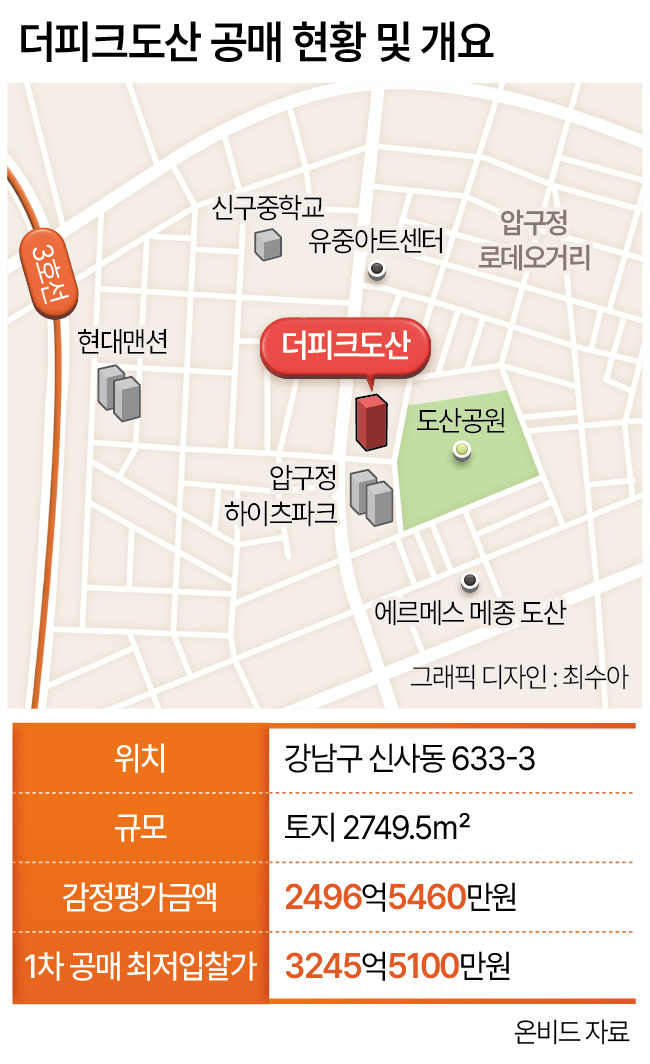
According to the Korea Asset Management Corporation's online auction platform OnBid, the first-round auction for land at 633-3 Sinsa-dong, Gangnam-gu, Seoul is set for June 30. The site, where real estate developer RBDK had been pursuing The Peak Dosan project, carries a minimum bid of 324.55 billion won ($211 million).
The Peak Dosan was originally planned as a residential complex of 26 units spanning five basement floors and 20 above-ground floors near Dosan-daero. Pre-sale prices were reported to range from 15 billion to 50 billion won depending on unit type.
The project ran into repeated obstacles as high interest rates and a prolonged freeze in real estate project financing persisted. RBDK signed a bridge loan agreement with a lender group in late June 2022 for up to 200 billion won to fund The Peak Dosan. The conversion to full project financing was repeatedly delayed, forcing multiple extensions of the loan's maturity.
Pre-sales also failed to gain momentum as expected. The Peak Dosan began taking pre-sale contracts in the first half of last year, but the contract rate by unit count is understood to have barely exceeded 50 percent. With pre-sale prices running into the tens of billions of won per unit, lenders and the contractor have raised their expectations regarding actual down payment receipts and the feasibility of converting to full project financing.
The company's financial condition has added to uncertainty surrounding the project. RBDK received a disclaimer of opinion from its external auditor for two consecutive years. Last year the company posted both an operating loss and a net loss, and is understood to have fallen into complete capital impairment, with liabilities exceeding assets by more than 100 billion won.
The auction is scheduled to proceed in up to seven rounds through mid-July. The minimum bid for the final round stands at 176 billion won — roughly 70 percent of the appraised value of 249.65 billion won. If no buyer emerges by the final round, the sale could proceed through a private negotiated contract.
The Peak Dosan is not the only ultra-luxury Gangnam development to have landed in the auction market. Diad Cheongdam, a high-end membership facility at 1 Cheongdam-dong, Gangnam-gu, also succumbed to project financing difficulties and rising construction costs, and went through the auction process. The property sold in its sixth round on June 19 after five failed attempts, fetching 112.1 billion won — about 85 percent of its initial appraised value of 131.9 billion won.
On the same day, the site of the Aston55 project in Jamwon-dong, Seocho-gu, also found a new owner. According to OnBid, a 4,722-square-meter plot and a 459-square-meter building at the Aston55 site sold in the seventh auction round held June 18 for 278.22 billion won. That represents about 56 percent of the first-round minimum bid of 490.8 billion won. Aston55 had also been planned as an ultra-luxury residential complex, with pre-sale prices reported at 20 billion to 40 billion won per unit and penthouses discussed at 60 billion to 80 billion won.
Industry observers say the string of Gangnam high-end project auctions signals a shift in the ultra-luxury housing market. Where prime location and scarcity alone once guaranteed strong project viability, the market has grown more demanding — scrutinizing actual contract rates, the likelihood of project financing conversion, construction cost burdens and financing expenses all at once.
"Acquiring land at excessively high prices during the boom years for luxury residential development has become a fundamental burden," said Park Hap-su, an adjunct professor at Konkuk University's Graduate School of Real Estate. "Since the real estate project financing market tightened after 2022, and construction costs have surged due to supply chain disruptions following COVID-19, it has become very difficult to keep these projects going."
Park added that the market itself has grown more discerning. "As luxury residential products have been supplied to the market multiple times, buyers' expectations have risen compared to the past," he said. "Going forward, location alone will no longer be enough — only projects with genuine product quality will survive, and a real shakeout is about to begin."
quq@heraldcorp.com





