
'2026 Korean Economy Outlook' seminar held
Growth to exceed potential rate by 0.7 percentage points, first expansion in two years
Record current account surplus expected on semiconductor boom
Analysts flag vulnerability from rising semiconductor dependence
Spreading recovery to non-semiconductor sectors, domestic demand seen as key task
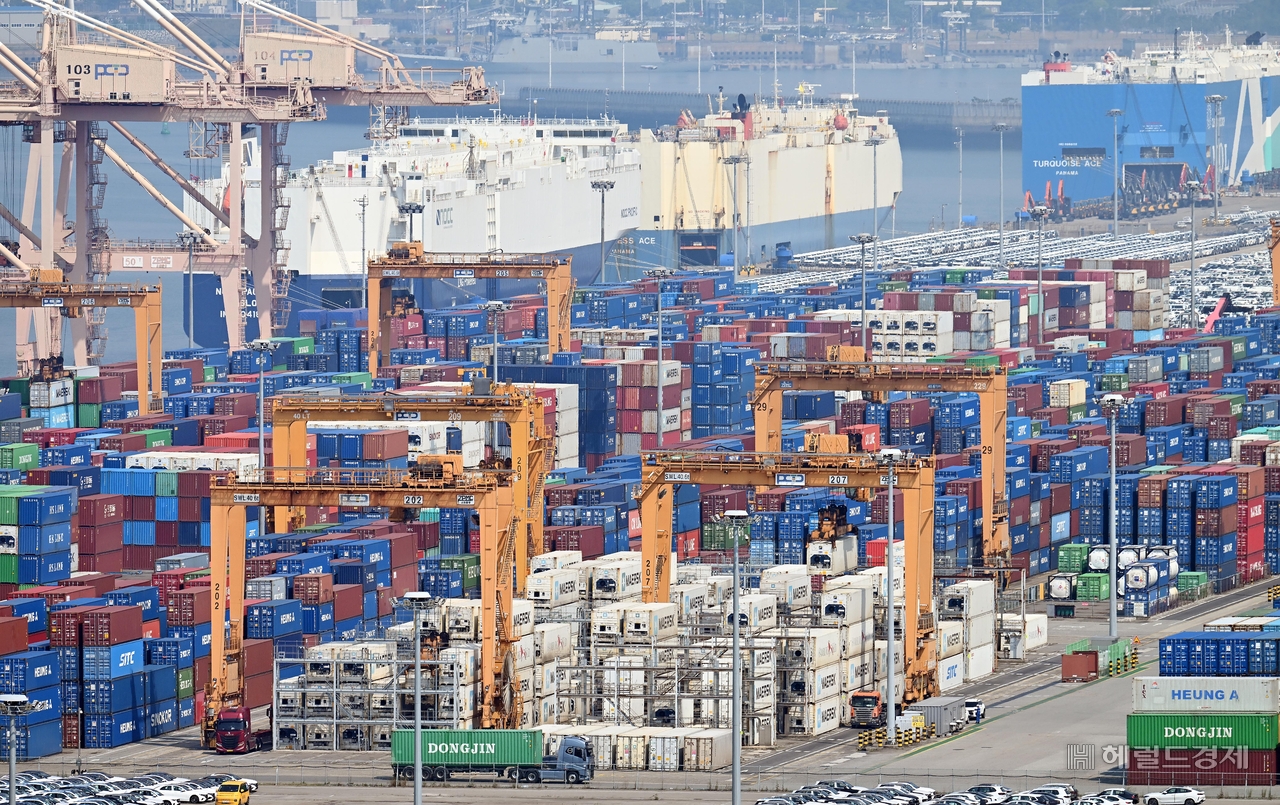
South Korea's economy is forecast to grow 2.7% this year, outpacing its potential growth rate, but analysts warned Thursday against complacency given the country's heavy reliance on a semiconductor export boom.
The Korea Economic Research Institute, an affiliate of the Federation of Korean Industries, held a seminar titled "2026 Korean Economy Outlook: A Crossroads of Opportunity and Risk" at the FKI Tower conference center in Yeouido, Seoul, on Thursday.
Lee Seung-seok, a senior research fellow at the institute who delivered the first presentation, said the 2.7% growth forecast exceeds the potential growth rate of 2.0% by 0.7 percentage points, marking a return to an expansionary phase for the first time in two years after last year's sluggish 1.1% growth.
Lee projected a front-loaded growth pattern, with first-half growth at 3.4% and second-half growth at 2.0%, driven by a base effect from a surprise first-quarter expansion.
He cautioned, however, that "2.7% is a question, not an answer," adding that "the warmth of economic recovery has yet to spread evenly." Growth momentum, he noted, remains concentrated in a handful of sectors such as semiconductors, limiting the breadth of the recovery.
Lee identified a "K-shaped polarization" — semiconductors outpacing non-semiconductor industries, manufacturing outpacing non-manufacturing, and exports outpacing domestic demand — as the shadow side of the rebound. He called spreading the recovery's benefits to non-semiconductor sectors and domestic demand the central challenge facing the Korean economy.
Private consumption is forecast to recover only 2.0% despite income improvements and supplementary budget effects, as high prices and accumulated household debt continue to weigh on spending. Construction investment posted its first increase in seven quarters but is expected to rise just 0.5%, constrained by rising construction costs.
Analysts also cautioned against excessive dependence on the semiconductor industry, which has been the primary engine of domestic economic growth this year.
Do Young-woong, another senior research fellow at the institute, said in a presentation on the semiconductor supercycle that the current account surplus is expected to surpass $200 billion for the first time in history this year, reaching $225 billion, on the back of an exceptional boom in the semiconductor sector.
Do urged caution against excessive optimism, however. "The semiconductor boom in the first quarter was driven in significant part by a temporary surge in DRAM prices, beyond structural factors," he said. "If Korea fails to secure pricing power across the broader semiconductor ecosystem, the economy could be rattled at any time by external conditions."
Meanwhile, analysts said the geopolitical risk stemming from the Middle East — cited as the biggest downside variable this year — has recently entered an easing phase. With concerns over a blockade of the Strait of Hormuz subsiding, upward pressure that had been pushing up oil prices, consumer prices and the exchange rate is expected to moderate somewhat.
The institute forecast consumer price inflation rising to 2.7% this year from 2.0% last year, exceeding the Bank of Korea's 2.0% target, though it said the pace of increase would be limited if oil prices stabilize at lower levels. With the benchmark interest rate expected to remain on hold at 2.5%, pressure for a rate hike is also seen easing as supply-side shocks subside.
Kim Chang-beom, vice chairman of the Federation of Korean Industries, said the economy is showing signs of recovery but that a clear-eyed assessment is needed of whether that signals a genuine strengthening of the economy's fundamentals. "We must not let structural vulnerabilities be obscured by the dazzling appearance of a stock market rally and a semiconductor supercycle," he said.
joze@heraldcorp.com





