A hidden seismic zone where the Caribbean and South American plates collide
Twin magnitude 7.2 and 7.5 quakes struck 39 seconds apart, compounding the destruction
Shallow focal depths and aging buildings left Caracas directly in the line of fire
Fears grow of a repeat of the 1812 disaster that killed about 30,000 people
![Rescue workers search through the rubble of a collapsed building in Caracas, Venezuela, on Wednesday. [Reuters]](https://wimg.heraldcorp.com/news/cms/2026/06/25/rcv.YNA.20260625.PRU20260625448801009_P1.jpg)
By Seo Ji-yeon, The Herald Business
Venezuela is not typically grouped with earthquake-prone nations like Japan or Chile. Geologically, however, it sits on a hidden seismic zone where the Caribbean Plate and the South American Plate grind against each other, steadily building stress. Analysts say decades of accumulated energy released in two successive quakes — a magnitude 7.2 followed by a magnitude 7.5 just 39 seconds later — combined with shallow focal depths to deliver a direct blow to the capital, Caracas, sharply worsening the toll.
According to the US Geological Survey (USGS), a magnitude 7.2 earthquake struck near Morón on Venezuela's Caribbean coast on Wednesday, followed 39 seconds later by a magnitude 7.5 quake along the same fault zone.
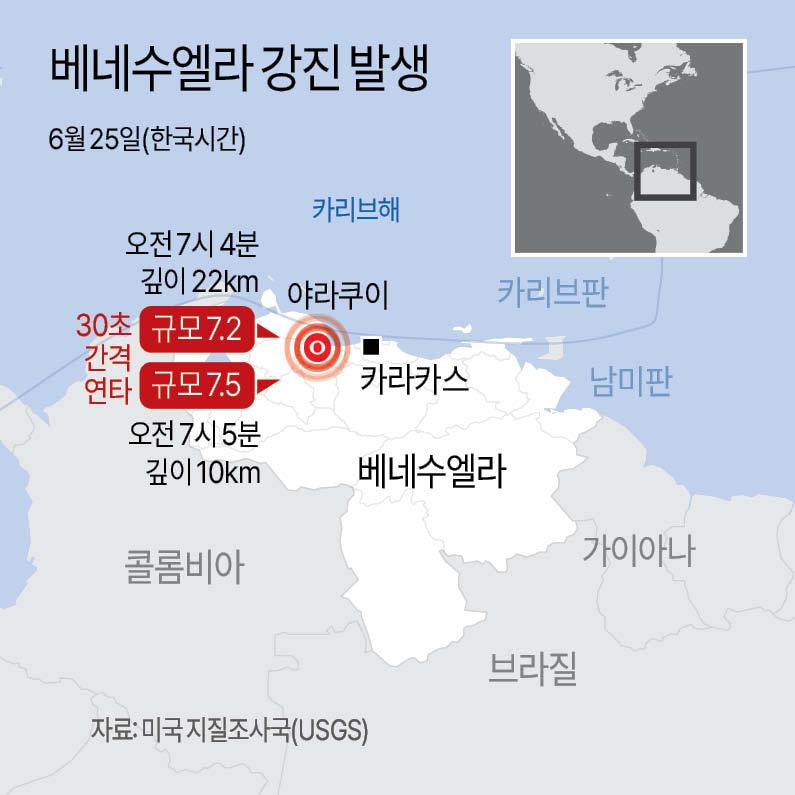
The USGS described the event as a sequence of two major earthquakes occurring in rapid succession, saying the second magnitude 7.5 tremor in effect served as the main shock.
Typically, a powerful main shock is followed by smaller aftershocks, but in this case two quakes exceeding magnitude 7 struck back to back. Structures already weakened by the first jolt could not withstand the larger second tremor, significantly raising the risk of building collapses and casualties.
The USGS assessed through its PAGER disaster-evaluation system that the quakes were likely to cause mass casualties and widespread property damage. Early analysis put the probability of the death toll reaching between 10,000 and 100,000 at 44 percent. The Venezuelan government has not yet released official casualty figures and continues to conduct rescue operations.
The earthquakes have drawn particular attention because, while Venezuela is not widely perceived as an earthquake-prone country, it has in fact been struck repeatedly by major quakes throughout its history.
![Rescue workers search through the rubble of a collapsed building in Caracas, Venezuela, on Wednesday. [Reuters]](https://wimg.heraldcorp.com/news/cms/2026/06/25/rcv.YNA.20260625.PRU20260625446601009_P1.jpg)
Geologically, Venezuela lies along the boundary where the Caribbean Plate and the South American Plate slide past each other. When the two plates accumulate stress over decades and release it all at once, the result can be a quake exceeding magnitude 7.
According to the USGS, Venezuela has recorded roughly 180 damaging earthquakes over the past several centuries. The 1812 Caracas earthquake killed about 30,000 people, and a magnitude 6.3 quake struck the capital again in 1967, causing significant casualties. A magnitude 7.3 quake hit in 2018 as well, though its epicenter was close to the sea, limiting the damage.
![A resident searches through rubble after a building collapsed in La Guaira, Venezuela, on Thursday. [Reuters]](https://wimg.heraldcorp.com/news/cms/2026/06/25/rcv.YNA.20260625.PRU20260625476001009_P1.jpg)
Experts point to two decisive factors that amplified the destruction: the back-to-back major quakes and the shallow focal depths.
The first quake's focal depth was estimated at about 22 kilometers; the second's at about 10 kilometers. The shallower a quake's focus, the more directly seismic energy transfers to the surface, producing far stronger shaking for a given magnitude.
The proximity to Caracas meant that one of the country's most densely populated areas absorbed the full impact. Buildings and homes collapsed across the capital, hospital ceilings caved in, and several high-rise structures sustained severe damage. Residents fled into the streets and could not return home well into the night, while rescue teams worked through the rubble of collapsed buildings searching for survivors.
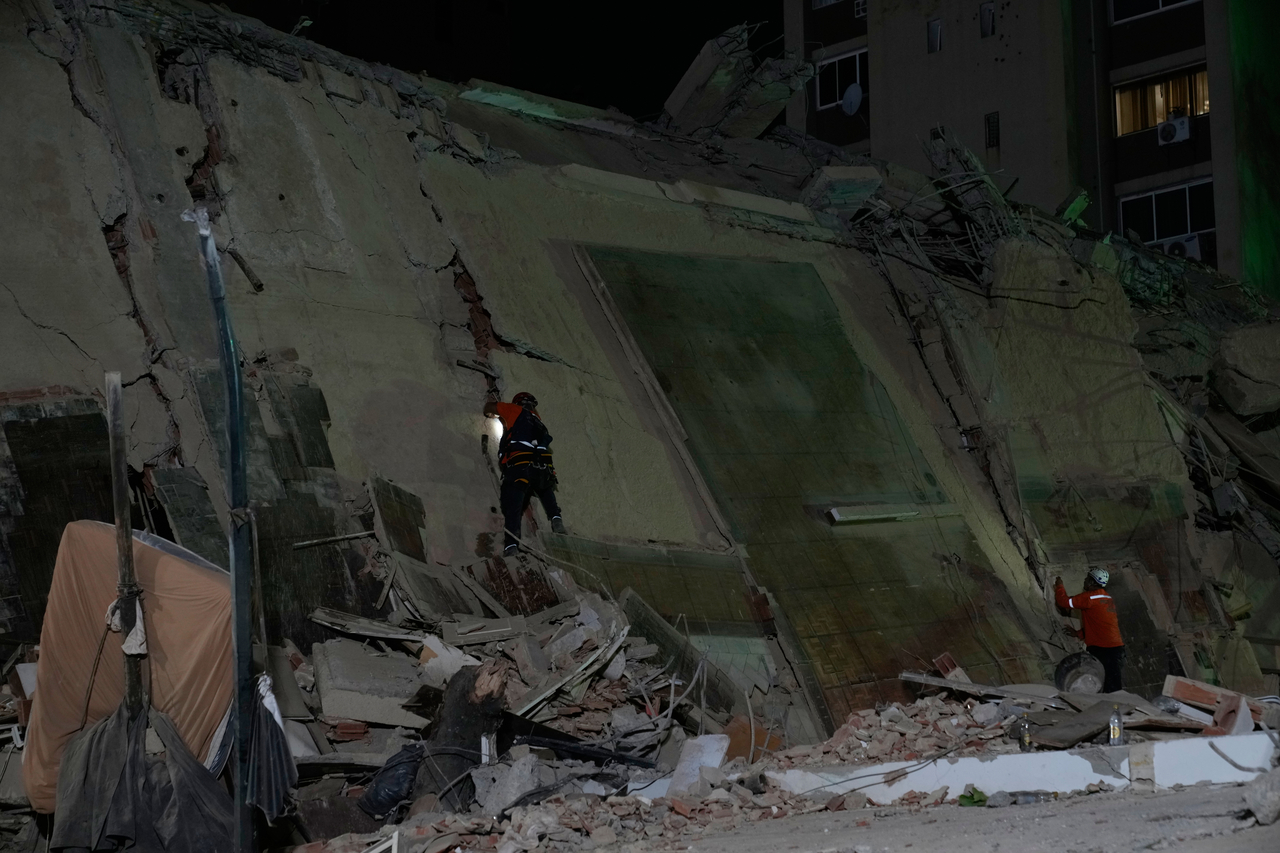
AFP reported that a 22-story building in the Altamira district of Caracas suffered severe collapse, with families gathered at the rubble calling out the names of missing relatives and pleading for rescue. Some residents said the experience was far more terrifying than the 1967 earthquake, with stairwells crumbling and entire walls cracking.
Aging infrastructure has also been identified as a factor that worsened the toll. Years of economic hardship have left many buildings poorly maintained, and a large number of structures were built without modern seismic-resistant design, leaving them highly vulnerable to strong shaking.
The effects extended beyond Venezuela's borders. Tremors were felt in Bogotá, the Colombian capital, and the US Tsunami Warning Center briefly issued tsunami warnings for Puerto Rico and the US and British Virgin Islands before lifting them about an hour later after determining the threat had subsided.
![Residents search through debris around a damaged building in Catia La Mar, La Guaira state, about 30 kilometers northwest of Caracas, in the early hours of Thursday. [AFP]](https://wimg.heraldcorp.com/news/cms/2026/06/25/rcv.YNA.20260625.PAF20260625251601009_P1.jpg)
Experts warn it is too early to feel safe. Following a sequence of quakes exceeding magnitude 7, residual stress along the fault can trigger aftershocks of magnitude 5 or 6 or greater for weeks or even months as the fault readjusts. Colombia's National Seismic Network also warned of further aftershocks and urged people to stay away from buildings at risk of collapse.
The disaster has again shown how much a city's seismic resilience and disaster-response systems determine the scale of casualties — not just the raw force of a quake. Experts say that, separate from the climate crisis, reinforcing aging urban infrastructure against earthquakes will be one of the central challenges in reducing casualties from major quakes in the years ahead.
sjy@heraldcorp.com