The company signed an MOU with Jiyeok Nanbang Anjeon Co. to develop smart heat-transport operation technology — establishing IoT-based continuous monitoring to reduce human error and shift to prevention-focused safety management
Safety management of heat supply pipelines — the critical infrastructure that delivers thermal energy to residents — has long relied on on-site inspections and the experience of skilled personnel. In recent years, however, the importance of building a smart safety management system incorporating digital technology has grown significantly.
In response, Seoul Energy Corp. said it will integrate IoT-based technology into pipeline safety management and establish a continuous monitoring system to complement field- and personnel-centered inspection methods, as part of efforts to develop prevention-focused safety management technology.
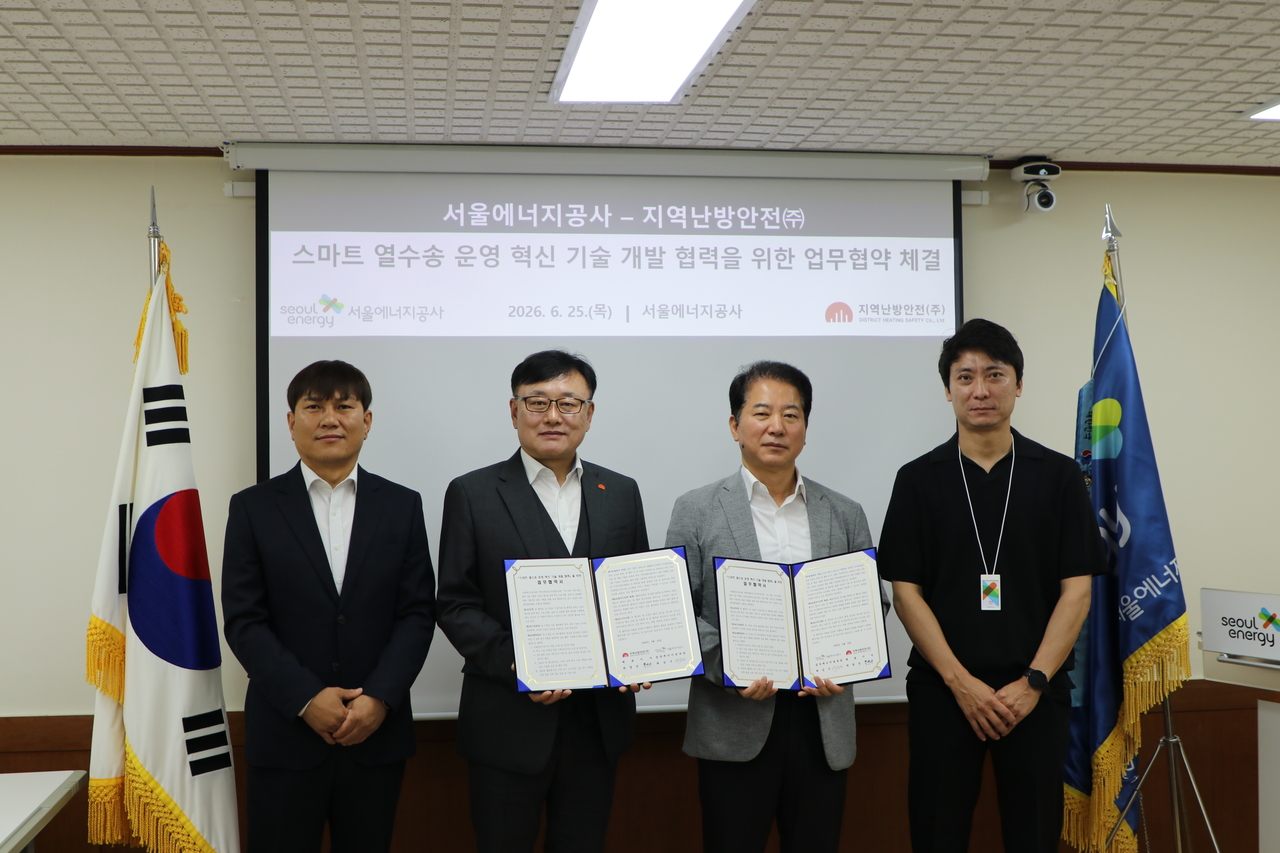
Seoul Energy Corp. (president Hwang Bo-yeon) and Jiyeok Nanbang Anjeon Co. (CEO Park Young-jin) signed an MOU on Thursday to cooperate on developing innovative smart heat-transport operation technology. The signing ceremony was attended by Kwak Seung-shin, head of Seoul Energy Corp.'s district energy division, and Park Young-jin, CEO of Jiyeok Nanbang Anjeon.
The agreement is a joint pilot project aimed at detecting early signs of abnormalities in aging and underground heat supply pipelines and establishing a data-driven continuous monitoring system. The two organizations plan to go beyond simple technology exchange, extending their cooperation to real-world field demonstration and verification of commercialization potential, jointly developing and testing innovative technologies to improve operational efficiency and strengthen the safety of district heating infrastructure.
The key areas of cooperation include drone-based thermal imaging diagnostics of heat supply pipelines, installation of IoT-based multi-channel pipeline monitoring devices, construction of a smart diagnostic platform for heat-use facilities, and research and development of IoT-based continuous monitoring technology using acoustic sensing.
Under the agreement, Jiyeok Nanbang Anjeon will apply its independently developed "heat supply pipeline leak monitoring terminal" to Seoul Energy Corp.'s pipeline network. The device is an IoT-based monitoring unit that connects to the sensor and feed lines of heat supply pipelines to detect leaks and wirelessly transmits the data to a server.
The equipment is designed to withstand water, dust and vibration, and features a terminal block-integrated design with a rechargeable built-in battery that blocks external moisture — making it well suited to on-site conditions of heat supply pipelines.
The device goes beyond simple leak detection to collect real-time data on pipe temperature, pressure and flow rate. The accumulated data will be used through AI learning to assess pipeline integrity and predict damage risks in advance, and is expected to serve as the foundation for shifting from a reactive management approach to a prevention-focused smart safety management system.
Seoul Energy Corp. will select pilot complexes and target sections for technology demonstration, provide on-site support, and supply foundational data needed for facility diagnostics — including pipeline drawings and records of vulnerable sections. The company will also designate target facilities for developing smart operational innovation technology for heat-use facilities, provide administrative support, and share operational information and technical advice for research into acoustic-sensing-based IoT continuous monitoring technology.
The IoT-based continuous monitoring technology to be established through this agreement is expected to supplement the limitations of existing on-site inspections, enabling faster and more systematic assessment of facility conditions. It will also reduce human error, support a prevention-centered safety management system, and contribute to stable heat supply and the safety of Seoul residents.
"We need to move beyond field- and personnel-centered inspection methods for heat supply facilities and build an advanced inspection system using IoT- and AI-based innovative technology," said Kwak Seung-shin, head of Seoul Energy Corp.'s district energy division. "We will do our utmost to ensure this agreement goes beyond a formality and translates into tangible results that contribute to the safety of Seoul citizens and stable heat supply."
Seoul Energy Corp. is a local public enterprise leading Seoul's energy independence through its district energy business — which produces heat and electricity simultaneously — as well as the expansion of renewable energy and the realization of energy welfare.
seouldream01@heraldcorp.com