H1 average exchange rate hits 1,484.6 won, matching Asian financial crisis levels
June monthly average third-highest on record; Iran war, foreign selling, US rate fears weigh
Experts see won recovering toward year-end, but disagree on timing
By Kim Byeo-ri, The Herald Business
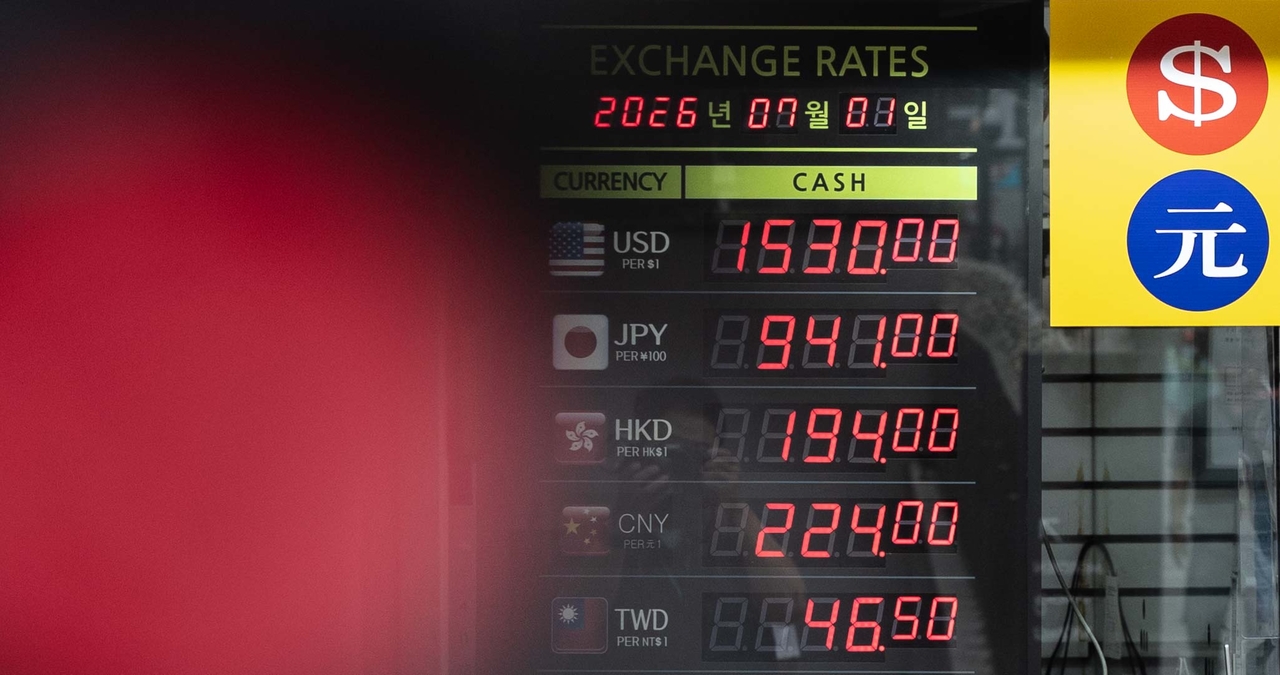
The average won-dollar exchange rate for the first half of this year came in at 1,484.6 won, a level rivaling that of the Asian financial crisis. A string of headwinds — the Iran war, sustained foreign selling of domestic equities and fears of US interest rate hikes — combined to push the won lower.
Experts broadly expect the exchange rate to ease somewhat by year-end, though they differ on when that decline will take hold.
H1 rate averages 1,484.6 won as Iran war, foreign selling drive upward pressure
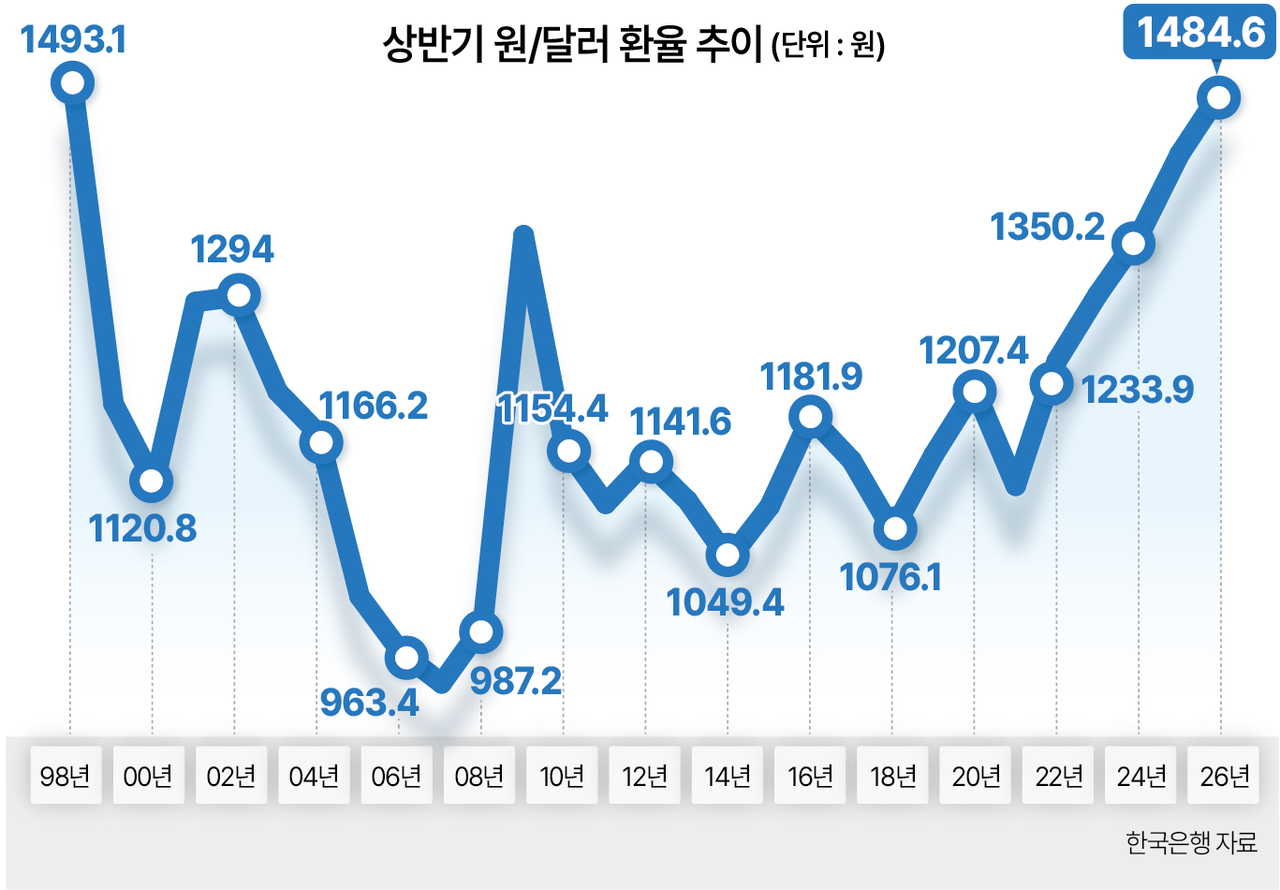
The average won-dollar exchange rate for the first half of this year, measured on a weekly closing-price basis, reached 1,484.6 won, according to financial industry data released Tuesday. That is the highest first-half average since the 1998 Asian financial crisis, when the rate stood at 1,493.1 won, and 133.5 won above the level recorded during the global financial crisis (1,351.1 won).
The rate eased through February as the overseas stock investment craze among retail investors cooled somewhat, but surged to 1,492.5 won in March after the Iran war sent oil prices sharply higher. It dipped slightly in April before foreign investors' sustained selling of domestic shares pushed it back up to 1,491.3 won in May. In June, mounting fears of US interest rate hikes compounded the pressure, driving the rate to 1,527.9 won — the third-highest monthly average on record, behind only January 1998 (1,701.5 won) and February 1998 (1,626.8 won).
Weekly closing prices have been breaking global financial crisis-era records in succession. On Monday, the rate closed at 1,549.4 won — just below the 1,550-won threshold — surpassing for the first time the March 9, 2009 closing record of 1,549 won.
The first-half surge reflects a combination of factors: the supply shock from the Iran war, persistent foreign net selling of domestic equities and growing inflationary pressure in the United States.
In March, international oil prices climbed above $100 per barrel following the outbreak of the Iran war, pulling the exchange rate higher. South Korea's heavy dependence on Middle Eastern crude means oil price swings have an outsized effect on inflation and the country's broader economic trajectory.
Oil prices retreated after the US and Iran reached a ceasefire agreement, but foreign net selling and expectations of US rate hikes have since resumed their upward pressure on the won-dollar rate.
Foreign investors extended their net selling streak to five consecutive months through June, according to the Financial Supervisory Service. In May alone, they net sold 47.02 trillion won ($30.5 billion) worth of domestically listed shares. Cumulative net selling through June reached 114.22 trillion won — more than 10 times last year's full-year net selling figure of 11.08 trillion won. In June, foreign investors were net sellers on 16 of 21 trading days, with total net selling for the month exceeding 45 trillion won.
At its June 18 Federal Open Market Committee meeting, the US Federal Reserve held its benchmark interest rate steady for the fourth consecutive time while strongly signaling the possibility of future rate hikes, citing persistent inflationary pressure. The median year-end federal funds rate projection in the FOMC's dot plot came in at 3.8 percent, a reading widely interpreted as pointing to one rate increase before the end of the year.
The CME Group's FedWatch tool showed that as of Monday (local time), the probability of at least one rate hike before year-end stood at 82.7 percent — up 37.5 percentage points from a month earlier, when it was 45.2 percent.
Experts see won easing toward year-end, but differ on timing
Experts generally expect the exchange rate to fall to some degree in the second half of the year, though they disagree on the pace of the decline.
Some analysts foresee continued upward pressure in the near term before a gradual easing as the year draws to a close.
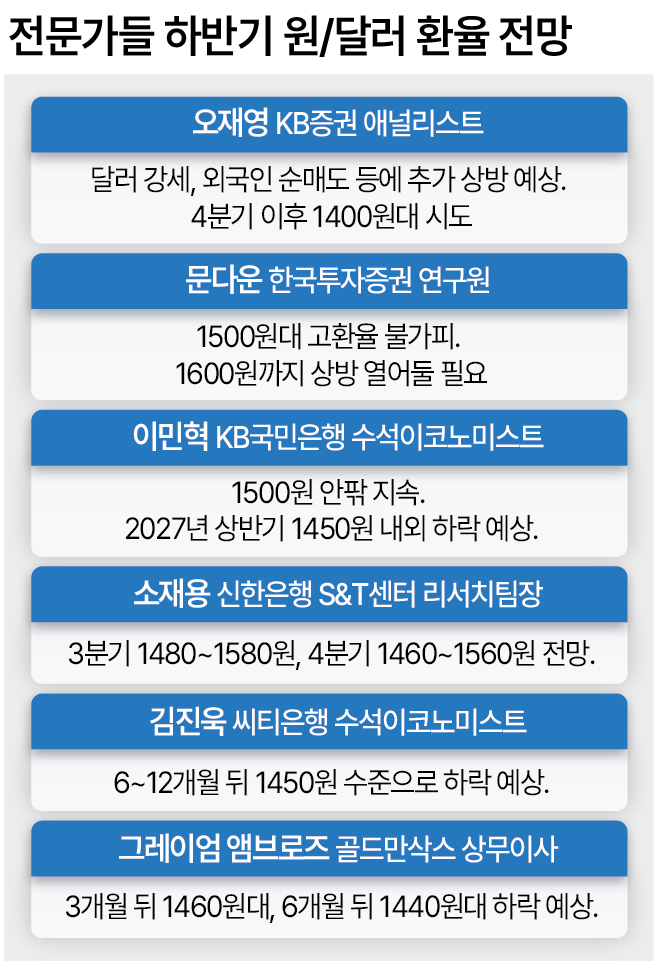
Oh Jae-young, an analyst at KB Securities, said the won-dollar rate could climb as high as 1,580 won in the second half on the back of a stronger dollar and continued foreign securities selling, but added that it would "attempt a decline toward the 1,400-won range toward year-end as fundamentals reassert themselves."
Moon Da-un, a researcher at Korea Investment & Securities, said the dollar would be "the key driver determining the level and direction of the exchange rate in the second half," and that "in broad terms, the dollar index will gradually fall as expectations for US rate hikes recede and monetary policy uncertainty settles." Moon cautioned, however, that "until a clear inflection point for a weaker dollar emerges, domestic supply-demand pressures will persist and a rate in the 1,500-won range is unavoidable," adding that "if the rate breaks through the previous peak of 1,560 won, it will be difficult to identify meaningful resistance, so the upside should be kept open to 1,600 won."
Lee Min-hyuk, chief economist at KB Kookmin Bank, said the second-half exchange rate faces "lingering short-term upside risks, but the medium- to long-term path points to a gradual decline." He said foreign net selling and uncertainty around the Fed would "keep upward pressure on the rate at around 1,500 won through the third quarter," and went on to say that "easing war risk and improving semiconductor exports will act as downward forces from the fourth quarter onward," with the rate likely to fall to around 1,450 won in the first half of next year as interest rate differentials, the trade balance and supply-demand conditions all improve in tandem.
Some analysts expect the won to begin strengthening as early as the third quarter. Kim Jin-wook, chief economist at Citibank Korea, said at a recent seminar on second-half 2026 exchange rate forecasts and industry response strategies that the won-dollar rate would "hover around 1,480 won over the next three months before falling to around 1,450 won within six to 12 months." He cited a semiconductor boom-driven expansion in exports, a pickup in domestic investors' appetite for local equities and the likelihood of a sustained current account surplus as factors that would support won strength.
Graham Ambrose, a managing director at Goldman Sachs, also said in a recent private report that "the won is currently undervalued relative to fundamentals" and would "show a strong recovery in the second half of this year." He forecast the rate at around 1,460 won by the end of the third quarter and around 1,440 won by year-end. The report said large-scale won conversions by chipmakers such as Samsung Electronics and SK hynix — for domestic investment and tax payments — would pull the exchange rate lower, and that an expansion of the National Pension Service's currency-hedging ratio would also help curb won weakness.
kimstar@heraldcorp.com