![[Yonhap-Reuters]](https://wimg.heraldcorp.com/news/cms/2026/07/01/rcv.YNA.20260629.PRU20260629259501009_P1.jpg)
China semiconductor and STAR Market exchange-traded funds swept the top performance rankings in South Korea's ETF market in June, as investors priced in the anticipated listing of CXMT — China's leading DRAM maker — on Shanghai's STAR Market, raising hopes that Chinese equities would finally offer a dedicated memory chip investment vehicle.
Market analysts say CXMT is unlikely to pose an immediate threat to Samsung Electronics and SK hynix in high-bandwidth memory, but warn the company could become a meaningful variable for commodity DRAM prices over the medium to long term.
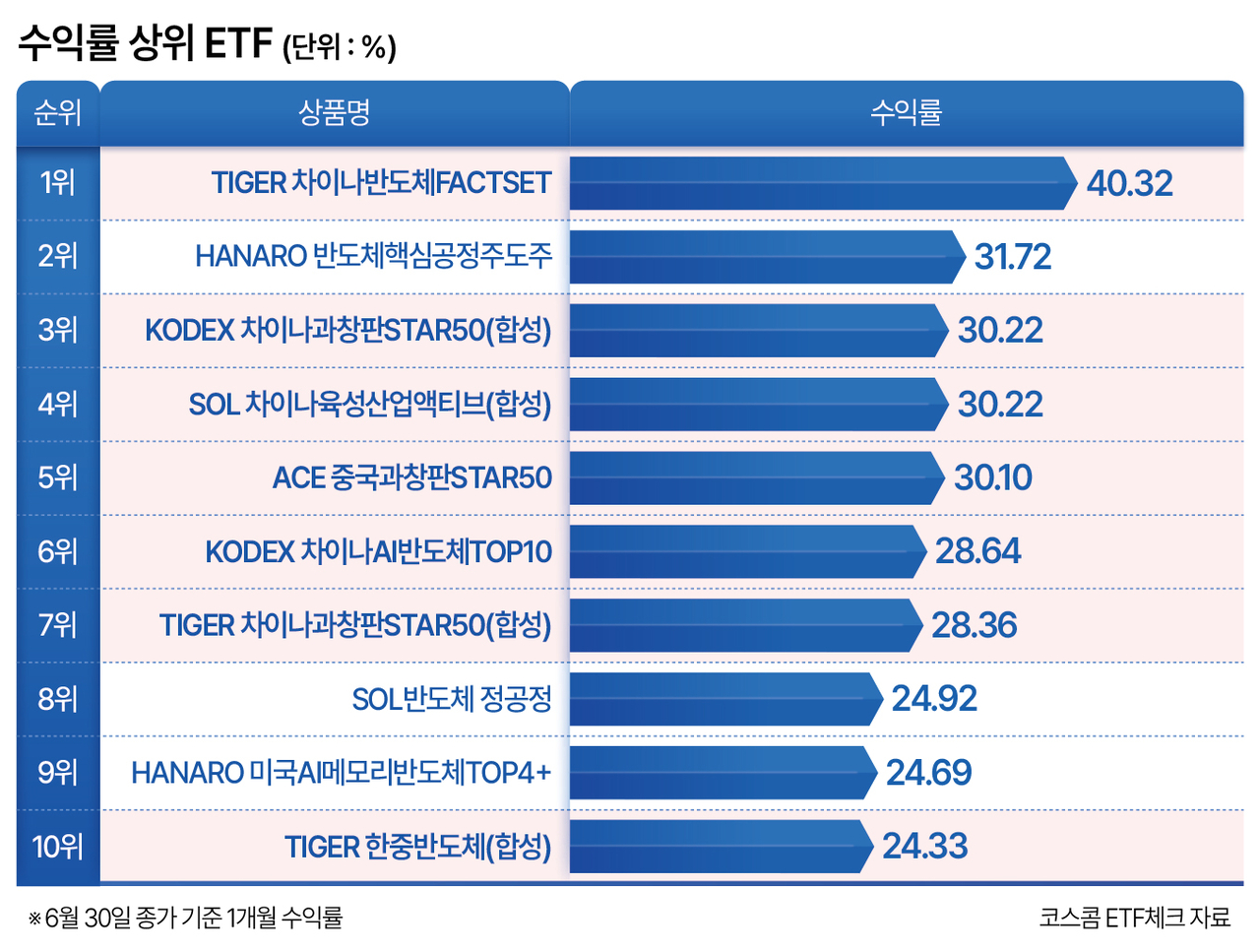
According to ETF Check, the top-performing domestic ETF last month was TIGER China Semiconductor FACTSET, which returned 40.32 percent. Five more China semiconductor and STAR Market products ranked third through seventh: KODEX China STAR50 (Synthetic), SOL China Strategic Industries Active (Synthetic), ACE China STAR50, KODEX China AI Semiconductor TOP10 and TIGER China STAR50 (Synthetic) posted returns ranging from 28.36 to 30.22 percent.
The surge in China semiconductor ETFs coincided with a broader rally in Chinese technology stocks. Yeo Tae-gyeong, a researcher at Hyundai Motor Securities, said the ChiNext index and the STAR 50 index — both technology-heavy benchmarks within China's A-share market — hit record highs last month. "China's A-share market has recently shown a differentiated rally centered on advanced technology themes such as semiconductors and AI, driven by investor expectations surrounding tech IPOs," he said, adding that the momentum was likely to persist through late July when the major IPO listings are completed.
The central catalyst behind the rally is anticipation of CXMT's listing — a dynamic similar to the run-up in aerospace stocks and related ETFs ahead of SpaceX's expected listing last month.
CXMT is the world's fourth-largest DRAM maker, behind Samsung Electronics, SK hynix and Micron. It received final IPO registration approval from China's securities regulator on June 12 and is expected to list on Shanghai's STAR Market — often called China's Nasdaq — as early as this month. According to industry sources, CXMT plans to raise 29.5 billion yuan ($4.34 billion) through the offering, which would rank as the second-largest fundraise in STAR Market history, trailing only SMIC, China's largest foundry.
Markets are paying close attention to the fact that CXMT's listing would create the first genuine memory chip investment target in China's A-share market. While Chinese equities already include foundry, equipment, materials and chip design companies, integrated device manufacturers focused on memory have been largely absent.
Analysts expect the enthusiasm surrounding CXMT's listing to ripple across China's broader semiconductor supply chain. With roughly 70 percent of the 29.5 billion yuan in IPO proceeds earmarked for upgrading memory production lines and advancing DRAM technology, orders for front-end process equipment — including etching, deposition, cleaning and chemical mechanical planarization tools — are expected to come first, followed by benefits spreading to materials, gases and back-end processes.
Because direct investment in the STAR Market is difficult for South Korean retail investors, ETF products are expected to become the primary channel for gaining exposure. "A significant number of Chinese semiconductor materials, parts and equipment companies are listed on the STAR Market, where direct investment by foreign individuals is restricted," said Shin, a researcher at Shinhan Investment. "Since the benefits after CXMT's listing are more likely to spread across equipment, materials, gases and back-end processes rather than concentrate in any single company, a diversified approach through ETFs is more effective than picking individual stocks."
Shin Seung-ung, also a researcher at Shinhan Investment, described CXMT's listing as "an event where the memory supercycle meets the China strategic asset premium," adding that Samsung Electronics and SK hynix are not the only companies benefiting from the memory supercycle. "CXMT, China's leading DRAM company, is also seeing the gains from rising prices show up in its numbers," he said.
Still, analysts see limited near-term risk for Samsung Electronics and SK hynix. The technology gap between CXMT and the three global leaders — Samsung, SK hynix and Micron — in HBM is at least three years, and CXMT's lack of EUV lithography equipment is expected to constrain its production yields and cost competitiveness.
Shin said initial demand for CXMT's HBM is likely to concentrate on validation volumes destined for local AI accelerators, including those made by Huawei, as well as state-owned cloud and data center operators. "It is meaningful from a supply chain self-sufficiency standpoint, but it is not a variable that will erode the AI premium enjoyed by the three global leaders," he said.
The longer-term concern for the industry centers on commodity DRAM. Rather than disrupting the HBM market immediately, CXMT is seen as a potential drag on standard DRAM prices if and when the memory cycle turns down. Should CXMT expand production while serving its domestic Chinese customer base, Samsung Electronics, SK hynix and Micron could find their pricing power in commodity DRAM weakened during any demand slowdown, analysts said.
kacew@heraldcorp.com