
Shin presents unified ledger platform with government bond issuance at ECB forum
By Kim Byeo-ri, The Herald Business
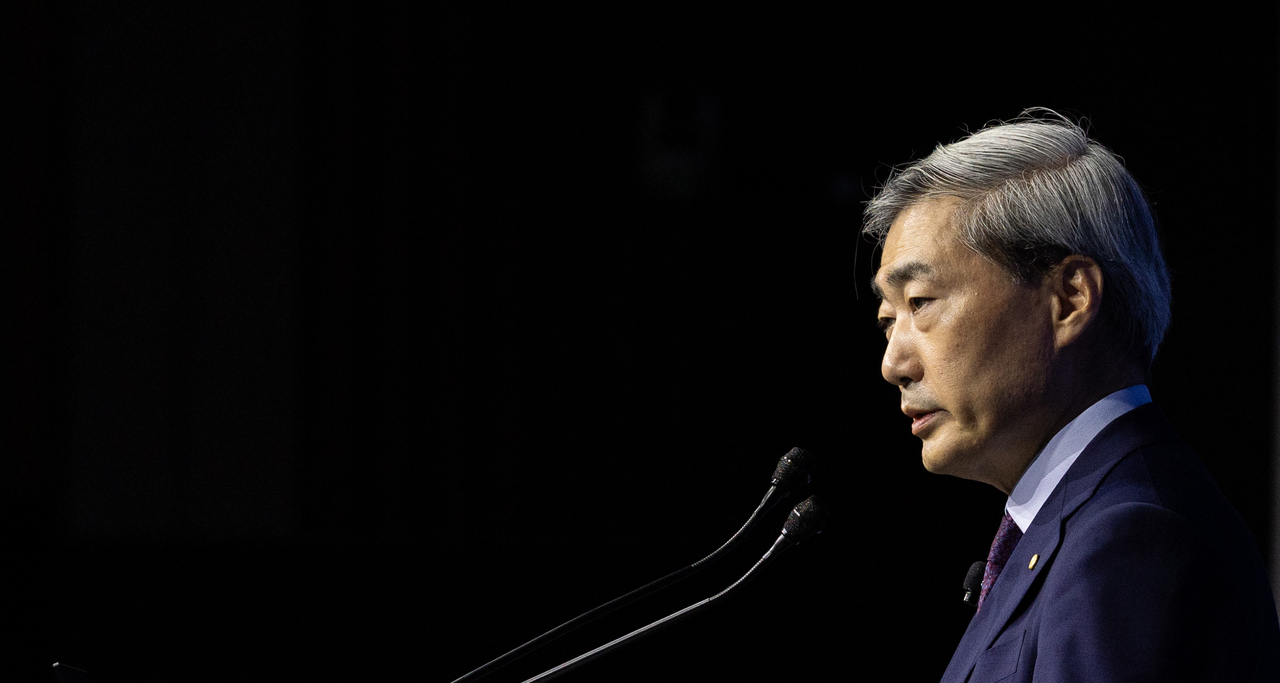
Bank of Korea Gov. Shin Hyun-song said Tuesday that Korea's tokenization ecosystem projects, including Project Hangang, are about two years ahead of Europe.
Shin made the remarks at the European Central Bank's annual Sintra Forum in Sintra, Portugal, on Tuesday (local time), presenting a paper titled "A Unified Ledger in Practice: Lessons from Project Hangang."
Asset tokenization refers to the process of converting ownership of real and financial assets — such as real estate, artwork and bonds — into blockchain-based digital tokens. The approach allows assets to be divided into smaller units for trading, improving transaction efficiency and asset liquidity.
"Tokenization is at the heart of the transformation of the monetary system," Shin said, adding that tokenized money goes beyond a simple store and transfer of value to become "smart money" that embeds commitments and procedures. He said the same concept applies not only to currency but also to assets such as government bonds and shares.
Shin proposed a "unified ledger" as the platform where tokenized money and assets would come together. The concept envisions placing tokenized central bank money, tokenized bank deposits and tokenized assets on a single programmable platform. Shin said this would allow transactions to be processed simply and securely without mismatches.
On why a central bank should sit at the center of the unified ledger, Shin said decentralized blockchains require constant rewards for verification participants, and that costs and fees surge as stability improves. "By leveraging the trust that central banks have built over a long period, we can create a system that enjoys the benefits of tokenization while operating stably without costly competition," he said.
On the difference between deposit tokens and other private payment tokens, Shin said stablecoins and similar private payment tokens fluctuate in value depending on the issuer's circumstances, and that the same token can be treated as different money depending on which blockchain it resides on. "A deposit token is worth exactly one won at any bank, and is more stable than private payment tokens that are traded anonymously," he said.
Shin went on to outline Project Hangang, Korea's digital currency pilot program. In the second phase, set to begin in the second half of this year, the number of participating banks will increase to nine, and convenience features such as biometric authentication and automatic conversion between deposits and deposit tokens will be added. Programming functions will also be fully applied to government fiscal disbursements.
"Until now, treasury disbursements have relied mainly on post-payment checks and reconciliation, making it difficult to prevent misuse in advance and requiring considerable personnel and resources for auditing and recovery," Shin said. "Shifting to a rules-based, pre-emptive approach through programming would help transform the very foundation that underpins fiscal efficiency and transparency."
Shin also announced plans to tokenize assets including government bonds. "There are two more things we need to consider going forward. The first is tokenizing 'assets' on top of central bank money and deposits," he said. "If government bonds are issued and distributed within the unified ledger, the exchange of bond ownership and payment can be processed simultaneously, collateral management can be automated, and this will support monetary policy and financial stability — the core mandates of a central bank."
He added that linking Project Agora with the digital currency system should also be explored. "This would allow foreign exchange and, further, securities settlement to be processed in a single transaction, lowering costs and expanding the international use of the won," he said. Project Agora is a cross-border payment experiment involving central banks from eight countries, including the United States and European nations, along with more than 40 financial institutions, aimed at exchanging tokenized currencies from multiple countries on a single platform.
kimstar@heraldcorp.com





