The initiative targets a 30%-plus cut in permit processing times and aims to shorten delayed project timelines by more than two years through direct coordination channels with the Seoul Metropolitan Government and the Ministry of Land, Infrastructure and Transport.
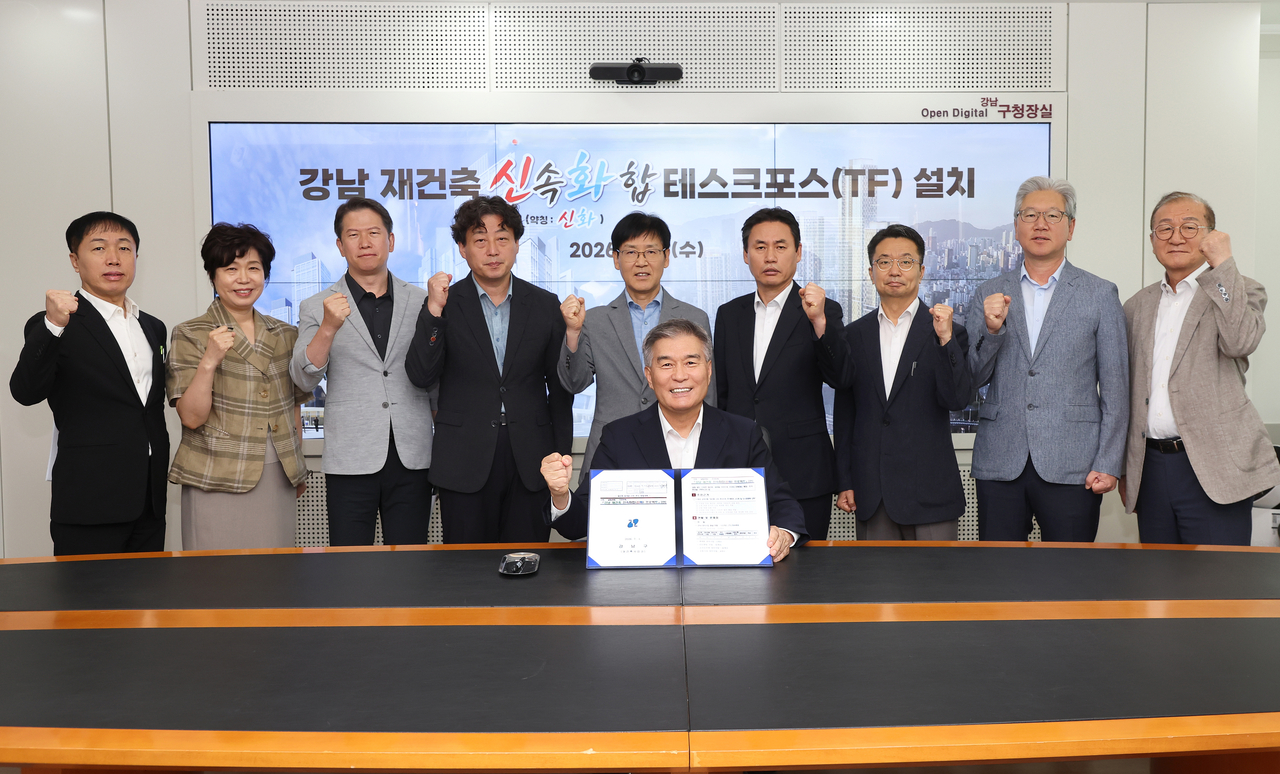
Gangnam-gu District Mayor Kim Hyun-gi signed off on a sweeping reconstruction and redevelopment acceleration plan — dubbed the "Gangnam Reconstruction Swift Harmony (Sinhwa) Project" — as his first official act on Wednesday, his first day in office, signaling an aggressive push for what he calls a "great transformation of Gangnam."
The decision to make the plan his first approval reflects Kim's determination to prioritize urban renewal projects that have stalled due to administrative delays and community disputes. The project is built around three core values: speed, zero conflict and resident satisfaction.
Through the initiative, the district aims to cut permit and approval processing times by more than 30% and intensively manage delayed project sites to bring forward completion dates by more than two years — with a goal of supplying approximately 27,000 housing units within Kim's term. Gangnam-gu currently has 103 urban renewal projects underway, including 53 reconstruction sites as well as remodeling and redevelopment projects.
A task force reporting directly to the district mayor will be activated immediately, with Kim himself serving as its head. The task force comprises a rapid-execution team, a field communications team and a panel of outside specialists. The rapid-execution team will handle project progress management and coordination with the Seoul Metropolitan Government, while the field communications team will run a reconstruction partners program and provide support to housing associations. The specialist panel will offer expert consulting on legal, accounting and other urban renewal matters, as well as conflict mediation.
Because Kim leads the task force directly, the district is strengthening on-the-ground communication. A consultative body bringing together the district mayor, the Seoul Metropolitan Council and the Seoul Metropolitan Government will be established, and Kim will personally handle negotiations with outside agencies when needed. He will also visit reconstruction complexes to assess project conditions, hold on-site meetings with association officials to hear key concerns, and gather field input through regular association-head roundtables and an urban renewal communication forum.
Project progress will be managed in real time and made public. A status board tracking each project site will be installed in the district mayor's office for daily review, and the district's website will publish forward-looking plans and targets for each site so residents can easily follow reconstruction progress. Resident satisfaction surveys will be conducted twice a year — once each half — with findings fed back into the project management process.
A specialist support panel of about 40 professionals — including lawyers, accountants and tax advisers — will be assembled. Experts will be assigned one-to-one to project zones to mediate disputes, and ad hoc advisory meetings will be convened as needed for sites facing pressing issues. Panel members will also be on-site at the district office once a week to provide specialist consulting on tax, accounting and other urban renewal matters.
The project's central goal is speed. The district plans to cut the total statutory processing time for key approvals — covering promotion committee authorization (60 days), association establishment approval (60 days), project implementation plan approval (120 days) and management and disposal plan approval (120 days), totaling 360 days — down to 238 days, a reduction of 33.8%. At the association establishment stage, individual-reviewer processing will be replaced by team-based review, and inter-agency pre-consultations will be held before applications for project implementation plan approval are submitted. At the management and disposal plan approval stage, feasibility reviews will begin immediately upon receipt to shorten turnaround times.
Sites where projects have fallen behind will receive dedicated intensive management. Progress review meetings will be held monthly under the district mayor's chairmanship and weekly under the director general's, and procedures that can run concurrently — such as inter-department consultations, public notice periods and district council opinion-gathering — will be consolidated. Relocation and demolition reviews will also proceed in parallel so that demolition can begin immediately after residents have moved out. Through these measures, the district aims to shorten timelines at delayed sites by more than two years.
"During the election campaign, I heard countless desperate pleas from residents asking when their reconstruction would ever happen," Kim said. "Now I will step in personally as task force head — going directly to project sites, clearing procedural bottlenecks and taking the lead on negotiations with the Seoul Metropolitan Government and the Ministry of Land, Infrastructure and Transport." He added, "Residents have waited a long time, and I will repay that patience with speed and results."
seouldream01@heraldcorp.com