
Korea-Japan currency swap due to expire in November
'Super dollar' weighing on yen too, supporting renewal case
Korea-US swap seen as unlikely despite repeated requests
New Fed chair's stance among key variables to watch
Bank of Korea gives only boilerplate response to Assembly inquiry
By Kim Byeo-ri, The Herald Business
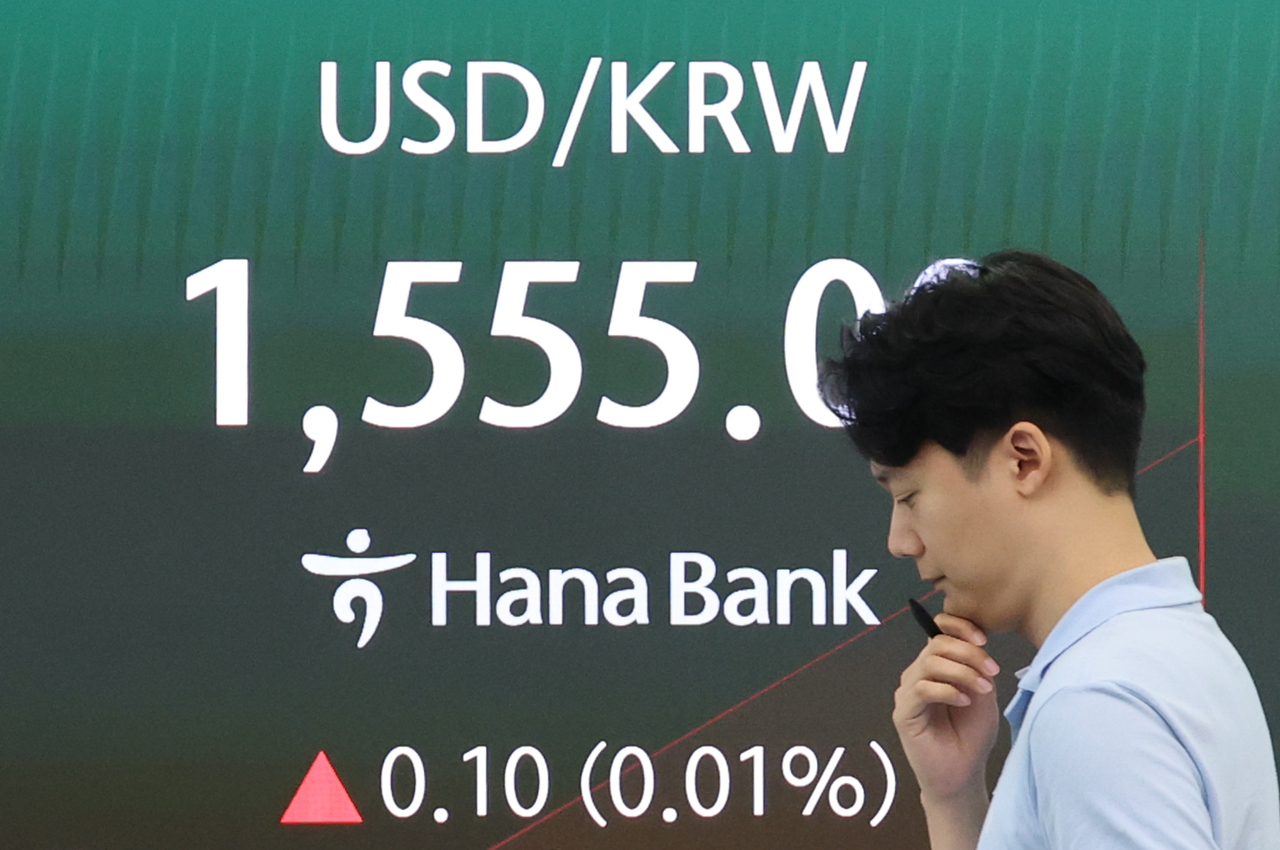
As the won-dollar exchange rate hovers stubbornly in the 1,550-won range, attention is turning to currency swaps — often called a "firebreak" for foreign exchange markets. The Korea-Japan currency swap, set to expire in November, is widely expected to be renewed, but prospects for a Korea-US swap remain murky despite its far greater potential impact on the currency market.
Japan is currently the only country with which South Korea holds a dollar-based currency swap, according to financial industry sources Wednesday. The two countries signed the agreement in December 2023 for $10 billion, and it expires in November.
A currency swap is a contract between two central banks to exchange their respective currencies at a pre-agreed rate. It functions as a kind of emergency credit line — allowing one country to borrow the other's currency as a safety net during a foreign exchange crisis or other emergency.
The urgency has grown as the won-dollar rate has been running above the 1,550-won level. The average won-dollar rate for the first half of this year — based on weekly closing prices — came to 1,484.6 won, the highest since the first half of 1998 (1,493.1 won) during the Asian financial crisis and 133.5 won above the level recorded during the global financial crisis (1,351.1 won).
Wednesday's won-dollar rate opened the weekly session at 1,552.3 won, down 2.6 won from the previous trading day. It was the first time the opening rate had exceeded 1,550 won in 18 trading sessions since the session that opened at 1,555.2 won.
Markets broadly expect the Korea-Japan swap to be extended. The "super dollar" phenomenon has been dragging down the yen alongside the won, giving both countries strong incentive to renew the arrangement. The yen-dollar rate has recently soared to its highest level in 40 years, reaching territory last seen in December 1986 — just after the Plaza Accord — when it traded between 158 and 163 yen. In March, the finance ministers of South Korea and Japan reaffirmed the importance of financial cooperation, including currency swaps, and agreed to discuss further improvements to regional financial safety nets.
However, a renewal on the same terms is unlikely to move the needle much on the won-dollar rate. "A simple rollover of the existing swap on identical terms would have little effect on the foreign exchange market," a senior foreign exchange authority official said.
A Korea-US swap is a different matter entirely. The two countries have struck such an agreement twice before. The first, worth $30 billion, was signed in October 2008 during the global financial crisis and, after two extensions, expired in February 2010. The second, for $60 billion, was concluded in March 2020 during the COVID-19 pandemic, extended three times, and terminated in December 2021.
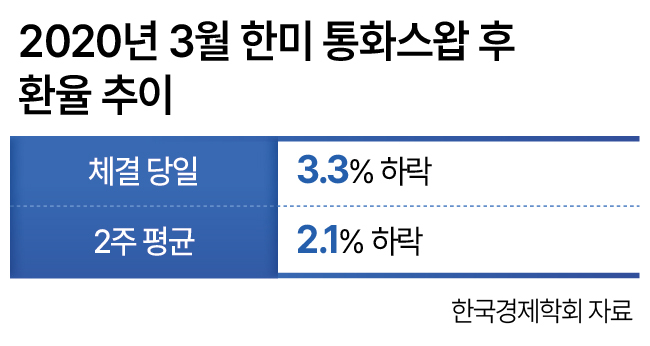
In both cases, the stabilizing effect on the exchange rate was immediate. On Oct. 30, 2008 — the day the first swap was signed — the won-dollar rate (weekly closing basis) fell 12.4 percent to 1,250 won from 1,427 won the previous trading day. The day after the second swap was announced, on March 20, 2020, the rate dropped 3.1 percent to 1,246.5 won. A paper published by the Korea Economic Association found that the won fell 3.3 percent on the day the March 2020 swap was announced, with an average decline of 2.1 percent over the following two weeks. Each of the six subsequent foreign-currency loan operations under the swap pushed the rate down by an additional roughly 0.5 percent.
A revived Korea-US swap could therefore be a powerful tool to arrest the won's slide. "If a swap with the United States were concluded, the symbolic weight alone would have a substantial downward effect on the exchange rate," a senior government official said.
Yet officials inside and outside the government see a Korea-US swap as a long shot. Seoul has made multiple requests for an unlimited swap since last year, but Washington has not responded. The United States currently maintains unlimited swap lines only with reserve-currency economies — the EU, the United Kingdom, Switzerland, Canada and Japan. With the won not a reserve currency, there is little incentive for the US to extend an unlimited line to South Korea. That said, the swap card could come into play during future negotiations over investment in the US or tariffs.
Nor does the current situation rise to the level of emergency that prompted the temporary swaps of the past. "A swap is meant to bolster the safety net available when foreign currency liquidity is needed," another official said. "South Korea's foreign currency liquidity is ample at the moment." The country's foreign exchange reserves stood at $426.99 billion at the end of May — 12th largest in the world, behind Hong Kong — and have held in the low-to-mid $400 billion range even as authorities have drawn on reserves to defend the won.
A separate official said South Korea's current situation does not meet the Federal Reserve's basic criteria for a swap line. "We will have to wait and see whether there is any shift in the US Treasury's position, or any subtle change in stance after Kevin Warsh takes office as the new Fed chair," the official said.
The Bank of Korea, responding in writing to an inquiry from People Power Party lawmaker Kwon Young-se of the National Assembly's Finance and Economy Planning Committee, offered only a standard reply: "It is customary not to disclose new currency swap negotiations or contracts until they are finalized, taking into account the counterparty."
kimstar@heraldcorp.com





